



Updated with graphs illustrating median ages of deceased inmates and causes of death.
Bobby Pope planned to get away from drugs once he was released from prison. He also wanted to get away from his friends in north Mississippi whom he believed were leading him down the wrong path. His sister told him he should to join her in North Dakota, where he could find work and put distance between himself and the psychological and physical abuse that he and his two sisters endured growing up.
There was no career waiting for him in North Dakota, and no guarantee that distance alone could undo what had happened to him or the youthful mistakes he had made. He would also be leaving behind a young daughter. Still, Pope figured he would be better off far away.
But the 24-year-old never made it to North Dakota.
Just four days before Thanksgiving in 2021, Pope’s body was carried out of a solitary confinement cell at the Central Mississippi Correctional Facility in Pearl after he reportedly hanged himself with a bedsheet. Rather than make the fresh start his sisters had imagined, he became yet another death in a corrections system in which an increasing number of young people, often sick or mentally ill, die before they get a second chance.
This year, Mississippi’s state prison inmates are dying far younger than during the years of the past decade, according to a statistical analysis by The Mississippi Independent of data obtained from the Mississippi Department of Corrections as well as an online advocacy group that reports state prison deaths, published obituaries and UCLA’s Law Behind Bars Data Project.
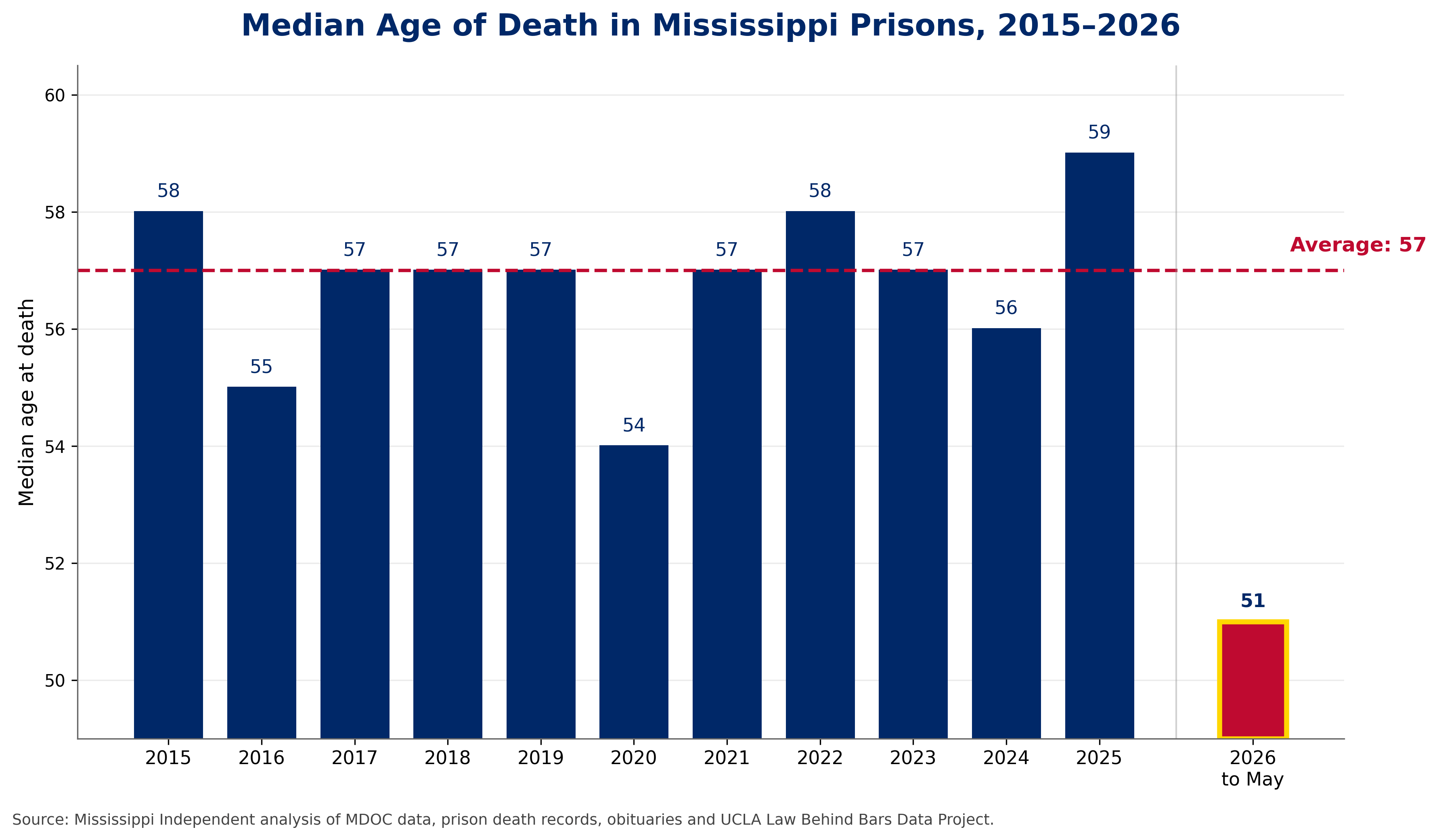
The median age of death among MDOC inmates has fallen from 57 in 2015 to 51 this year, even as the prison population has gotten older, pushed by longer sentences and more restrictive parole. The number of incarcerated 60-year-olds in Mississippi has more than doubled in a decade, according to a 2026 report by the Crime and Justice Institute, a Boston-based research and policy organization. Yet deaths are skewing toward lower ages.
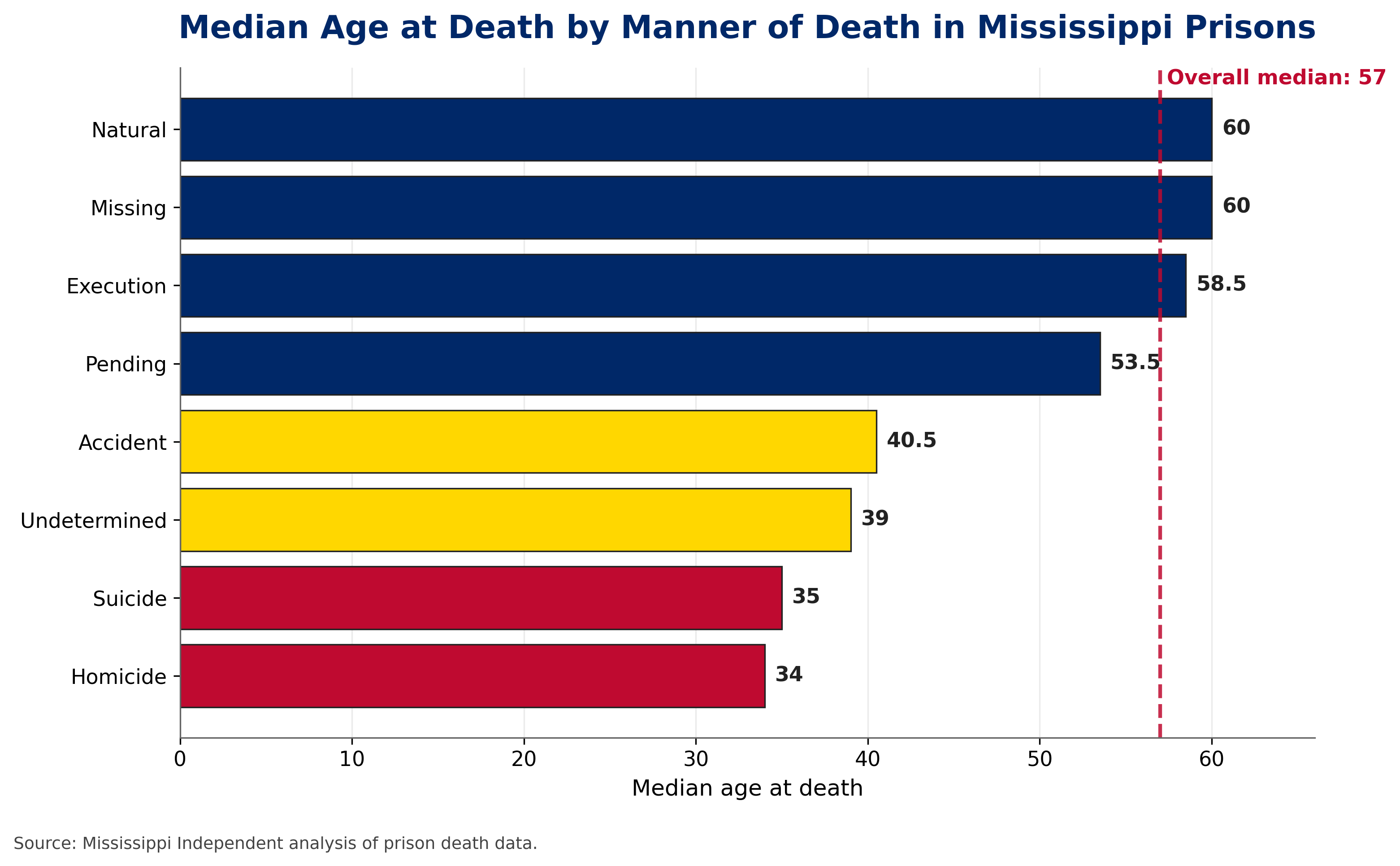
The drop in median age of death means that in 2026 state prisoners who die do so more than 20 years earlier than most free Mississippians. The total number of deaths in Mississippi prisons since 2015 is in excess of 915, based on The Mississippi Independent’s analysis. Overall, suicides accounted for the highest number of non-natural deaths—61—and skewed especially young, with more than half being under age 35.
That pattern points to a corrections system where mental healthcare, medical treatment, isolation, deadly violence and chronic understaffing have turned many prison sentences into premature death sentences, where more than 87 percent of all prisoners die younger than those on the other side of the prison fence, according to MDOC prison records and federal government health records.
Bobby Pope joined this grim list as one of the youngest to die, going back more than a decade, which inmate advocates say illustrates the consequences of horrific conditions inside state prisons.
“It’s may also be reflective of how desperate and despairing many incarcerated people are in prisons,” said Aaron Littman, a UCLA law professor and deputy director of the university’s Law Behind Bars Data Project.
Deaths among inmates aged 35 and under in 2025 and 2026 include:
Cameron Roby, 23
Desmond Earl, 24
William Tutor, 25
Vonta Harris, 25
Eric Stallone, 27
LaLeon Smothers, 27
G’Qwhuan Ward, 28
Rico Lyons, 28
Donald Jones, 29
Donald Jones, 29
Justin Pittman, 31
Brian Riley, 31
Norman Tate, 32
Calvin Kelly, 32
Doty Houser, 33
Jaquentin Lawson, 33
Andrew James, 34
Sophia Muse, 34
N’Kosi Parris, 34
Montez Ward, 34
Seventeen men aged 35 and older also lost their lives the year Bobby Pope died, according to available MDOC records. Most of the deaths were suicides. What made Pope’s death particularly disturbing was his relatively short sentence: He was scheduled to get out before he turned 30. He was a father, a brother, and, by his sisters’ account, a young man with a plan and his family’s unwavering love and support.
“Bobby wasn’t hardened enough for prison,” said Anita McAulay, his Mississippi-based adoptive sister, who spoke with The Mississippi Independent alongside her North Dakota-based sibling, Shantel Pope. “He fell between the cracks.”
All three siblings came through Mississippi’s adoption system and were placed in the same family home in the north Mississippi town of Water Valley. They all had tragic stories and the baggage that comes with them.
But as they grew into adulthood, Bobby Pope was a little more troubled than the average foster kid. By the time he began having run-ins with law enforcement, he was addicted to drugs, and, according to his sisters, struggling to carry psychological baggage when he entered a prison system that has long been criticized as unequipped to care for the mentally ill people inside it. His suicide is part of a larger pattern in Mississippi prisons, where people are dying in record numbers and much younger than in past years, while the state struggles and often fails to explain why.
Deaths are occurring at a pace that could make 2026 the deadliest year on record within Mississippi prisons and the first time that the state corrections system has recorded more than 100 deaths in consecutive years, based on records provided by MDOC and other sources. As of May 14, 2026, 43 people have died this year. If that rate continues, it would put the total at more than 115 by the end of the year, close to the 122 that died in 2020 (15 of which were related to COVID).
Overall, deaths more than doubled from around 47 in 2015 to 108 a decade later, based on death records The Mississippi Independent reviewed.
An already uncertain life
Pope’s life was unstable long before he entered the carceral system. He was placed in foster care at eight months old, which provided a safer environment than the one he had been born into, where the children faced various forms of abuse, according to his sisters.
According to McAuley, their adoptive mother was the source of the abuse, while their adoptive father was a steadying presence in the home. “He was a good man,” she said. “He must have died when Bobby was 13 or 14. After that, there was no one to stop her.”
Shantel Pope said her adoptive mother has changed for the better since they were children, as a result of family interventions, but back then she was a harsh disciplinarian who didn’t do drugs or drink alcohol but was a firm believer in corporal punishment and had other outdated beliefs.
“She would say mental health was imaginary, so Bobby didn’t get the help he needed growing up,” Shantel Pope said. “I really think that was a big part of what pushed him toward drugs.”
Bobby Pope was in and out of prison for a couple of years, for stealing a car, dealing drugs and possessing a weapon as a felon, according to court records. He never spent long in the county jail, but failing to stop for a cop in January 2021 landed him in state prison without any part of his sentence being suspended or any opportunity for expedited parole. The officer said Pope acted with willful disregard and showed extreme indifference to the value of human life. He got five years.
Because MDOC doesn’t share parole, transfer or release records, it is difficult to determine precisely which county jails Bobby Pope served his state sentences in or when he was granted parole. According to his sisters, he joined a gang behind bars for protection, but more worrying for them was that he began experiencing unusual thoughts and visions, including that he had sold his soul to the devil and had a demon on his shoulder.
“He said the words would disappear when he read the Bible,” McAuley said. She spent considerable time reading scripture to her brother, as it became one of the few things that helped ease him. “You could see the fear in his eyes,” she said.
“She [their adoptive mother] said he was full of shit and, like, fucking crazy,” Shantel Pope added during a three-way call with The Mississippi Independent.
Though the sisters don’t condone the mistakes their brother made, they believe his addiction and untreated mental illness were not adequately addressed within a system built to punish rather than help. When Pope picked up an evading-arrest charge in 2019, his parole was revoked and a new five-year sentence was added to his time incarcerated.
By the time he finished his MDOC sentence in county jail and arrived at the Central Mississippi Correctional Facility, Pope was no longer just a young man trying to get clean. According to McAuley, he was someone with a serious mental illness, locked inside a prison system known for violence, neglect and inadequate care. It wasn’t long before he got into a fight with a fellow inmate and was sent to solitary confinement.
“The prison doctor diagnosed him with schizophrenia, and he was given a shot, like one with a black-label warning box that was supposed to help him deal with it,” Shantel Pope, who used to work in a pharmacy, recalled.
Less than a month later, he was dead.
Longstanding crisis
The situation has gotten considerably worse since Pope’s death five years ago, with Mississippi’s prison system in the grips of crisis. From inadequate staffing and medical neglect to inhumane conditions and extreme violence, little has been done to change its course.
Littman said deaths among young, incarcerated people are easier to recognize as avoidable than those of older inmates who die of natural causes.
“Deaths among young people in prisons are in some ways more alarming because it’s much easier to recognize as excess mortalities,” Littman said. “People who are dying who shouldn’t be.”
In-state news outlets have reported extensively on the vast array of issues that beset the state prison system, and The Mississippi Independent recently published reports on the struggles families face in obtaining timely and transparent information from MDOC, including the exact details of how and when their loved ones were injured or died.
The Mississippi Legislature took up a series of bills in 2025 and 2026 that would have begun to address years of decay and mismanagement, particularly issues related to poor healthcare, but ultimately, most were not taken up.
The Mississippi Department of Corrections did not respond to questions about the potentially record-breaking death toll in 2026 or whether the agency has plans for trying to stem the pattern of young deaths in custody. The Mississippi Independent also reached out to the Mississippi House chair on corrections, Beckie Currie, who led attempts to reform the prison system earlier this year, but she likewise did not respond.
Federal reports as recently as 2024 found widespread evidence of prison rape, homicide, preventable deaths and gangs exercising control inside Mississippi prisons. The findings described conditions that were both dangerous and unconstitutional.
In recent weeks, several wardens have either resigned or been replaced, a sign of continuing instability.
Littman said understaffing can make prisons more dangerous in immediate, practical ways. “Suicide is much less likely to be seen and interrupted in progress if there aren’t people walking around the unit,” he said. “When staffing drops so low that guards do not feel safe entering housing units, they may remain in booths rather than looking into cells.” Prisons frequently go on restrictive lockdowns due to short staffing.
Michele Deitch, director of the Prison and Jail Innovation Lab at the University of Texas, said deaths like Pope’s raise broader questions about whether prison systems are identifying people in crisis, supervising them properly, and keeping them out of conditions that can make suicide more likely. Prison suicides, she said, can reflect failures related to supervision, suicide-prevention protocols and housing decisions, especially when vulnerable people are placed in isolation or left with the means to harm themselves.
“If there’s one obligation that prisons have, it’s keeping the people inside safe and alive,” Deitch said. “These are not people who were sent to prison to die.”
There are many reasons why young inmates are dying, Deitch said. Her decades of studying prisons have taught her that most suicides are preventable. “It could also be that people feel really threatened in that environment, and they would rather take their lives than face whatever they’re going to face,” she added.
Record deaths
Because many Mississippi prison death records in 2025 and 2026 remain pending, unknown or redacted, the true number—including of suicides—among inmates younger than 35 may be higher. It includes the 24 deaths in 2015 where no age was given.
Mississippi’s prison population under age 35 fell from about 8,860 in 2015 to about 6,760 in 2021, a decline of roughly 24 percent, according to the National Corrections Reporting Program, a Bureau of Justice Statistics dataset. Yet deaths among younger prisoners did not fall with it—on the contrary, from 2017 to 2021, deaths among Mississippi prisoners ages 18 to 34 more than doubled, meaning raw death counts alone may understate the risks facing younger people in state custody.
Details of MDOC death records from 2019 to 2026 are heavily redacted due to HIPAA medical privacy concerns, limiting the public’s ability to fully understand how people are dying and what solutions might help.
“Without data and without information, you can’t solve the problems,” Deitch observed.
The records only show the broadest outline of the crisis. But individual cases reveal how quickly mental illness, isolation and inadequate supervision can become fatal.
“Prison becomes a much harder place to live when staffing is so low,” Littman said. “It can limit access to mental health and medical care, hot meals, classes, showers and other basic needs. It also often becomes more violent and contributes to declines in mental health for the people who live there.”
“Do what you gotta do”
Denise Short was 21 when she died by suicide at the Central Mississippi Correctional Facility on March 20, 2024.
Like Bobby Pope, she entered prison young, damaged and in need of mental healthcare. Short was serving a 10-year sentence after being convicted as the getaway driver in a drive-by shooting in which no one was killed, according to court records kept behind a paywall, which can limit public access. She had entered MDOC custody less than three months earlier, on Dec. 28, 2023.
In a medical malpractice lawsuit filed against VitalCore, the private healthcare provider for the Mississippi Department of Corrections, Short’s family alleges that her mental health problems were known, repetitive and urgent. The lawsuit claims Short told VitalCore employees about her prior mental health conditions, past medications, current distress and suicidal thoughts during her incarceration.
Vic Bishop, an attorney at the Mississippi-based Rozier Legal who represents Short’s family, said Short had been molested as a child and had long struggled with mental illness, including depression and anxiety. He said she had previously been on medication, but the family was told that after she entered prison, “they stopped giving her medicine and that she was not doing well mentally.”
“She had asked to speak to therapists, or asked for mental health resources, and she did not get access to that,” Bishop said.
The lawsuit, which represents one side of a legal argument, accuses VitalCore employees of failing to recognize or of disregarding Short’s mental health problems, failing to take her statements seriously, and providing negligent, substandard care. Bishop said his firm also intends to bring claims against the prison system over what he described as failures to monitor Short after she was placed in solitary confinement.
According to Bishop, Short told others she was thinking of hurting herself. “We’ve been told that she informed guards that she was not doing well, that she was going to hurt herself,” he said. “In fact, one person we spoke to said that when Denise told this person that she might kill myself, they said, ‘Do what you gotta do.’”
Bishop said Short had asked to speak with a mental-health professional the day before she died, but that did not happen. After she “acted out in some way,” he said, she was placed in solitary confinement, where staff were supposed to check on her regularly.
“They did not check on her for hours,” Bishop said. “I’m talking like eight to 10 hours.”
A private autopsy confirmed Short’s death was a suicide, Bishop said. For her family’s attorneys, the question is not only how she died. It is why a 21-year-old woman who had allegedly warned prison staff and medical providers that she was suicidal was left alone long enough to do it.
Victim of a broken system
Bobby Pope’s sisters remember a young man who had a talent for bringing joy and humor to the tumultuous, sometimes sad childhood they shared. He rarely asked for much, even when he needed basic things. Not long before he was sent back to prison for what would be the final time, his sister Shantel Pope took him shopping prior to heading back to North Dakota. He picked out the ordinary things he needed—clothes, socks, body wash and other items—which suggested he was still trying to keep himself together, she said.
It was the last time Shantel Pope saw him in person. What his sisters cannot reconcile is how quickly that person disappeared inside the prison system. Shantel Pope, a busy single mother living far away in a different time zone, missed her brother’s last call. McAuley’s letters to him celebrating her new business went unanswered.
Both sisters still have questions about his diagnosis, the medication he was given, the time he spent in solitary confinement, and the details of his suicide note that they claim Bobby Pope’s adoptive mother has never let them see.
They aren’t even sure if he really committed suicide.
“In my heart, I don’t think he did that to himself,” Shantel Pope said.
To the sisters, Bobby Pope’s death was not only the end of his life. It was the end of his time in a prison system where abject trauma and death have been well documented over decades, and where he faced being trapped inside a dark cell the size of a standard elevator for 23 hours a day—all while suffering from frightening visions.
“Bobby was a victim of broken systems in Mississippi since he was a baby,” McAuley said.
“But,” Shantel Pope added, “he didn’t deserve to die in prison. You know, his daughter might look all this up one day. We’ll make sure she knows that her daddy was really good at making people laugh when they were sad. He was so funny.”
According to McAuley, Bobby Pope was “a really good person” who, though he made mistakes, ultimately fell victim to a dysfunctional system.
Image: Bobby Pope and his daughter during better times (courtesy Shantel Pope)
