


A package of prison healthcare and oversight bills that passed the Mississippi House unanimously last week has moved to the Senate Corrections Committee, where its chair, Sen. Juan Barnett (D-Heidelberg), will decide whether to bring the measures up for consideration.
The 2026 legislative timetable gives the Senate until mid-March to act. Three people died in state prison custody the week before the House vote.
The bills are the work of Rep. Becky Currie (R-Brookhaven), a former nurse who chairs the House Corrections Committee and has spent two years pushing to reform conditions in Mississippi prisons. Her effort has been informed by tours she has taken of state facilities and by Mississippi Today’s “Behind Bars, Beyond Care” investigative series, which documented alleged denial of medical treatment—including potentially thousands of hepatitis C diagnoses going untreated, a broken arm left untreated until it required amputation, and delayed cancer screenings.
A 2025 omnibus reform bill passed the House 118–0 but died in late negotiations between the chambers. Currie has said the bill drew opposition from Gov. Tate Reeves’s office, which favored awarding monitoring authority to a private firm rather than the Department of Health. This year Currie returned with individual bills rather than a single omnibus measure.
The bills that cleared the House address healthcare delivery, contract oversight and death investigations. H.B. 1744 mandates that the Department of Health and the state’s private prison healthcare contractor, Kansas-based VitalCore Health Strategies, create hepatitis C and HIV treatment programs for incarcerated people. It also requires that medications be purchased through the federal 340B discount drug program, which can reduce costs by 20 to 50 percent, and instructs the state to develop a plan for improving the health of incarcerated women. VitalCore holds a three-year contract worth more than $357 million and was previously awarded more than $315 million in emergency, no-bid contracts between 2020 and 2024—a combined outlay of roughly $682 million.
In its own 2023 request for proposals, MDOC acknowledged that the agency “does not employ any licensed personnel responsible with oversight of its contracted healthcare provider.”
H.B. 1692 transfers authority over future healthcare contract bids from MDOC to the Department of Finance and Administration, which would handle contract solicitations after VitalCore’s current contract expires in 2027.
H.B. 1739 overhauls the existing Corrections and Criminal Justice Oversight Task Force, reconstituting it as a 13-member body with limited MDOC staff participation and requiring it to investigate all “unexpected” deaths in custody—defined as those not linked to a previously diagnosed terminal illness—and issue public reports with findings and recommendations. The House also unanimously passed a bill by Rep. Justis Gibbs (D-Jackson), requiring protective equipment for incarcerated people forced to use industrial chemicals.
Several other bills in Currie’s package died at the Feb. 3, 2026, committee deadline, including H.B. 1745, which would have redirected $690,000 from a contract MDOC awarded to the law firm Butler Snow to PEER, the legislature’s own watchdog committee, for an independent audit of the VitalCore contract.
Currie, who was not informed of the Butler Snow arrangement until late December 2025 despite her position as House Corrections chair, also lost H.B. 1748, which would have removed a requirement that legislators give advance notice before visiting prisons. She has also begun scrutinizing the Inmate Welfare Fund, in which she found approximately $32 million that she says has not been adequately accounted for.
Whether the surviving bills become law depends on Barnett, Reeves and the Senate leadership. Barnett told reporters he planned to meet with Currie and supported the principle of stronger oversight.
“We need to be more proactive because we have to realize that at the end of the day, most people in there are going to get out, and it’s best to let them out as healthy as we can versus letting very unhealthy people out into the general population,” Barnett said.
But he has also said he wants to center his committee’s efforts on reducing the prison population itself—a structural question that Currie’s bills, focused on healthcare and accountability, do not directly address. Mississippi incarcerates approximately 19,500 people in state facilities at an annual cost to taxpayers of roughly $459 million. Reeves’s office has not publicly commented on the 2026 bills.
The death oversight bill may face particular scrutiny. The existing task force, established by H.B. 585 in 2014, uses MDOC employees for its staff and is authorized to make policy recommendations but lacks enforcement power. State Public Defender André de Gruy, a task force member, has described the arrangement as “MDOC reviewing themselves.” The task force’s January 2025 annual report makes no mention of investigating prisoner deaths.
A collaborative investigation by the Marshall Project, Mississippi Today, the Clarion Ledger, the Hattiesburg American, and the Mississippi Link found that understaffing and gang violence has led to the killings of nearly 50 incarcerated people since 2015, with just eight criminal convictions. Corrections Commissioner Burl Cain promised in October to review unprosecuted homicides, yet four months later, there have been no additional indictments.
The bills arrive after three decades of legislative efforts to address Mississippi’s growing prison population. That population exploded after 1995, when lawmakers enacted the 85 percent rule requiring all people convicted of felonies to serve 85 percent of their sentence before becoming parole-eligible. The Department of Corrections held 9,629 prisoners in 1993; by 1998 the figure had nearly doubled to 16,695. By 2013, the population had grown 307 percent over thirty years to more than 22,400, and Mississippi held the second-highest imprisonment rate in the country.
A bipartisan task force convened in 2013 developed 19 policy recommendations that became House Bill 585, signed by Gov. Phil Bryant on March 31, 2014. The law restructured sentences for drug and property offenses, expanded drug courts and alternatives to incarceration, and reduced parole eligibility requirements. The task force was chaired by then-Corrections Commissioner Christopher Epps, who was later sentenced to more than 19 years in federal prison for accepting bribes and kickbacks from private prison contractors.
In its first three years, H.B. 585 produced measurable results in its first years: the prison population and imprisonment rate declined 10 percent, and the Pew Charitable Trusts estimated it averted $266 million in projected prison spending. The legislature built on those gains with H.B. 387 in 2018, which ended incarceration for failure to pay fines, and S.B. 2795 in 2021, which extended parole eligibility to additional offenses.
But implementation faltered. Parole grant rates declined. The 85 percent rule remained on the books for people convicted before 2014, creating what advocates called a patchwork of sentencing standards in which three people convicted of the same crime in different eras faced drastically different release timelines. S.B. 2123, a 2024 bill that would have made parole standards uniform, died after late opposition. The prison population climbed again, and by 2022 Mississippi had reclaimed the highest imprisonment rate in the nation—661 per 100,000 residents, more than twice the national average.
The U.S. Department of Justice has found unconstitutional conditions at all four of the state’s major prisons, documenting widespread violence, gross understaffing, uncontrolled gang activity, and systemic failures in medical care across facilities housing approximately 9,200 people. The initial investigation was opened in February 2020 after riots at the Mississippi State Penitentiary at Parchman and other facilities left multiple inmates dead. Assistant Attorney General Kristen Clarke described conditions as “severe, systemic, exacerbated by serious deficiencies in staffing and supervision.” The federal government warned that failure to remedy the violations could result in a lawsuit, as occurred in Alabama.
The current bills do not address the sentencing and parole questions that drive Mississippi’s incarceration numbers. They focus on healthcare delivery, contract accountability and death investigations within the existing system. The Senate has until mid-March to act on the measures before the legislative deadline.
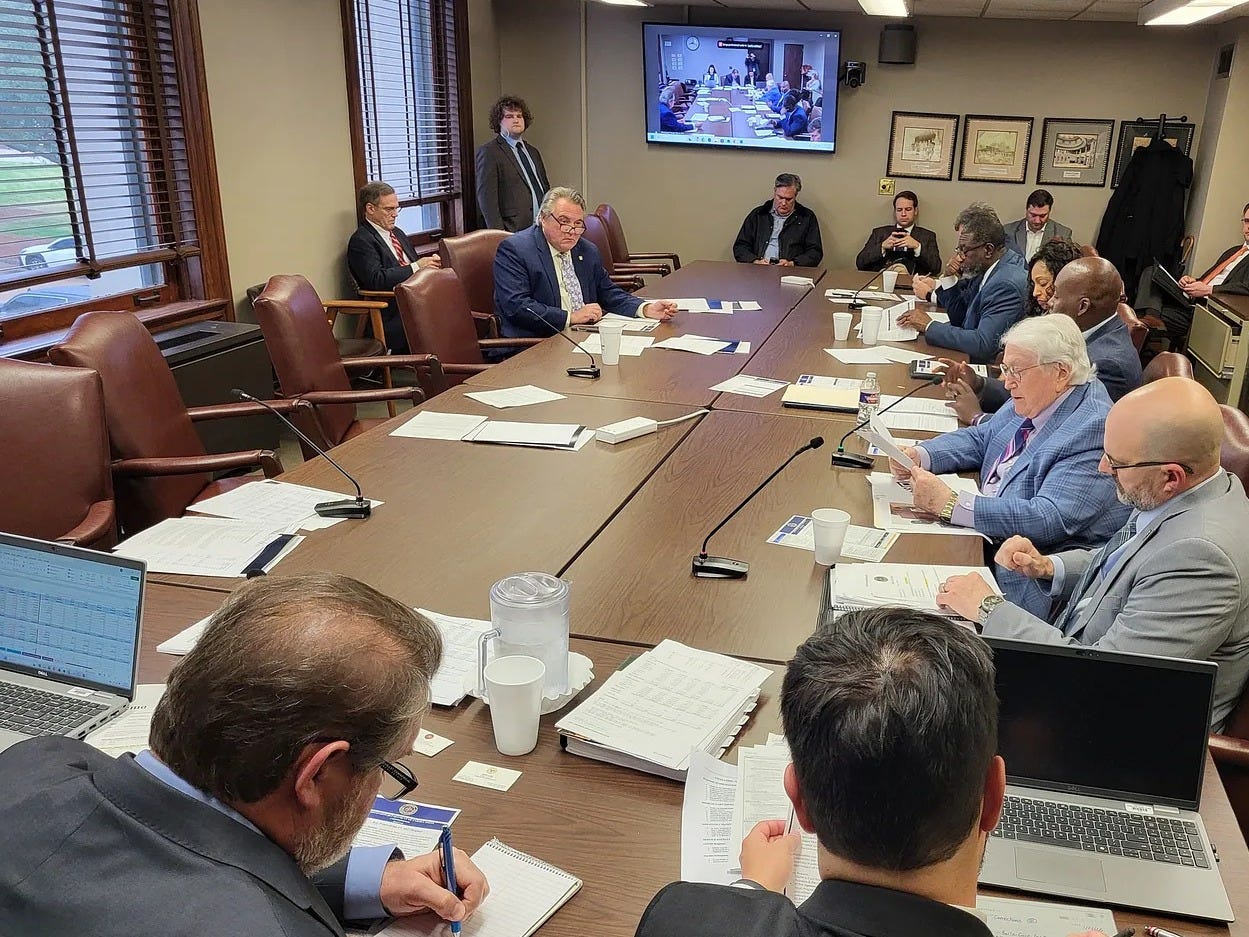
Image: Corrections Commissioner Burl Cain discusses agency plans at a state Senate Appropriations Subcommittee meeting on Jan. 21, 2026 (via Mississippi Department of Corrections Facebook page)

The SUPERMAJORITY PLAN TO IMPEACH TRUMP and HIS ADMINISTRATION
It will take 292 house and 67 senate votes to obtain a supermajority vote. This is the key to accomplishing anything in the house or senate. The house and senate will be able to impeach Trump and his administration for their crimes and corruption.
The Democrats are the only ones that will stand against Trump. We have to vote out as many republicans as possible.
EVERYONE IS GOING TO HAVE TO VOTE FOR DEMOCRATS IN THE NOVEMBER 3RD MIDTERM ELECTIONS TO MAKE THIS WORK
Make sure you share this with everyone you know without social media. People without social media are unaware how corrupt and detrimental Trump’s administration really is for our country. The media outlets do not post anything negative about Trump. Some people don’t even know what the midterm elections are or how important they are.
TRUMP, HIS ADMINISTRATION, HIS BILLIONAIRE PEDOPHILE NETWORK , AND THE REPUBLICAN PARTY ARE MAKING IT IMPOSSIBLE FOR THE WORKING CLASS TO SURVIVE.
WE HAVE TO STOP THEM FROM DESTROYING THE COUNTRY