



It was 1 p.m. when Angel Readus received a chilling message from an inmate inside one of Mississippi’s most violent prisons.
“You need to call down to the prison, something is going on with your brother,” read the message, sent through Facebook Messenger from inside the Central Mississippi Correctional Facility, in the city of Pearl. It was a disturbing sentence for Readus to read when her sibling was incarcerated inside a system with a reputation for brutality, neglect and death.
Readus began making phone calls. For two hours, she was transferred from one prison official to another before the facility’s chaplain finally told her the news she had been dreading.
“Your brother Monquel Nason passed away this morning at 7:41 a.m.,” Readus recalled being told during the Nov. 20, 2021, call.
Nason was 29.
In the days and weeks that followed, bits of information began to reach Readus from inside the prison. She discovered that her brother had double pneumonia and was admitted to an outside hospital in the days before he died, only to be returned to his cell, where he bled for two hours before fellow inmates managed to get him help. Readus also discovered that her brother had likely died a day earlier than reported.
Nason’s health was far from perfect. He had lived with kidney disease for more than a decade, starting long before his incarceration. But it had gotten far worse while in prison.
“They barely took him to dialysis,” Readus, a former Mississippi Department of Corrections employee, told The Mississippi Independent. “Why did they send him back to prison with pneumonia in both his lungs when he was already fighting kidney disease?”
Readus suspects she’ll never find out. She doesn’t know what, exactly, killed her brother or what his final words were, or whether he was scared, at peace, or crying for his mother, who had died from the same disease years earlier while he sat in jail awaiting trial.
“I do know he died alone in prison, and I didn’t get to say goodbye,” Readus said.
Readus felt helpless. Her brother’s death was shattering, but what followed—the scramble for basic information, the unanswered questions, the uncertainty that hardened into a kind of permanent limbo—is what families often endure after losing someone inside Mississippi’s chaotic prison system.
State prisons have become places where people die with alarming frequency, from medical neglect, homicide or the sheer strain of incarceration. Relatives are frequently left to piece together their last hours, days and weeks on their own, sometimes with details provided by other inmates, sometimes from rumors, and often with little help from MDOC.
About 43 incarcerated people have been unlawfully killed in Mississippi prisons between 2015 and 2025, according to a joint investigative series by Mississippi Today, The Marshall Project and several other Mississippi-based news organizations that looked into the failings of the state prison system. Very few of the homicides have been investigated or resulted in a criminal conviction.
Since that series was published, there have been dozens of additional deaths due to causes not yet established. A Nov. 23, 2025, autopsy concluded that Nason's official cause of death was endocarditis with septic emboli, a heart infection in which bacteria infect the inner lining or valves, which can be caused by issues including sharing drug needles, using dirty dialysis machines or pneumonia.
The state drastically underreports the deaths of people in law enforcement custody, whether they’re serving life in prison or sitting in a county jail drunk tank for one night. The FBI opened a homicide investigation in late February 2026 into the 2025 death of Melvin Cancer, who CMFC officials said died from a heart attack—before a Department of Public Safety report suggested that guards beat him to death.
Mississippi incarcerates people at the second-highest rate in the nation, nearly double the national average, and the potential for deadly violence is ever-present.
The crisis has once again gained attention at the state capitol, where lawmakers spent the latest session debating bills meant to improve prison healthcare and strengthen prison death oversight. But those proposals have repeatedly moved forward only to stall, leaving life-or-death problems inside Mississippi’s prisons largely unchanged. Among the likely contributing factors are chronic understaffing, crumbling and inhumane facilities, and living environments that families and former inmates have described as deadly. The result is a system where people keep dying of causes that are sometimes not fully explained, leaving relatives to try to chase down their own answers.
Such questions have consumed Mildred Washington since her son, Demetrios Washington, known as “Bubba,” died alone in solitary confinement at the privately run East Mississippi Corrections Facility in Meridian on June 29, 2023. MDOC officials told her he died of dehydration, she wrote on social media at the time. Not that she believes it.
Washington thinks her son, who suffered from schizophrenia, was destroyed rather than helped during his time in prison.
“Sadly, he was placed in a prison system where he was neglected and denied the medical care he deserved,” Washington wrote in a social media post on Feb. 10, 2026.
Washington told The Mississippi Independent that she was unable to talk about her son’s death due to an ongoing legal proceeding against MDOC. But court records offer some clues to how Demetrios Washington was treated as he was processed through the state’s criminal justice system.
In an Oct. 3, 2019 order, Hinds County Senior Circuit Judge Tomie Green wrote that Demetrios had been held in the Hinds County jail for 134 days without indictment, a delay the judge called unconstitutional, and that prosecutors had shown “callous indifference,” while noting that the defendant was in “dire need of mental health treatment and care.” Demetrios Washington was indicted later that month. A mental evaluation found him fit to stand trial.
There is little information about what happened to Washington after he was sent to EMCF.
“To this day, our family is still searching for the truth about how he passed away,” Mildred Washington wrote in the same social media post.
What the state says should happen
Mississippi law lays out a simple process meant to prevent exactly that kind of uncertainty. When someone dies in state custody, prison officials kickstart a chain of events that starts with the county medical examiner, includes a mandatory autopsy, and ultimately ends at the office of the local district attorney, who can present the case to a grand jury if foul play is suspected. Prison officials are also supposed to tell relatives, if they can be found.
In practice, families describe a messier reality.
“I talked to the coroner of Rankin County, and he said they didn’t do the autopsy because they knew my brother had bad kidney disease,” Readus said. “I didn’t understand it because I feel like there’s always more to it if someone dies in prison. They need to prove to a family that nothing happened, like assault or murder, or if they was left to die.”
Readus recalled that her brother complained about missing many of his dialysis treatments because of prison staff shortages and that the machines used to clean toxins from the blood were often dirty. Missed dialysis treatments can be life-threatening and reduce a person’s life expectancy significantly.
“I don’t believe prison staff cared about his wellbeing,” Readus said. “I’ve seen it firsthand.”
Other MDOC inmates have previously complained about non-functional dialysis machines.
The inconsistent treatment Nason allegedly received in the hands of the Mississippi criminal justice system began more than five years before he died at CMCF, according to an emotional handwritten letter the inmate wrote that is buried within hundreds of court documents relating to Nason’s manslaughter case. The July 2015 letter to District Judge John H. Emfinger begged him to reduce bond from $200,000 to $75,000 so Nason could be released from the Madison County Detention Center for better treatment. Nason said in the letter that his jailers had rarely taken him to his dialysis appointments since he was arrested in October 2014.
“My mother hasn’t long past [sic] away from the same illness I have,” Nason wrote. “Please, Judge Emfinger, help me. I don’t feel good at all because I’m not getting the proper medical attention here at this jail, and the help I really need. Please! Judge Emfinger, I really need your help. Please! Please!”
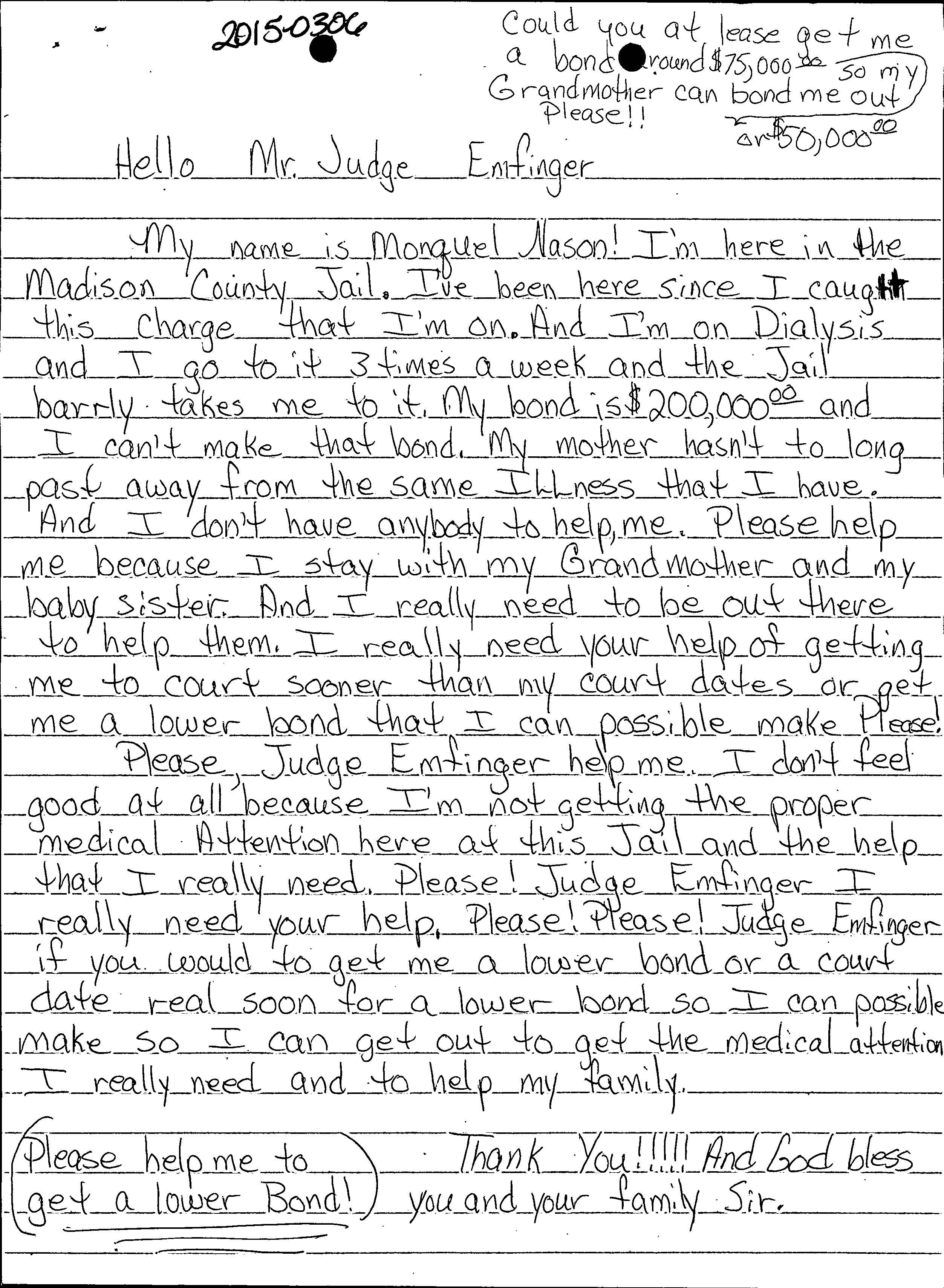
There’s no indication in court records that Judge Emfinger granted Nason’s request. Emfinger did not respond to questions from The Mississippi Independent.
Nason’s letter captures the fear that haunts many individuals and families long before anyone dies: that a treatable condition can become fatal when care is delayed, inconsistent or simply withheld. In Mississippi’s prisons, relatives say that medical neglect is not limited to one diagnosis or one facility; it can follow people with chronic diseases, mental illness or acute emergencies, leaving families to wonder whether a death was inevitable or preventable.
Other cases highlight how families can be left without even the basic facts and no opportunity to say goodbye. Nicholas Duell Hardy III was taken from the prison in Pearl to a hospital on Jan. 27, 2026, with liver cancer and died Feb. 4, but his mother was not notified until Feb. 11, 2026, according to his aunt, Jojo Irwin. Brandon Boone, of Boonesville, died Aug. 7, 2020, one day after arriving at Alcorn Regional Facility, according to his sister, Laken Brea. She says the family is still searching for answers five years later.
The legislative response
Politicians in Jackson are paying some attention, but it has so far been ineffective. In late January, the Mississippi House unanimously passed a raft of prison healthcare and oversight bills sponsored by Rep. Becky Currie, a Brookhaven Republican and former nurse who chairs the House Corrections Committee. The measures would expand treatment for incarcerated people with HIV and Hepatitis C, improve women inmates’ healthcare, and create a task force to review deaths in custody—a push that followed Mississippi Today’s extensive reporting on medical neglect in the prison system. But the bills effectively died in the Senate after Lydia Chassaniol, the vice chair of the Senate Corrections Committee, committed to only promoting two measures to a full Senate vote. In response, Currie, in a last-minute legislative maneuver, was able to revive the bills by inserting language in other Senate bills on prisons and probation.
Currie has spent the last two years scrutinizing the state’s prison medical contract with VitalCore Health Strategies, a Kansas-based company that won a three-year, $357 million agreement in 2024 to administer state prison healthcare. The company collected nearly $300 million in no-bid contracts between 2020 and 2023. Currie said that the state’s request for proposal was “only for VitalCore.”
The contracts have attracted extensive media coverage during those years, and a potential conflict of interest has emerged involving Catherine Fontenot, a longtime lieutenant of state corrections commissioner Burl Cain, stemming from his nearly 15 years as warden at Louisiana’s notorious Angola prison. Cain left Angola following a series of news reports alleging corruption, though a state investigation found no evidence of wrongdoing. He was then hired to head Mississippi’s prison system.
Media reports indicate that Fontenot eventually followed Cain to Mississippi, working as a consultant for MDOC while simultaneously holding a director’s position at VitalCore even as the state continued to award the healthcare provider no-bid contracts. MDOC has not responded to requests for records of any contracts involving Fontenot or an explanation of her relationship with VitalCore.
Fontenot is now the chief of corrections and warden at Louisiana’s East Baton Rouge Sheriff’s Office. Her biography on the office website says she served as director of a reception and diagnostic unit in Mississippi. An April 2024 court filing lists her as holding the same title with VitalCore; a January 2023 Newsweek article described her as working in that role for “VitalCore Health Strategies at the Mississippi Department of Corrections.” Fontenot did not respond to questions from The Mississippi Independent.
A deadly system
Despite legislative attempts, the sheer number of deaths emerging from Mississippi’s prison system suggests the crisis runs deeper than any single reform package or healthcare contract can address. Some facilities are so understaffed that inmates are left unsupervised in open units--areas that have been identified in Department of Justice reports as epicenters of violence and inhumane conditions. A February 2024 DOJ report noted that gangs operate in the “void left by staff” and use “violence to control people and traffic contraband.”
The report found that restrictive housing at East Mississippi Correctional Facility and the other privately run prison, Wilkinson County Correctional Facility, outside Woodville, was unsanitary, hazardous and chaotic, making the areas “breeding grounds” for suicide, self-inflicted injury, fires and assaults.
For those inside the system, survival can be uncertain.
“I’ve seen a guy get stabbed to death over a tray of hotdogs and people get stomped out over $10,” said an inmate at CMFC, whom The Mississippi Independent granted anonymity for fear of reprisals from prison guards and MDOC officials. “All these guys got to do is get high and kill each other.”
One inmate, the man said, ripped out his own testicles after a bad drug experience. He said he concurred with allegations that gangs run the prison and control drugs coming in. The DOJ report cited similar findings.
The well-documented violence inside Mississippi’s men’s prisons can make it easy to forget that women are living and dying inside the same system, often with far less public attention. Cheri Alicia Womack, who was incarcerated at CMCF between 2013 and 2018, said she had to drag dying friends out of cells and through common areas to get medical help.
“I’ve lost a ton of friends inside those walls,” Womack told The Mississippi Independent. She alleged that violent guards would beat inmates half to death or break an inmate’s jaw without blinking. The victims, she said, were, “Good people who deserved the chance to live outside those walls.”
Two weeks ago, 54-year-old Tonya Caradine was found dead at the women’s section of CMCF. Officials said she overdosed. Womack, who was incarcerated alongside Caradine, said “Ms. Tonya” had been medically neglected for years and had gone “insane.”
“She would pace in circles for days and days without sleep, murmuring under her breath,” Womack said. “But MDOC will never admit the ‘living conditions’ that lead to a life like that are actually death conditions, because that means they are at fault.”
MDOC did not respond to questions and data requests from The Mississippi Independent regarding the full number of deaths inside the prison system during the last decade, including how many were unexplained and what processes were being followed in the aftermath of a death. However, in late 2025, MDOC committed to reviewing more than two dozen unprosecuted and unexplained deaths going back years. MDOC spokesperson Grace Fisher did not respond to messages from The Mississippi Independent.
The Wilkinson County Correctional Facility has drawn particular scrutiny in reports over the years. Two inmates have died in the facility since the start of 2026: Myron Ward, 37, who was found unresponsive in his solitary cell on Jan. 16, and Justin Crumb, 37, who collapsed during recreation on Feb. 2, three days after arriving at the prison. Ward’s family has alleged foul play, saying he was found in a pool of blood with visible bruising, according to media reports.
Emily Lawhead, director of communications for the company that operates the Wilkinson prison, Management & Training Corporation, told The Mississippi Independent that the facility houses some of the state’s highest-risk inmates, which “increases the complexity” of maintaining safety, but said new programming has been added that focuses on mental health, substance use and reentry.
This comes after the 2024 DOJ report found that WCCF, along with CMCF and the South Mississippi Corrections Institution, allowed violence to go unchecked, failed to control gang activity and drugs, and suffered from severe staffing shortages, with a vacancy rate of about 50 percent being noted at the Wilkinson facility. This led to an alarming situation in 2019 in which the Wilkinson warden at the time reported that he relied on gangs to keep prisoners under control.
The report also faulted the prison’s handling and reporting of serious incidents, including suicides and sexual abuse allegations.
For families, the most painful part is not only how often people die inside Mississippi prisons, but how quickly those deaths slip into obscurity.
Readus has learned in the years since her brother’s death that grief is rarely accompanied by answers that make sense. It often comes with paperwork that doesn’t explain much, with shifting timelines, and with ignored emails and letters. She has tried, for years, to get someone in authority to tell her what happened in the days and hours before her brother died, why a man with kidney disease was returned to a cell with double pneumonia, why he was bleeding, and why there was no clear medical accounting of what happened.
By Readus’ estimate, her brother’s release date was around five months away on the day he died. She said she used to think about that number a lot, how it would slowly tick down to a single glorious day when her brother would finally be able to put the years trapped in the living hell of prison behind him.
“I think if I got to see him, it might have made a difference,” she said. “It might have given him strength to carry on and live, you know, a different life on the outside.”
Image: Monquel Nason (courtesy Angel Readus)
