


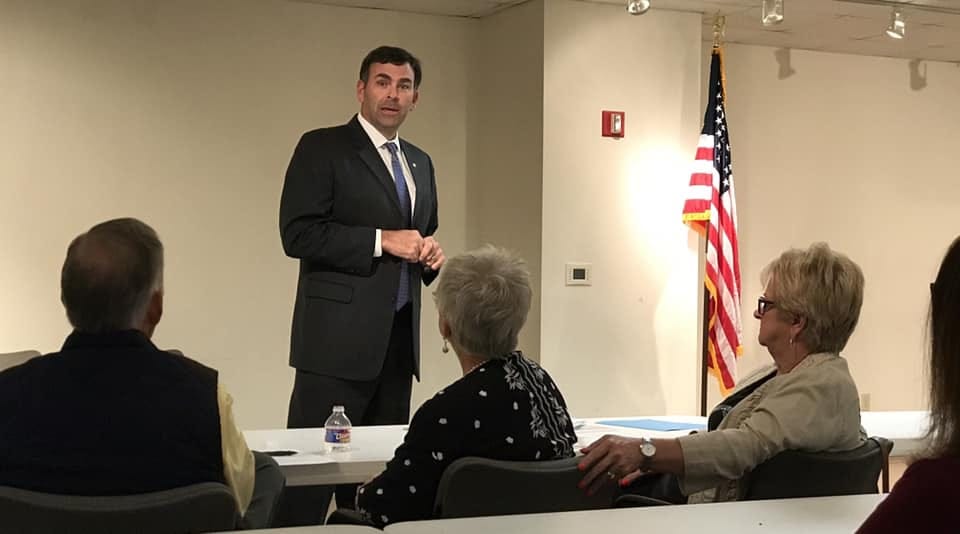
Mississippi Secretary of State Michael Watson launched his campaign for lieutenant governor in the Republican primary on a message of coalition-building across the Capitol.
“As lieutenant governor, no one individual can get anything done in Jackson by themselves,” Watson said. “It takes a team.”
Watson’s team spirit was a departure from his positioning as a state senator, from 2008 to 2020, when, in his final year, he sponsored Senate Bill 2123 to cut the membership of the House from 122 members to 70 members and the Senate from 52 to 30. The bill, which was referred to the Senate Rules Committee on Jan. 11, 2019, never reached a committee vote and died at the end of the session.
Bills to shrink the legislature have been a recurring feature in Mississippi politics during the past two decades. They do not generally find friends among lawmakers whose own political futures could be threatened by the change, which was the case with Watson’s effort.
As a Republican senator, Watson also:
Was part of a legal team that sought to have votes in Black-majority counties thrown out in the 2014 election for the U.S. Senate seat won by incumbent Thad Cochran
Proposed a closed-primary system requiring Mississippians to register to vote by political party
Voted against a bill to provide college students with greater access to absentee ballots—an effort he again opposed as secretary of state, saying it would lead to more “woke” voters
Embraced partisan opposition to the Affordable Care Act and Common Core education standards
Sponsored multiple bills modeled on templates supplied by the conservative American Legislative Exchange Council
The American Legislative Exchange Council, commonly known as ALEC, is a Washington, D.C.-based organization that drafts template bills for state legislators and is affiliated with the Heritage Foundation and Project 2025. The scope of some Mississippi legislators’ reliance on outside-drafted bills was documented in the 2019 “Copy, Paste, Legislate” investigation by USA Today, the Arizona Republic and the Center for Public Integrity, with reporting contributed by Giacomo Bologna and Luke Ramseth of Mississippi’s Clarion Ledger. The two-year investigation analyzed nearly a million pieces of state legislation between 2010 and 2018 and found that Mississippi led the nation with at least 744 model bills introduced during that period—200 more than the next-highest state, 255 of which were ALEC bills, also the most in the country.
Watson, the investigation found, introduced at least 56 copycat bills as a state senator, 22 of them from ALEC, on subjects including charter schools, school vouchers and a constitutional convention to limit federal spending. Watson acknowledged the practice on the record. “We go down to our attorneys in Legislative Services and say, ‘Here are the issues I want to cover. I know several other states have done this, so there’s some kind of boilerplate language out there. Let’s pull in the good pieces and put some legislation together,’” Watson told the investigation’s reporters.
Republican former state lawmaker Bill Crawford of Meridian, writing in a syndicated column that ran in the Greenwood Commonwealth and other Mississippi newspapers in 2019, identified Watson by name as “a top sponsor of model bills in the country.” Crawford framed the practice as a matter of public knowledge among Mississippi political observers at the time, writing that “it is also no secret that much of the legislation championed by these two”—referring to then-Lt. Gov. Tate Reeves and then-Speaker Philip Gunn—“originates from outside the Mississippi Legislature, often from outside the state.”
In one of his multiple local announcements of his candidacy for lieutenant governor, at the Mississippi Trade Mart on April 7, 2026, Watson told supporters that the office requires coalition-building among senators, representatives, the governor and the speaker. Among his more prominent supporters is former Republican Gov. Phil Bryant, who endorsed Watson by video, and state Sen. Josh Harkins, a Republican from Rankin County, who said he has known Watson since 2011.
Watson described his politics as conservative and framed his candidacy around improving relationships across the Mississippi Capitol after what he characterized as a culture of personal score-settling during the current term. He offered no further details about that score-settling.
A Pascagoula attorney, Watson served three terms in the Mississippi Senate representing District 51 in Jackson County, beginning in January 2008 and continuing until he took office as secretary of state in January 2020. He was elected to a second term as secretary of state in 2023 and is term-limited from seeking a third. The lieutenant governor presides over the state Senate and exercises substantial control over which bills move through committee and to floor votes.
Watson’s most prominent first-term legislation was Senate Bill 2988, the Mississippi Employment Protection Act, which the 2008 legislature passed and which Watson cites in his official biography as Mississippi’s first comprehensive law to tackle illegal immigration.
The law required Mississippi employers to enroll in the federal E-Verify electronic employment verification system on tiered timelines based on company size. It established penalties for noncompliance and laid out enforcement procedures through the state attorney general. The bill’s findings section asserted that illegal immigrants sheltered and harbored in the state through the benefit of work obstruct federal immigration enforcement and undermine the security of the borders.
SB 2988 was part of a wave of state-level immigration-employment legislation enacted between 2007 and 2012 in states including Arizona, Georgia, Alabama, South Carolina and Mississippi. Several of the bills shared structural features and policy mechanisms with model legislation distributed during the same period by ALEC, which publishes a library of model policies on its website, including templates that mandated employer enrollment in E-Verify on tiered timelines and routed enforcement through state attorneys general.
The Center for Media and Democracy, which maintains a public database of identified ALEC model bills, has documented the parallel between the ALEC models and the wave of state legislation enacted during this period.
In 2010, Watson sponsored legislation that would have authorized charter schools in Mississippi. That bill failed in the 2010 session, but its policy framework was similar to charter authorization legislation that passed in Mississippi in 2013.
ALEC has published model legislation on charter schools since the 1990s, including its Next Generation Charter Schools Act, which provides template language on authorizer structure, conversion procedures, accountability metrics and state oversight that has shaped charter school legislation in more than 30 states.
Through his second and third terms, Watson sponsored or coauthored bills opposing the Affordable Care Act and Common Core education standards, according to the iVoterGuide profile of his secretary of state campaign, which compiled his Senate record from public legislative materials. None of the anti-ACA or anti-Common Core measures became Mississippi law in their original form. Watson also voted against legislation that would have permitted college students to use campus voter registrars for absentee ballots, a position consistent with his subsequent positions on voter access as secretary of state. Faced with criticism, Watson later acknowledged the insensitivity of his “woke” characterization of college students.
On July 16, 2014, three weeks after McDaniel lost the Republican primary runoff to U.S. Sen. Thad Cochran by 7,667 votes out of 382,197 ballots cast, Watson stood beside lead McDaniel attorney Mitch Tyner outside the Tyner Law Firm in Jackson as Tyner previewed the legal challenge the McDaniel team intended to file within 10 days. Tyner told reporters the campaign had uncovered widespread illegal voting but declined to provide specifics, alleging illegal votes “of all types”—absentees, affidavits, vote buying and crossovers. Geoff Pender of the Clarion Ledger, whose reporting ran on the front page of the Hattiesburg American the next morning under the headline “Challenge Expected Soon,” identified Watson by name in the cutline of the press-conference photograph as one of the attorneys at Tyner’s side.
When the McDaniel team filed its formal challenge, the pleadings stated that the 10 counties where Cochran most improved between the first primary and the runoff were counties where Black residents made up 69 percent or more of the population. The filings asked the courts to invalidate the ballots cast in the five counties at the heart of that improvement: Hinds, Claiborne, Coahoma, Madison and Sunflower. Excluding those counties from the statewide tally, the McDaniel team argued, would have made McDaniel the victor. A Mississippi judge dismissed the suit. The Mississippi Supreme Court rejected the appeal.
In each of the four legislative sessions following the 2014 primary, Watson filed bills consistent with the McDaniel challenge’s framework. In 2016, Senate Bill 2479 would have revised the procedure for examining records and for filing election contests. Senate Bill 2480, filed the same session, would have authorized procedures to promote full investigation and detection of election-law violations. A separate Watson bill across these sessions would have established a closed-primary system requiring Mississippians to register by party. None of these bills was considered in committee.
Watson’s positions on family law also drew attention during his Senate years. On Feb. 8, 2017, the Mississippi Senate took up two bills that would have added to the state’s grounds for divorce. One bill would have allowed two-year separation as grounds for divorce in cases without children under 18 still living at home. According to Sun Herald reporting by Paul Hampton, that bill passed 44-8, with Watson among the senators voting against it. Also voting against were senators Chris McDaniel of Ellisville, Gary Jackson of French Camp, Chad McMahan of Guntown, Mike Seymour of Vancleave, Dennis DeBar Jr. of Leakesville, and Angela Burks Hill of Picayune. The companion bill, which added spousal domestic abuse to the existing “cruel and inhuman treatment” ground for divorce, passed 51-0 with McDaniel voting present.
Watson’s involvement in election-law legislation has continued in his current office. He backed and Gov. Tate Reeves signed into law the immigration-focused SHIELD Act, Senate Bill 2588, during the 2026 legislative session, which requires Mississippi voter-registration applicants to be checked against a federal immigration database. A coalition of civil rights organizations has since notified Watson’s office of an alleged violation of the National Voter Registration Act in connection with the law and has initiated the required 90-day notice period before filing suit. Watson’s office did not respond to The Mississippi Independent’s request for comment on the alleged violation.
As secretary of state, Watson has also pushed for election reforms. And in a controversial move that tapped into a national flashpoint between Republicans and big financial firms, he issued a cease-and-desist order against BlackRock, alleging the firm made “fraudulent and deceptive” statements about its environmental, social and governance investment strategies. Watson warned that “investment companies will not push their political agenda on Mississippians.”
Watson’s April announcement focused on relationships and process rather than specific policy commitments. The Mississippi Free Press coverage of his announcement noted that Watson described regulatory reduction in workforce-pay terms and declined to provide specifics on his platform when asked, telling reporters his platform would be released throughout the campaign. The Mississippi Independent’s subsequent profile of Watson’s candidacy reported that his campaign had been contacted four times for follow-up questions and had not responded substantively, leading to one conclusion: At this stage, voters have a thinly sketched image of Watson as a candidate for the higher office.
The Republican primary for the 2027 Mississippi gubernatorial cycle is expected to draw a large field, including Commissioner of Agriculture and Commerce Andy Gipson, former House Speaker Philip Gunn, Lt. Gov. Delbert Hosemann and State Auditor Shad White. The lieutenant governor primary, for which Watson is currently the most prominent declared candidate, will be conducted on the same calendar. It seems likely that Watson’s Senate-era legislation and his role in the 2014 election challenge will figure prominently as the primary develops.
Image: Then-state Sen. Michael Watson, October 2018 (via Watson’s Facebook page)
