


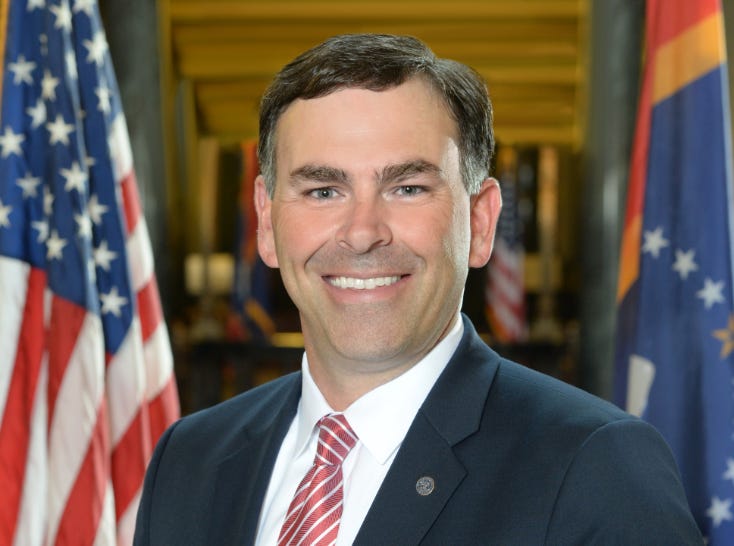
Since announcing his run for the Republican nomination for lieutenant governor in the 2027 statewide election, Secretary of State Michael Watson has provided few details about his aims beyond taking a conservative approach, with healthcare, transportation infrastructure and economic development his primary focus areas.
One intriguing detail he offered was that he wants to move past what he describes as a culture of personal score-settling at the Mississippi Capitol, though he has likewise offered few details about that.
The Mississippi Independent contacted Watson’s office four times seeking further information about his campaign platform but got nowhere. On one occasion, a staff person called back and confirmed that an interview could be scheduled. A follow-up call was transferred to the voicemail of a secretary who did not return the call. Other calls were not returned.
At this stage, voters have a thinly sketched image of Watson as a candidate for the higher office, the responsibilities for which differ significantly from those of the secretary of state. One clue to Watson’s campaign was his choice of venue for his announcement: the former site of Pascagoula’s LaFont Inn, where U.S. Sen. Trent Lott launched his congressional career and later announced his Senate retirement. Before the hotel closed in 2019, it was a fixture of Gulf Coast politics, which has sometimes proved problematic in campaigns for statewide elective office.
Built on U.S. 90 when the beachfront boulevard was the main Gulf Coast thoroughfare, the LaFont was a popular venue for city clubs, political announcements and community gatherings. The building itself was demolished shortly after the hotel closed. Watson’s announcement took place inside a Hilton Garden Inn that now stands on the site. The location for the announcement, the first of several across the state, was a nod to Watson’s coastal roots. “This is where I’m from, and this is who I am,” he told the crowd.
When Watson became secretary of state, he was the first person from the Coast to be elected to a statewide office in almost two decades. Prior to that, he had represented Jackson County for three terms in the state Senate.
The Coast is in many ways a political outlier. Among the state’s four lieutenant governors since 2000, all came from inland regions: Ronnie Musgrove from Panola County in north Mississippi; Phil Bryant from Sunflower County in the Delta; Tate Reeves from Rankin County; and current Lt. Gov. Delbert Hosemann from Vicksburg.
Three of the four most recent lieutenant governors went on to win the governorship. Musgrove served as lieutenant governor from 1996 to 2000, the year he was elected governor. Bryant won the lieutenant governorship in 2007 and the governorship in 2011. Reeves was elected lieutenant governor in 2011 and governor in 2019.
The Coast has traditionally been a distinct region, culturally and economically tied to a narrow corridor stretching from New Orleans to Mobile. Its economy is built around Ingalls Shipbuilding, the petrochemical industry and casino gaming. Politically, it has been solidly Republican, though Democrats appear to be making gains.
Jere Nash, a Mississippi political strategist and coauthor of Mississippi Politics: The Struggle for Power, said Gulf Coast candidates who ran statewide in recent cycles faced structural disadvantages that had less to do with geography than with their opponents. The most recent two—Dave Dennis and Billy Hewes, both of whom ran in the 2011 Republican primary for lieutenant governor—faced Bryant and Reeves, who had already served in statewide offices and had greater name recognition.
Still, Nash pointed to two structural factors that have long constrained the Coast’s statewide influence. “It is only recently that it has accumulated enough population to be a threat,” he said. “More important, it has historically had an awful voter participation rate—the number of people voting in an election versus the number of people counted by the census. Back when I used to crunch numbers and would divide the state into 10 or 11 regions, the Coast would have the lowest or next to the lowest voter participation rate. So, even though it had a lot of people living there, they just didn’t vote.”
Watson enters the 2027 race having served two terms as secretary of state, giving him the statewide name recognition that Dennis and Hewes lacked. Whether Coast voter participation has kept pace with the region’s population growth will be one factor shaping how much his home base can deliver.
Watson has acknowledged the regional challenge directly. “History doesn’t bode well for the Coast,” he told WTOK in April. “It’s hard for somebody from the Coast to win. But I feel like the job we’ve done as secretary of state speaks for itself. I think people realize, ‘Hey, it doesn’t matter where the guy’s from.’”
One area in which Watson has been outspoken is election fraud, yet noncitizen voting is vanishingly rare, according to research by the Brennan Center for Justice. A review by Watson’s own office of Mississippi’s 1.7 million registered voters produced 15 people with suspect citizenship status, some of whom were later found to have been mistakenly flagged, according to Senate floor debate.
Meanwhile, when Watson was in the state Senate, he voted against Senate Bill 2702, a 2017 measure introduced by now-former Republican Sen. Sally Doty that would have made absentee voting easier for college students by allowing college registrars to witness their absentee ballot applications, according to the Mississippi Free Press. The bill passed the Senate 30–20 with cross-partisan support but died in the House.
Watson also pushed for, and the Mississippi Legislature passed, SB 2588, known as the SHIELD Act, during the 2026 session requiring voter registration applicants to be checked against a federal immigration database. Gov. Tate Reeves signed the bill into law on April 1.
On April 10, a coalition of civil rights organizations sent Watson a notice of violation citing the National Voter Registration Act. Under federal law, the organizations have a 90-day window before they can file suit over the SHIELD Act. Watson’s office did not respond to requests for comment about the alleged violation.
In 2014, as an attorney for U.S. Senate candidate Chris McDaniel, Watson was part of a legal team that sought to invalidate what they described as “illegal and fraudulent” African American votes in the Republican primary runoff between McDaniel and incumbent Sen. Thad Cochran, according to Mississippi Today. The challenge failed.
Watson has also worked to strengthen campaign finance disclosure requirements and sought to reduce regulatory burdens on businesses.
The lieutenant governor presides over the state Senate, appoints the chairs of every legislative committee and controls which committees receive which bills. Those powers enable the officeholder to influence the fate of legislation before it reaches a floor vote. Current Lt. Gov. Delbert Hosemann has held the office for two terms and is now term-limited.
Watson is the first candidate to announce a run in the 2027 lieutenant governor’s race. In the days before his announcement, he reportedly met privately with several state senators to inform them of his intentions and seek their input on which issues to emphasize. It is not widely known which senators he met with, and efforts to find out were ignored.
Image: Michael Watson (via Mississippi Secretary of State’s Office)

Sounds like a typical Magat..and the coast sent a Democrat to the Attorney Generals office over and over again..but that was years ago..its been hard down here for a liberal fir some time now