


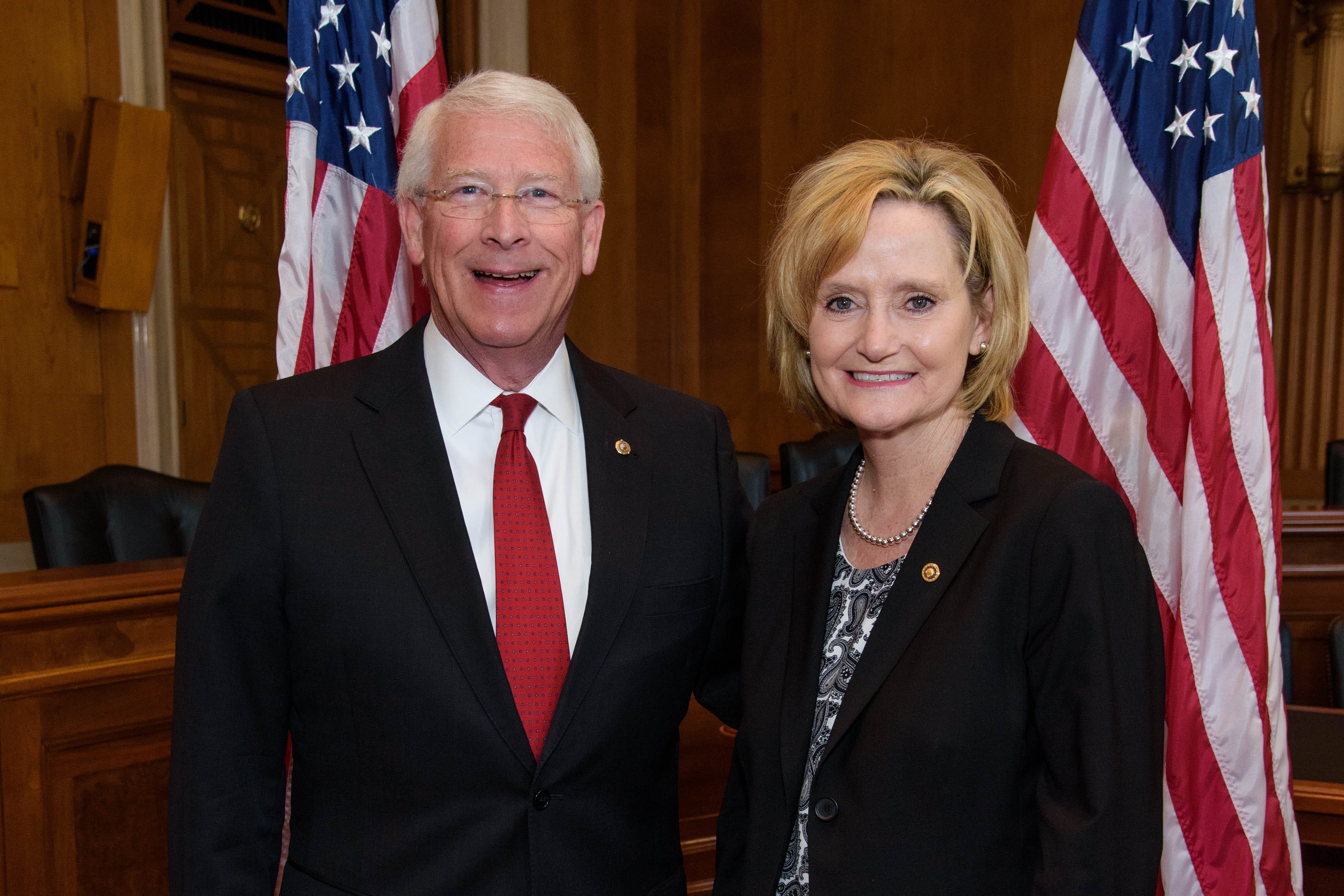
Mississippi’s two U.S. senators, long regarded as reliable supporters of free trade, have received failing marks for their positions on tariffs during President Trump’s second term, according to a recent report released by a Washington D.C.-based liberal think tank.
The Center for New Liberalism graded both Sen. Cindy Hyde-Smith and Sen. Roger Wicker an F on free trade, a sharp reversal from the A grades each received just a year earlier based on their pre-Trump records, underscoring a broader political realignment within the Republican Party.
The report arrives amid heightened legal and political uncertainty over U.S. trade policy. The Supreme Court is weighing whether Trump has exceeded his authority under the International Emergency Economic Powers Act to impose sweeping tariffs, even as the administration continues to deploy import tariffs as leverage in foreign policy disputes.
“Donald Trump’s reckless protectionism continues to raise costs for American families,” Colin Mortimer, the Center for New Liberalism’s director, said in a statement accompanying the report. “But there are still leaders in the Senate who are working across the aisle to tell the truth: tariffs are nothing more than a tax on everyday Americans.”
The group’s Senate Tariff & Trade Response Index evaluates lawmakers on votes, public statements, and legislative efforts related to tariffs and congressional authority over trade.
The report found that 33 Republican senators who had earned A or B grades for their pre-Trump trade records now received Fs for their current positions, reflecting what the report authors describe as a dramatic abandonment of long-standing party principles.
“The Republican Party has fallen far from its past support for free trade,” the report notes.
Sen. Hyde-Smith voted to preserve the president’s emergency tariff powers and supported key White House-led trade measures despite mounting evidence of harm to Mississippi’s agriculture sector. “Ignoring the trade war’s impact on Mississippi’s agriculture industry, she has instead argued for government bailouts to assist producers in economic crises,” the report states.
Sen. Wicker’s F grade is related to “his failure to speak out against Trump’s 2025 tariff agenda.” The report notes that he was once an “avid opponent of tariffs that would hurt Mississippi jobs.”
Neither Hyde-Smith nor Wicker responded to questions from The Mississippi Independent regarding the grades or their approach to trade policy.
Since oral arguments in the IEEPA case last fall, Trump has repeatedly used tariffs not only as economic instruments but as leverage in unrelated geopolitical negotiations. Over the weekend, the White House threatened a 10 percent tariff on eight European countries unless they agreed to talks over the sale of Greenland to the United States, with the possibility of duties rising to 25 percent. On Monday, the president warned he would impose 200 percent tariffs on French wine, including champagne, if President Emmanuel Macron declined to participate in a proposed “Board of Peace” for Gaza. He also threatened Canada with 100 percent tariffs over its possible free trade deal with China.
In 2025, the administration’s tariff agenda resulted in an average annual cost increase of roughly $1,100 per household, according to estimates cited in the Center for New Liberalism report, which calls it the largest single-year “tax increase” since the 1990s. In general, companies forced to absorb higher input costs have primarily passed them on to consumers, who are already grappling with inflation.
Mississippi’s economy is especially exposed. Trade supports roughly one in five jobs in the state and generates billions of dollars in annual revenue. For farmers, particularly those dependent on export markets, the damage has been acute. Agriculture, led by poultry, forestry and soybeans, is among the most export-dependent sectors. Soybeans alone account for an estimated $1.6 billion of the state’s economy.
Yet those global markets have eroded steadily under successive rounds of tariffs and retaliatory measures, with China making the most significant dent in trade revenues. In the Mississippi Delta, farmers like Ray Crawford say the consequences are existential. A fourth-generation soybean grower, Crawford has watched China, once the dominant buyer of U.S. soybeans, pivot toward Brazil and Argentina, investing heavily in reliable long-term supply chains.
Speaking to The Mississippi Independent in September 2025, Crawford said that he and other farmers were “sitting on a mountain of soybeans we don’t know what the hell to do with.”
China did agree to buy 12 million tons of soybeans in the last two months of 2025 as part of a trade truce with the U.S., adding to the six million tons Beijing bought in early 2025. It also agreed to purchase 25 million tons per year through to 2028. However, the 2025 purchase represents a 33 percent reduction from 2024’s exports, according to industry reports, while the 25-million-ton agreement is also slightly less than previous years.
The Center for New Liberalism’s index attempts to capture how lawmakers have responded to these realities. Senators were graded on their trade records before Trump’s return to office in 2025; their votes on key tariff-related resolutions this year, including measures addressing tariffs on Brazil, Canada, and global imports; and their public messaging and leadership in opposing or supporting the administration’s trade agenda.
Under the scoring system, lawmakers received failing grades if they actively supported broad tariffs, opposed trade liberalization, or embraced protectionism as sound economic policy. Higher grades were reserved for senators who publicly labeled tariffs as taxes, highlighted state-specific harms, and supported legislation to restore Congress’s constitutional authority over trade.
Only eight senators, including Democrats Maria Cantwell of Washington and Ron Wyden of Oregon, and Republican Rand Paul of Kentucky, earned top marks and were designated “Free Trade Titans.” Just four states had both senators receive A-level grades, and only Washington produced two “titans.”
In contrast, Republican Sen. Thom Tillis of North Carolina was among those cited as emblematic of the shift. Once praised as a free-trade advocate, Tillis received an F for what the report called a contradictory record. While he cosponsored legislation to review tariffs and voted to lift duties on Brazil, he supported tariffs on Canada and global imports, arguing that the president’s “strategic” use of tariffs could yield short-term gains despite long-term risks.
Across the South, the pattern is similar. Republican Sens. John Kennedy and Bill Cassidy of Louisiana, Sen. Marsha Blackburn of Tennessee, and Sen. John Boozman and Sen. Tom Cotton of Arkansas all received failing grades after enthusiastically backing free trade in the past. Alabama’s two newest senators also earned Fs, though they lacked prior scores for comparison.
Both Hyde-Smith and Wicker either voted against or abstained on resolutions aimed at curbing tariffs on Brazil, Canada and other global trade partners, while neither publicly supported legislation to reclaim congressional authority over trade policy. Neither publicly criticized the administration’s use of Section 232 and Section 301 tariffs, which allowed the White House to impose tariffs on national security grounds and for unfair trade practices.
Hyde-Smith has acknowledged the pain caused by tariffs while expressing optimism about their long-term benefits. “I think that it’s a really good tool,” she said of tariffs at the Ridgeland Chamber of Commerce in April 2025. “I think the president knows how to use that tool. I’m pretty excited about the benefits that will come from the tariffs.”
Critics, however, contend that the strategy has already inflicted lasting damage. During the first trade war, farmers lost an estimated $27 billion between mid-2018 and late 2019, according to a U.S. Department of Agriculture report. The losses are thought to be far greater in 2025, with some estimates hitting $44 billion.
Homebuilders and insurers have also warned that tariffs on steel, aluminum and lumber are driving up construction costs, contributing to higher home insurance premiums, particularly in storm-prone states like Mississippi, highlighting the real-world significance of the pending Supreme Court case and the Senate’s ability to influence trade policy.
“The U.S. Senate must not abdicate its role as the executive branch violates the separation of powers,” the Center for New Liberalism report concludes, calling on lawmakers to reassert their authority over tariffs.
