


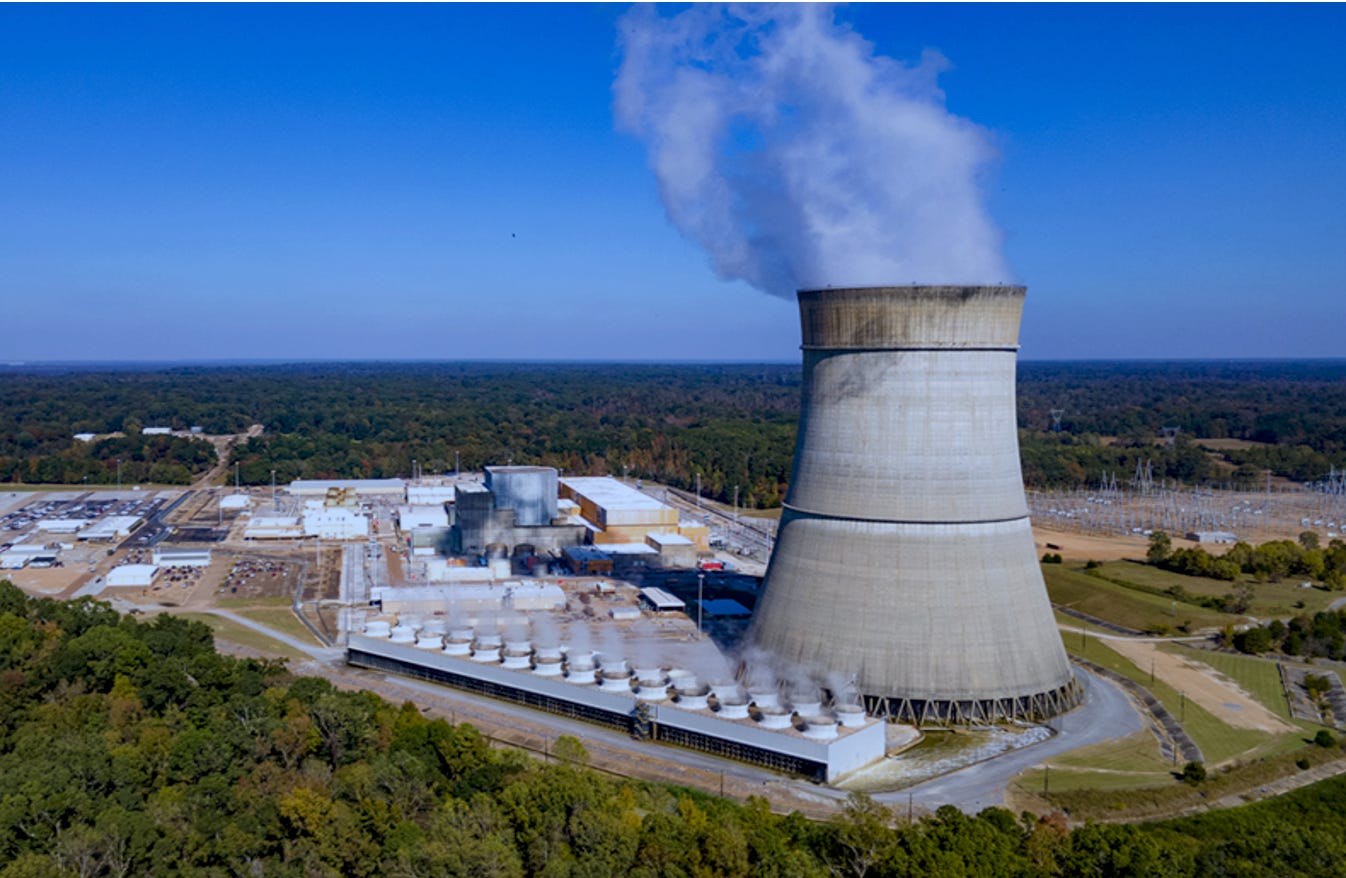
As the regional electric utility Entergy searches for new power sources for rapidly expanding data centers, the buzz in Port Gibson, Mississippi is that a new reactor will be built at the Grand Gulf nuclear plant to service a facility under construction in Louisiana.
Entergy supplies electricity and operates subsidiary companies in Arkansas, Louisiana, Mississippi and Texas, and operates Grand Gulf, Mississippi’s only nuclear power plant. Among the data centers it will provide power to is the $10 billion Louisiana data center known as Hyperion, under construction near Monroe, Louisiana, which will be the largest of social media giant Meta’s 20 facilities worldwide.
Though there is no reported link between Grand Gulf and Hyperion, local speculation is not far off the mark: Other data centers in Mississippi will need massive amounts of electricity, which could make another nuclear reactor more attractive.
At its core, the speculation is rooted in a lack of transparency surrounding the construction of data centers and related utility infrastructure across the South. Local residents have become acutely aware of the potential for significant, unexpected developments as a result of deals negotiated off-screen. When reliable information is not forthcoming, the rumor mill clicks into gear.
A case in point is Clinton, Mississippi, where officials withheld the details of a planned Amazon data center now under construction until the deal was done. Mayor Will Purdie said the reason for withholding an announcement was that the developer was still in negotiations about “some aspects of the project.” That left local media and freelance sleuths to find out what was happening at the site. The investment cost for the project varies according to the source, from $750 million to $1 billion.
Purdie later said the facility—the fourth major Amazon investment in the metro Jackson area—will connect to Entergy’s electricity grid and will not cause problems with air or noise pollution that sparked a backlash against xAI’s Grok facility in Southaven, Mississippi. Purdie also claimed the facility will be air cooled and will not require the large volumes of water that other data centers use.
Yet even the mayor’s explanation for not having apprised the public was vague, and many residents are growing skeptical of such official assurances. Last month, environmental activist Erin Brockovich pointed out that people in communities near new data centers often feel the projects are being “shoved down their throat in secrecy.”
“The single most common concern—more than noise, more than water usage, more than rising utility bills—is the one word that keeps appearing in submission after submission: transparency,” Brockovich wrote, referencing her efforts to gather public input about data centers and map the facilities across the U.S.
Brockovich said she was not arguing against data centers or A.I. but against “the pattern our map documents: projects announced after permits are already secured, developers who don’t return calls, local officials who signed NDAs before their neighbors knew a project was being considered.”
In response to negative public reactions, Clinton officials have promised to be more forthcoming about Amazon’s data center, but it is unclear how public input might factor into a project that has already been approved. Entergy Mississippi meanwhile announced that Amazon will pay all costs associated with powering the facility, including new energy infrastructure and upgrades to strengthen overall grid reliability.
Data centers are increasingly controversial for multiple reasons: the noise they generate, their intrusiveness compared with the relatively small number of permanent jobs they create, the potential for air and water pollution, and their outsized demands for coolant water and electricity. Public misgivings are often treated as a potential threat to multi-billion dollar investments. Given the air of secrecy, it is unclear precisely how many data centers are planned in Mississippi, with various websites listing from seven to 29 proposed, announced, under construction or in operation. Some data centers draw as much electricity as a small or medium sized city in a single day.
Across the river, Entergy has said that it will use a combination of “clean and renewable” energy sources to power Louisiana’s Hyperion data center and has broken ground on a new substation for that purpose. An agreement with the Louisiana Public Service Commission allows Entergy Louisiana to move forward with $6 billion in major infrastructure investments including a 10,000-acre solar farm, three natural gas turbines and 100 miles of new transmission lines. There is no mention of Grand Gulf. Massive solar farms and powerlines are also part of the mix in Mississippi.
Entergy has said in regulatory filings that Hyperion’s immense power needs will require a historic buildout of power plants—enough to fuel a more than 50 percent increase in its Louisiana power-generation capacity, according to reporting from the Times-Picayune. The construction of necessary infrastructure there has likewise been shrouded in secrecy.
There is no question that data centers will require significant new infrastructure and that utilities will reap financial benefits, and infrastructure expansions could include another reactor at Grand Gulf. Yet in response to concerns that utility companies will pass along the cost of building new infrastructure to residential and other commercial customers, Entergy has insisted its investments will not result in higher rates.
Elected officials have tended to treat developers of data centers and related power infrastructure as partners and the public as a potential impediment. State and local governments have meanwhile offered major tax incentives and other financial assistance to developers while treating the resulting need to create or expand power sources as an unquestioned public good. During the last session of the Mississippi Legislature, two appropriations bills were proposed to offset private costs associated with nuclear power development during the 2027 fiscal year. Senate Bill 2185, introduced by Sen. Joel Carter (R-Gulfport), proposed a $10 million appropriation specifically targeted to an expansion of Grand Gulf. House Bill 697, introduced by Rep. Jody Steverson (R-Ripley), sought to establish a dedicated fund for nuclear site development grants to be allocated to power companies, workforce training initiatives and site preparation projects. Given the considerable wealth of large utility companies and their investors, it is unclear why the lawmakers deemed such incentives necessary, but both bills died in committee.
It is not unusual for economic development officials and elected officials to be cagey about large projects in the works, which often involve nondisclosure agreements even when tax dollars and public safety are in play. Corporate CEOs likewise tend to be more candid with savvy investors than with the general public or the media.
As The Mississippi Independent previously reported, Entergy CEO Drew Marsh told investors during a first quarter 2025 earnings call that the company was considering adding a new reactor at Grand Gulf, and citing Marsh’s comments, the trade journal Power Engineering noted, “Nuclear power has regained popularity in recent years as end-use customers like data centers seek clean, reliable megawatts.” The journal noted: “Several of the tech giants, like Microsoft, Google and Amazon, have struck deals in the interest of procuring nuclear power for their AI data centers.”
In his comments, Marsh said Entergy has applied for an extension of what is known as an early site permit, or ESP, from the federal Nuclear Regulatory Commission, which would be required for the construction of another reactor at Grand Gulf. He added that the company was “in discussions with customers, potential partners and other stakeholders regarding that opportunity.” The existing ESP for Grand Gulf expires in 2027.
Among the possibilities Entergy is exploring are small modular reactors that can be brought online more quickly than conventional reactors. Building a conventional nuclear reactor can take up to 10 years from the start of construction and total project timelines, including for planning and licensing, can stretch that period to 15 years or more, with costs as high as $30 billion.
Referencing Grand Gulf’s ESP application in a September 2025 Energy, Oil & Gas Magazine article, Entergy Mississippi CEO Haley Fisackerly said, “That’s very important to us because it would help us to accelerate and reduce costs on another plant if we were to look at building one; it’s something we’re studying very carefully. For example, we’re looking at new technologies such as small modular reactors, which are greater passive safety systems than what we currently use today. We’re making investments in upgrading our transmission systems with more resilient, robust structures, as well as into various other grid enhancement technologies, to ensure that the grid is stable and operating at its highest capability.”
Fisackerly was careful to use the phrase “if we were looking to build one.” In another instance, an Entergy spokesperson said no Grand Gulf reactor was in the works “right now” or “at this moment.”
The fact that elected officials and developers have hedged on their plans has fueled further speculation. The Port Gibson newspaper The Southern Reveille reported on June 12, 2026, that the recent successful testing of a modular nuclear reactor known as Antares Mark-O at the Idaho National Laboratory could put Grand Gulf “back in the national nuclear conversation.” Grand Gulf has, in fact, been part of the national nuclear conversation for a while, mostly for operational and ratepayer issues, but the newspaper was citing the possibility of the local power plant playing an expanded—and groundbreaking—role.
Asked about the status of the ESP application, Entergy spokesperson Tosha Hester directed The Mississippi Independent to this Nuclear Regulatory Commission site, which monitors the permit process and indicates that no federal action has been taken on the application since January 2026.
“Right now, we don’t plan on building any new nuclear plants, at this moment,” Hester previously told The Mississippi Independent. Once the ESP permit extension is in place, Entergy will evaluate the possibilities, she said, adding, “If Entergy proceeds, that [Grand Gulf] would probably be the first site.”
Entergy has previously looked into expanding Grand Gulf, but two proposed conventional reactors ended up being shelved. Adjacent to the current station is an unfinished concrete structure that was to be the containment building for a planned Unit 2, a twin to the existing Unit 1 nuclear reactor. But in 1979, Entergy precursor Middle South Utilities stopped work on Unit 2 due to high construction costs and lack of sufficient electricity demand. In 2005, Entergy announced that Grand Gulf had again been selected as the site for another reactor to be known as Unit 3, but that project stalled in 2009 and the related NRC permit application was cancelled at the company’s request in 2015.
Those proposals differed, however, in that they were pursued prior to the ongoing proliferation of data centers.
In its current ESP application, Entergy states that the location to be evaluated is adjacent to the existing Grand Gulf reactor, with the disclaimer that the company “has not yet selected a specific reactor design for any future plant that may be built at this proposed site.” The Nuclear Regulatory Commission website notes that an extended ESP would allow a construction permit or combined license application for 20 years beyond the current permit’s expiration date of April 5, 2027. A notice of the agency’s consideration—which also opened the door for a request for a public hearing by March 30—was published in the Jan. 27, 2026, Federal Register.
The rapid proliferation of data centers and the secrecy that often shrouds their development taps into public misgivings about government, large corporations and artificial intelligence itself. It is easy to imagine people in the future marveling at America’s unquestioning embrace of data centers that require vast amounts of land, water and electricity yet few human workers, for an economic juggernaut that could end with machines taking over for humans who are subsequently rendered redundant. For now, Mississippi officials have wholeheartedly embraced the construction of data centers despite growing public resistance, and the Trump administration has squelched any effort to regulate A.I.
When it comes to the development of data centers, massive tax incentives are routinely used and the public is usually kept in the dark. Last year, NBC News reported that a survey of more than 30 data center proposals across 14 states found that in a majority of cases, local officials signed non-disclosure agreements and worked with what appeared to be shell companies that can conceal the identities of project developers.
All of which has led to public suspicion and speculation about both the data centers and the construction of related infrastructure. In places like Claiborne County, the primary focus is on the potential for economic development in a depressed region. Elsewhere, it is often on potential negative impacts, with local concerns exacerbated by misgivings about A.I., even as the public becomes increasingly dependent upon it in daily life.
In the short term, the biggest concerns being raised are that residential electricity bills will significantly increase as utilities shunt power to data center behemoths, and that multibillion-dollar deals are being made without public input or, often, even public awareness.
In the case of Louisiana’s Hyperion project, the Alliance for Affordable Energy urged the Louisiana PSC to postpone a vote on a gas-powered plant that would service the data center to give the public time to evaluate the proposal. Logan Burke, the alliance’s executive director, said she was concerned about a lack of transparency around the entire project. But the regulatory agency refused and forged ahead.
Residents in the vicinity of Grand Gulf—the largest single-unit nuclear power plant in the U.S.—also face the potential for the kind of risk that came to the fore with the partial meltdown of the Three Mile Island plant in 1979.
In response to Three Mile Island, the Nuclear Regulatory Commission suspended all nuclear power plant construction projects while regulators analyzed what went wrong. Grand Gulf was still under construction at the time and resulting delays and modifications caused its construction cost to skyrocket. The U.S. Supreme Court ultimately ruled that the utility could pass along those cost overruns to ratepayers in the states served by the plant.
Image: Cooling tower at Grand Gulf nuclear plant (via Entergy)