


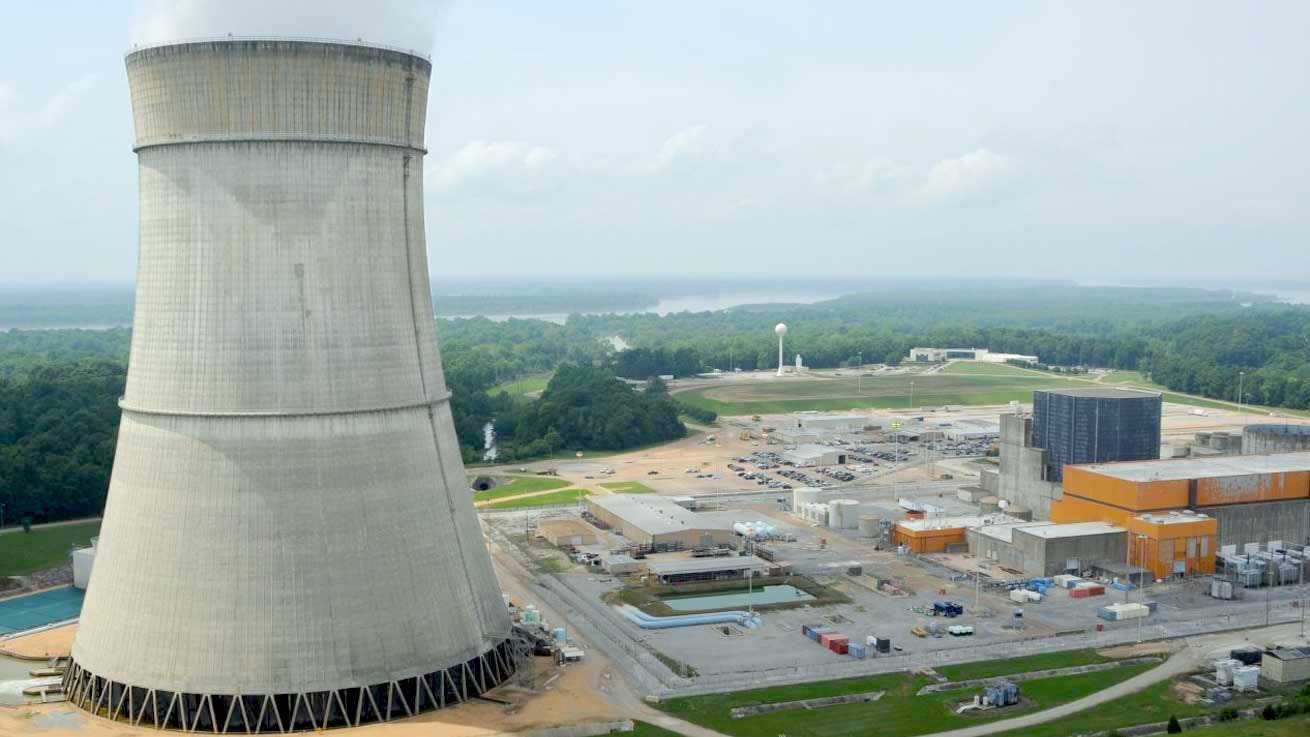
The iconic cooling tower of the Grand Gulf Nuclear Station looms incongruously above a forested landscape along a remote bend of the Mississippi River, about 10 miles west of the Claiborne County seat, Port Gibson.
The plant’s isolation is not incidental: Roadside signs identify evacuation routes in the event of a nuclear meltdown or other environmental or public health event.
Grand Gulf is the largest single nuclear reactor in the United States and the only nuclear power plant in Mississippi. It stands out in other ways, including for its sometimes troubled operational history and controversy over its assessment for taxation.
Now Entergy, the utility company that operates Grand Gulf, is considering adding a second nuclear reactor in part due to increased projected demand from AI facilities, according to an article in the trade journal Power Engineering which reported that the company had “secured an early site permit for such a project and is ‘in discussions with customers, potential partners and other stakeholders regarding that opportunity.’” The revelation came in a 2025 investors call that received scant attention outside the energy industry.
Power Engineering cited comments by Entergy CEO Drew Marsh during the April 2025 quarterly earnings call, and noted, “Nuclear power has regained popularity in recent years as end-use customers like data centers seek clean, reliable megawatts at a time when electricity demand is exploding due to EVs, manufacturing and the compute needed for artificial intelligence (AI). Several of the tech giants, like Microsoft, Google and Amazon, have struck deals in the interest of procuring nuclear power for their AI data centers.”
The article quotes Marsh saying the company has government support for its potential nuclear expansion, but that “offtaker’s financial support” would also be needed to bring another reactor online. (“Offtaker” refers to end-users or marketers of a project’s output.)
“The key issue for us is our ability to manage the construction risk,” Marsh said during the earnings call. “And of course, we need a customer to want to pay for that.”
In a transcript of the call, Marsh notes that Entergy held a Nuclear Regulatory Commission “early site permit” for a potential new nuclear facility at Grand Gulf that expires in April 2027, and that the company planned to seek renewal of the permit for another 20 years “to maintain a viable option for new nuclear.” Marsh adds, “We are in discussions with customers [and] potential partners and other stakeholders regarding that opportunity.” Entergy applied for the required NRC permit extension in September 2025 and the regulatory agency published a notice in the Federal Register accepting it for review on Jan. 27, 2026.
Entergy, which operates generation and distribution networks in Mississippi, Arkansas, Louisiana and Texas, announced plans on Feb. 16, 2026, to add 1,300 temporary workers for what the company described as a routine refueling and maintenance project at Grand Gulf. The announcement made no mention of a second reactor. Entergy holds 90 percent ownership of Grand Gulf through a subsidiary, System Energy Resources Inc. The other 10 percent is owned by Cooperative Energy.
The scheduled refueling and maintenance—the 25th since the plant began operation in 1985—requires a temporary outage as “station and contract workers will perform maintenance and testing activities to prepare the station for its next operating cycle,” according to the Entergy announcement. The 1,300 additional temporary workers were in addition to more than 700 full-time employees needed for fueling, maintenance and testing, with additional support from Entergy employees from other nuclear plants.
Entergy spokesperson Tosha Hester told The Mississippi Independent that the refueling and maintenance outage began on Feb. 14, 2026, and that the 1,300 contract workers are for that project—not for construction of a second reactor, an option that she said would be considered pending approval of the extended permit.
“Right now, we don’t plan on building any new nuclear plants, at this moment,” Hester said. Once the permit extension is in place, Entergy will evaluate the possibilities, she said, adding, “If Entergy proceeds, that [Grand Gulf] would probably be the first site.” The added workforce is already onsite, but for now, she said, “There is no groundbreaking.”
Entergy Mississippi president and CEO Haley Fisackerly discussed some of those possibilities in this interview with Energy, Oil & Gas Magazine. He said Entergy Mississippi is moving more toward renewable energy sources, including nuclear, and that, regarding the Grand Gulf expansion permit, the company is “working with the new Nuclear Regulatory Commission and the Trump Administration on seeking an extension for another 20 years. That’s very important to us because it would help us to accelerate and reduce costs on another plant if we were to look at building one; it’s something we’re studying very carefully.”
Fisackerly said that among the options are small modular reactors, which he described as “greater passive safety systems than what we currently use today.” He said the company is meanwhile investing in upgrades to its transmission systems through what he called “more resilient, robust structures, as well as into various other grid enhancement technologies, to ensure that the grid is stable and operating at its highest capability.”
The Mississippi Public Service Commission’s Brent Bailey referenced small modular reactors, or SMRs, in a commission bulletin and specifically mentioned the company NuScale, a major industry player that has been the subject of numerous controversies, including, most recently, a class-action lawsuit alleging securities fraud.
There are currently no SMRs operating in the U.S., but the Tennessee Valley Authority filed the first permit to construct one last year and other companies are undertaking feasibility studies, including NuScale, whose design the NRC has approved, and AES Indiana, a subsidiary of Massachusetts-based AES Corp. In 2024, AES Corp. began operating a 184-megawatt wind farm in Tunica County; its primary customer is Amazon and the tech giant’s data centers.
Entergy Nuclear, headquartered in Jackson, is responsible for the operation of Entergy’s nuclear fleet, which consists of five reactors in four locations. Entergy produces, transmits and distributes electricity to three million customers in its four-state service area.
A second Grand Gulf reactor has been proposed before. One was originally planned alongside the first, and adjacent to the current station is an unfinished concrete structure that was to be the containment building for a planned Unit 2, a twin to the existing Unit 1 nuclear reactor. In December 1979, Entergy precursor Middle South Utilities stopped work on Unit 2 due to construction costs and lack of demand. In 2005, Entergy announced that the plant had again been selected as the site for another reactor, to be known as Unit 3, but that project stalled in 2009 and the related NRC permit application was cancelled at the company’s request in 2015.
Entergy completed a Grand Gulf power upgrade in 2012 that made it the largest single-unit nuclear power plant in the U.S. and the fifth largest in the world. According to the company, the upgrade increased Grand Gulf’s production capacity by more than 13 percent, bringing its total output to 1,443 megawatts.
The energy education site Fairewinds, in reporting on an “unusual event” at Grand Gulf that required a report to the NRC in 2021, noted that the plant has had its share of problems over the years, including a “truly abysmal reliability record” and a long history of operating issues. For most of 2020, the plant was either shut down or operating at reduced power, according to Fairewinds, which reported that as far back as 1997 the NRC had identified radioactive tritium discharges that were among the highest concentrations at any plant in the U.S.
In 2011, Grand Gulf Unit 1 had another significant tritium leak into the basement of the unfinished Grand Gulf Unit 2 reactor, which was discharged directly into the Mississippi River. News outlets at the time reported that after heavy spring rains, workers were pumping standing water collected in the abandoned Unit 2 turbine building into the river when detectors sounded alarms signaling the presence of tritium and the pumping was stopped. The release was reported to the Mississippi Department of Health and the NRC.
The plant’s problematic history dates back to its original construction, though the first episode was beyond the company’s control: The cooling tower was severely damaged by a 1978 tornado that caused a massive fissure in its 520-foot-tall concrete superstructure, the result of the collapse of a crane. The ruptured cooling tower, spotlighted at night, gave the installation an ominous appearance at a time when the movie “The China Syndrome”—which focuses on the dangers of nuclear power plants—was coincidentally showing at a now-defunct local drive-in theater.
In 2024, New Orleans reached a deal with Entergy to settle longstanding allegations that the utility mismanaged the Grand Gulf plant, which delivers power to the city, garnering a $250 million payout. Nola.com reported that regulators in Louisiana, Mississippi and Arkansas had “accused Entergy of bilking ratepayers by using an array of arcane tax and accounting measures—such as billing them for lobbying and private plane rides for executives and generally mismanaging the plant—which for years was among the least reliable nuclear plants in the nation.”
Many residents of Port Gibson and Claiborne County are hoping a second reactor will revive the local economy, though the much-anticipated boom from Grand Gulf’s original construction proved short lived. After construction was complete, most of the workers moved on, and many whose operations and maintenance jobs remained chose to live elsewhere, including in Vicksburg, about 30 miles to the north.
The main benefit to Port Gibson and Claiborne County was the substantial tax revenue assessed for the plant, which was built at a cost of $6.325 billion. Yet even that turned out to be a mixed blessing. In the 1980s, the infusion of unprecedented tax dollars into the poor county ushered in a period of alleged political corruption, and in 1986 the Mississippi Legislature passed a law spreading Grand Gulf tax revenues across the Entergy Mississippi service area.
The law, which exempts the plant from local ad valorem taxes and instead requires it to pay a state tax, has been the subject of legal disputes, and during the current legislative session, House Bill 1277, the “Nuclear In Lieu Tax Distribution Equity Act” was filed to adjust the statutory formula governing the distribution of the taxes to ensure the equitable allocation of revenues” to the county bearing the associated “risks and burdens.” Several similar bills during previous sessions failed to pass.
Should Entergy build a second reactor at Grand Gulf, the tax revenues would increase, perhaps significantly.
The Port Gibson and Claiborne County economy could use a boost, as it is basically running on fumes. The region’s original fortunes were based on slave-based cotton production and its main draw remains its well-preserved antebellum architecture. For a time the town relied upon small industrial enterprises including a sawmill and a cottonseed (later soybean) oil mill, both of which have since closed. The town was also served by a railroad that is likewise abandoned. Signs on approaches to the town claim Civil War Gen. U.S. Grant deemed Port Gibson “too beautiful to burn,” though that is generally considered a myth, given that the war’s most brilliant strategist would not likely have based his military decisions on architectural aesthetics.
The town of Grand Gulf, named for a wide, turbulent bay created by the confluence of the Mississippi and the Big Black rivers, is now extinct, owing to fires, yellow fever epidemics, changes in the course of the Mississippi and out-migration. The former river port and Civil War battle site is commemorated in a state park with a museum, preserved buildings and the remains of artillery emplacements, with a scattering of residences nearby. A new river port dredged downstream from the Grand Gulf nuclear plant is currently unused.
Image: Grand Gulf Nuclear Station (via Entergy website)