


Candidates have until tomorrow to file with the State Board of Election Commissioners to qualify for a DeSoto County judgeship that Gov. Tate Reeves created—and made an interim appointment to—through his own state Supreme Court appointment, part of a chain of events that runs back to Washington, D.C.
Reeves has appointed a DeSoto County prosecutor and judge to a circuit court seat that came open after he moved its previous occupant up to the Mississippi Supreme Court. The DeSoto appointment is the latest link in a chain that began in Washington, D.C. and lands on a court system whose elections have been frozen for more than a year by a voting-rights case.
Reeves named Craig Treadway of Olive Branch to the 21st Circuit Court District, Place 2, on Aug. 19, 2026. The district covers DeSoto County, the fast-growing, majority-white county in the state’s northwest corner. Treadway has served as a county and youth court judge there since 2017 and before that worked as a prosecutor and public defender. He earned his law and undergraduate degrees at the University of Mississippi. His term begins Sept. 1, 2026. Reeves also reopened the qualifying window for the seat, giving candidates until 5 p.m. on Aug. 25 to file for the Nov. 3 election that will fill it for the remainder of the term.
The vacancy traces directly to the governor. The seat came open on Aug. 1, when Celeste Embry Wilson resigned from the post following her July appointment by Reeves to the state Supreme Court. Wilson’s move to the high court was itself a consequence of decisions made in Washington, D.C. President Trump nominated two Mississippi justices, Robert Chamberlin and James Maxwell, to federal judgeships in 2025, and after the U.S. Senate confirmed them in December, both left the state Supreme Court. Reeves filled their seats by appointment, elevating Wilson to one and Amanda Jones Tollison of Oxford to the other, which opened up Wilson’s circuit seat and set up Treadway’s appointment to it.
The pattern in whom Reeves chooses for such posts is consistent. Mississippi elects its judges in nonpartisan elections, but the governor fills any vacancy that opens between elections, and Reeves has repeatedly used that power to place prosecutors on the bench. He moved district attorney Joel Smith to the court of appeals and district attorney Matt Sullivan to a circuit judgeship in 2021; appointed former prosecutor Thomas Michael Reed as a circuit judge in 2025; and named John Weddle and John Emfinger, both with prosecutorial backgrounds, to the court of appeals. Treadway, a former prosecutor, fits the line. Reeves cited his experience as an attorney, prosecutor and judge.
The appointments come while the courts are in the midst of an unresolved fight over how their districts are drawn. A federal judge, Sharion Aycock, ruled in 2025 that the state’s three Supreme Court districts, unchanged since 1987, dilute Black voting strength, and she enjoined them. The special elections meant to make the Supreme Court appointments permanent cannot be scheduled until the Mississippi Legislature adopts a new map, which it has not done, and the case has slowed further since the U.S. Supreme Court’s decision this year in Louisiana v. Callais raised the standard for proving a Voting Rights Act violation. For now, the northern district that includes DeSoto County holds one appointed justice, Wilson, and one seat still vacant, with no election in sight.
Circuit judgeships like the one Treadway was appointed to are not part of that litigation, and the election for his seat will proceed on Nov. 3. The winner will serve the remainder of the four-year term.
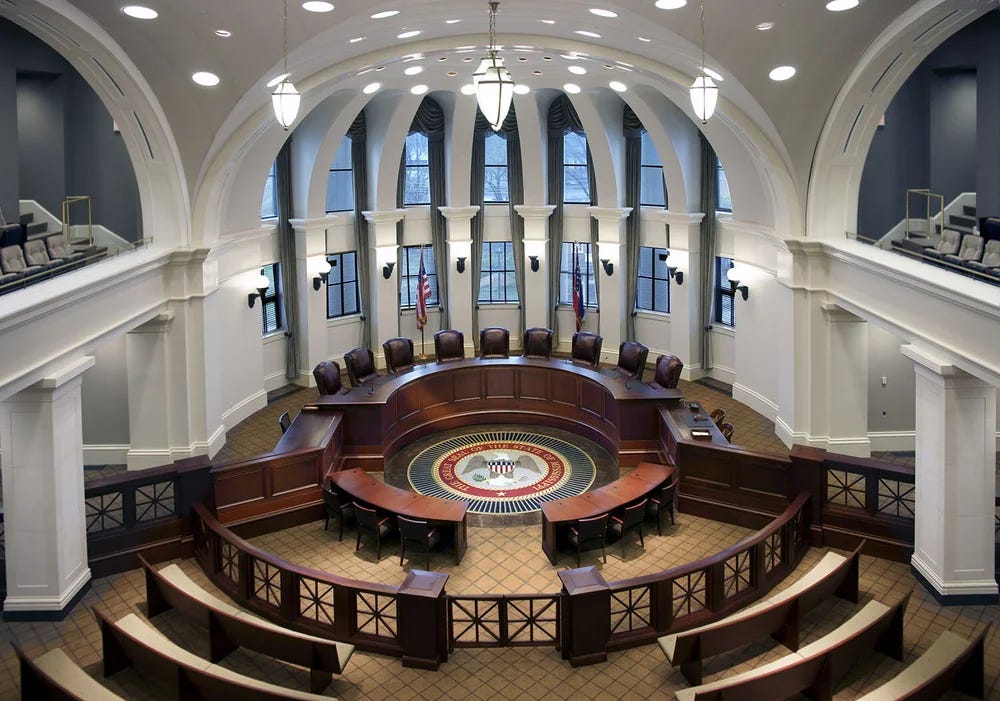
Image: State Supreme Court room (via Dale Partners Architects)
