


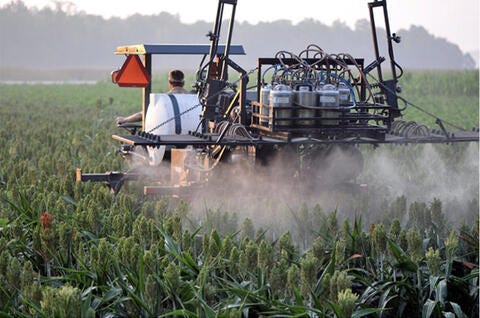
A majority of Mississippi Delta counties contain cancer clusters linked to the high use of controversial herbicides, according to two recently published reports, which place one of the nation’s most agriculturally productive regions at the center of a renewed national fight over the safety of the chemical glyphosate.
The studies focus on 500 U.S. counties that use large volumes of pesticides and have accessible cancer data, including 11 Delta counties in the fertile northwestern section of Mississippi. Of the latter, 10 counties recorded above-average rates of cancer compared to the national average, including non-Hodgkin lymphoma.
Of particular note are Coahoma and Tallahatchie counties, both among the nation’s top 20 percent of glyphosate users, and which had above-average rates of non-Hodgkin lymphoma, according to a March study by Food & Water Watch, a California-based environmental advocacy group.
Quitman County had the second-highest overall cancer rate among the counties analyzed in a February study by Investigate Midwest, an independent, nonprofit newsroom based in Champaign, Illinois.
The glyphosate saga
The findings arrive more than a decade after glyphosate, the chemical used in popular weed-killing products including Bayer’s RoundUp, came into question as a result of an International Agency for Research on Cancer landmark study that concluded the chemical was “probably carcinogenic to humans.” The study became the basis for multi-billion-dollar lawsuits, now comprising about 130,000 claims, and a wave of academic studies that alternately supported or refuted the harms.
Glyphosate is by far the most widely used ingredient in pesticides nationwide, according to federal data. Bayer bought Monsanto, the manufacturer of RoundUp, for $63 billion in 2018.
The herbicide is used primarily to kill weeds and is in widespread use, particularly on large farms and on genetically engineered crops such as soybeans, corn, cotton, canola and sugar beets that are bred to survive herbicide application. The USDA notes that more than 90 percent of U.S. acres planted in those crops use genetically engineered varieties, including in Mississippi.
Despite the swell of research contending that glyphosate causes harm to humans, the fight over its past and future is far from settled, with support for the chemical now coming directly from the Trump administration. The White House has used the president’s sweeping executive powers to help shield manufacturers from current and future lawsuits while pressuring the Supreme Court to rule favorably a case that would eliminate thousands of civil cases at the state level.
As these legal battles play out, Bayer’s army of big-spending corporate lobbyists has also sought to create obstacles to litigation at the state level, part of what Alabama-based lawyer Rhon Jones describes as a broad, coordinated campaign to influence the narrative around glyphosate that goes far beyond politics.
“There is a multi-level strategy in the courtrooms, in legislation, in academia and in research for Bayer Monsanto to promote their point of view,” Jones told The Mississippi Independent.
Jones heads the Beasley Allen law firm’s toxic torts section and has recovered billions of dollars for states and private clients related to the BP oil spill and ongoing opioid cases, among others.
Bayer’s influence is substantial, including in Washington D.C. The company donated $1 million to Trump’s inaugural fund in late 2024, per FEC filings, and in 2024 and 2025 tapped more than 100 lobbyists, spending in excess of $17 million, according to Open Secrets. The company hired the well-connected lobbying firm Ballard Partners, which has deep ties to the Trump administration, having previously employed U.S. Attorney General Pam Bondi for six years and White House Chief of Staff Susie Wiles for more than a decade. The company’s founder and president, Brian Ballard, raised more than $50 million for Trump’s 2024 campaign, according to the New York Times.
Perhaps unsurprisingly, the president in mid-February signed an executive order declaring glyphosate “critical to national defense and security,” effectively granting liability protection to individuals and companies involved in those efforts.
The executive order came one day after Bayer offered to pay more than $7 billion in compensation to tens of thousands of plaintiffs who claim the company’s glyphosate-based weed killer caused them to develop non-Hodgkin lymphoma, allegedly the most common cancer related to glyphosate.
Bayer, which has never admitted that its glyphosate-based products are dangerous, paid out more than $11 billion in 2020 to settle similar claims. If ongoing legal and legislative actions go its way, the company may never have to pay out compensation again.
In recent weeks, the White House has urged the Supreme Court to rule in Bayer’s favor in a case that could affect current and future state-court claims against the company. The Supreme Court case will determine whether Bayer can be sued under state law for failing to warn that RoundUp can cause cancer, or whether federal pesticide law and the EPA’s previous approval of its warning label shield the company from those claims. If Bayer wins, it could create significant barriers to pending state-court claims against it and prevent future claims from being filed. Supreme Court arguments are set for April 27, 2026.
Attempts to create “shield laws” for glyphosate manufacturers, including Bayer, were underway in a dozen state legislatures in 2025. Mississippi lawmakers, alongside those in nine other states, rejected bills that would have granted liability protections to pesticide manufacturers and effectively deny legal recourse for farmers and other claimants who believed glyphosate made them sick, according to Food & Water Watch. Georgia and North Dakota were the exceptions, according to state documents.
At the federal level, the latest version of the Farm Bill, approved by the U.S. House Committee on Agriculture on March 5, includes language that would end state authority to regulate pesticides that the federal government has not regulated, even if those pesticides contain carcinogens.
Legislative and legal support for Bayer and glyphosate have also caused ideological tension within the broader Trump coalition, exposing divisions between the White House’s policy agenda and the GOP’s newer, health-focused wing associated with the Make America Healthy Again movement, also known as MAHA.
How does Mississippi factor in?
The flashpoint over glyphosate comes during a period of heightened concern over Mississippi’s farmers and the state’s overall agriculture industry, as tariffs, inflation, strained relations with major soybean importer China, the stalled farm bill, high fuel costs resulting from the war in Iran, and the GOP’s interventions in the Bayer litigation have converged into a national struggle over whom the government ought to protect: farmers, consumers or chemical manufacturers.
Mississippi’s Republican U.S. Senator Cindy Hyde-Smith, who sits on the Senate Committee on Agriculture, did not respond to questions from The Mississippi Independent about whether she plans to support legislation granting pesticide manufacturers protection from liability.
Fellow Republican U.S. Rep. Trent Kelly, who sits on the House Commission on Agriculture, likewise did not respond to questions about the liability protections in the Farm Bill or the discussions that led to their inclusion.
Several members of Mississippi’s congressional delegation received large sums from multiple agricultural business Political Action Committees during the most recent election cycle, according to Open Secrets. Kelly received $154,000; Hyde-Smith brought in $41,500; Democrat U.S. Rep. Bennie Thompson raised $106,500; and Republican U.S. Sen. Roger Wicker took in more than $185,000.
As these political and legal developments play out in the nation’s capitol, the data from the two new cancer reports provide a stark reminder of how detached the political maneuvering and high-stakes lobbying can be from the fields of the places like the Mississippi Delta.
The Food & Water Watch report found that the Delta’s Sunflower and Washington counties apply the most glyphosate per agricultural acre of any counties in the United States. Neither has particularly high rates of non-Hodgkin’s lymphoma, but both have some of the higher cancer rates in the nation, alongside Tunica, Humphreys, Leflore and Sharkey counties, according to the Midwest Investigates data.
Bolivar County stood out as an exception, with below-average rates of both cancer and non-Hodgkin lymphoma in the two respective studies.
Future data analysis will be more difficult to undertake because the USDA recently ended a rule requiring farmers to record their pesticide use.
Jones, of the Beasley Allen law firm, said his office does not use geographical maps to assess new claims, but prefers to examine clients’ exposure history to glyphosate and/or RoundUp.
Focusing on geographical maps “may be something we’ll look at,” Jones said. “Either way, I’m of the opinion that glyphosate, as it’s used in Roundup, is not a good idea. I do think it’s dangerous for people who have been exposed.”
Both of the new reports showed cancer clusters stretching across the nation’s main agricultural corridors, particularly in the Midwest, with pockets in the northeast, Florida, California and the Pacific Northwest.
Scientific deadlock
Whether glyphosate causes cancer remains one of the more bitterly disputed questions in agricultural science.
“The acute toxicity of glyphosate is lower than that of aspirin,” argues Stephen Duke, a principal scientist at the University of Mississippi who specializes in the biological effects of glyphosate on vegetation. Duke told The Mississippi Independent that he has keenly followed the scientific travails of the chemical over decades. “There are a vast number of things you could correlate to cancer statistics, especially in agricultural areas of poor states like Mississippi.” He added: “I’m not saying there’s not a causal relationship between glyphosate and cancer, but Mississippi suffered from extreme health issues long before glyphosate was widely used.”
A February 2026 paper on glyphosate-resistant crops and weeds in which Duke was a coauthor noted that among the list of items and activities classed by the International Agency for Research on Cancer as “probably carcinogenic to humans” are art glass, indoor emissions from combusting wood or frying food, night-shift work, consumption of red meat or hot beverages, talc, and cobalt metal.
The U.S. Environmental Protection Agency reaffirmed in May 2025 that it does not believe glyphosate causes cancer, a position the agency has held for years. Yet independent researchers have continued to find signals of risk. A 2020 report from the U.S. Department of Health and Human Services, which reviewed decades of research, found a modest association between glyphosate exposure and non-Hodgkin lymphoma, including one study that reported a 41 percent higher risk among the more heavily exposed, though multiple studies found no statistically significant link.
That scientific divide adds context to the two recent analyses, both of which show significant correlations between where pesticides are sprayed and where cancer cases occur. The studies do not prove that pesticides caused any individual illness, and both compare pesticide use in 2022 with older multi-year cancer data.
Non-Hodgkin lymphoma, for example, can take anywhere from two to 20 years to develop after exposure to a carcinogen, according to a 9/11 study regarding latency periods. As Duke inferred, genetics, lifestyle and other environmental exposures can muddy the picture of what exactly causes cancer.
One of the main papers used in court to challenge glyphosate’s dangers was withdrawn at the end of 2025 after it was discovered that its three authors had received financial compensation from Monsanto (now Bayer).
The Mississippi Independent reached out to several Mississippi-based scientists to add context on how potential links between glyphosate and cancer play out in the state.
Mississippi State’s provost, David Shaw, an expert in weed science, did not respond to questions about glyphosate health risks or accusations published by the New York Times in 2015 that he was asked by Monsanto and another chemical company to persuade the USDA to approve new products by writing supportive letters and authoring complementary articles.
Shaw received significant financial support from Monsanto and Dow Chemicals, including an $880,000 research grant, additional funds and unrestricted gifts for himself and multiple faculty members--support he was reminded of when Monsanto sought his assistance, according to emails published in the New York Times article.
Mississippi State University professor Matthew Ross, who helped author the IARC study, declined to be interviewed by The Mississippi Independent.
Whether glyphosate is ultimately proved to be a major driver of cancer may take years of further research, if it can be proved at all. But in the Mississippi Delta, where pesticides are central to the state’s abundant yet increasingly strained farm economy, these studies suggest—though they do not prove—that the people who live and work there could be paying a grave cost that is only now coming into view.
Image: Field application of herbicides (via Mississippi State University Extension Service)
