

From staff reports
The Montgomery, Alabama-based Southern Poverty Law Center condemned the passage of the SHIELD Act, which creates new voting restrictions, on March 24, 2026—the same day the nonprofit announced that it had filed suit against the Hinds County Sheriff’s Office and the Mississippi Department of Public Safety for not providing documents related to inmate deaths in the Hinds County jail.
Both the SPLC and the ACLU lambasted SB 2588, the Safeguard Honesty Integrity in Elections for Lasting Democracy Act, a Republican-backed bill that will require all new voter registration applicants to be checked against a federal immigration database and that critics say will erect new barriers to voting in a state with one of the most contested voting rights histories in the nation. The bill now heads to Gov. Tate Reeves for his signature.
According to the SPLC, the law will “disenfranchise more than a million Mississippians despite there being no evidence of widespread voter fraud in Mississippi elections. Once implemented on July 1, 2026, voters, many of whom have voted legally for decades, will face unnecessary barriers.”
The SHIELD Act is among multiple Republican Party efforts to impose new voting requirements in the name of reducing fraud, although there is no evidence that widespread voter fraud takes place.
The Trump administration is pushing congressional Republicans to pass the SAVE Act, which would require voters to provide proof of citizenship at the time of registration and a photo ID when casting a ballot. The president has said he sees the act as a way to ensure Republicans retain congressional control in the midterm elections.
The U.S. Supreme Court is meanwhile poised to rule on a case that would gut the Voting Rights Act.
The SPLC noted that an estimated 647,000 female citizens have a last name that does not match their birth certificate and only 20.6 percent of Mississippians have a passport, making the state the lowest ranked for people with passports. Passports or birth certificates are required to prove citizenship when registering to vote. A complicating factor is that many women have a different married name than the surname on their earlier IDs.
“Similarly to the SAVE Act at the federal level, the Mississippi SHIELD Act is attempting to hand-pick who will vote in this year’s midterms and future elections,” SPLC Mississippi policy director Sonya Williams Barnes said in a news release. “This will restrict many eligible voters who do not have a passport or original birth certificate such as seniors, those that are disabled and married women whose last name does not match their birth certificate from casting a ballot in future elections.”
The SHIELD Act will also require Mississippi to run its voter registration records through “a notoriously error-ridden federal database, which will almost certainly lead to Mississippi voters wrongfully flagged as noncitizens,” the SPLC release notes. The state will be required to notify flagged registrants and demand proof of citizenship. Failure to present that documentation would mean removal from the rolls. Obtaining a birth certificate can cost $25 or more and a passport $165.
According to Williams Barnes, “Asking voters to take additional and unnecessary steps to vote will place undue burdens on voters, who already have the legal right to vote. In Mississippi, rural voters may have to drive hours round trip to reach the office where they can obtain official records. For people living on fixed incomes, cost matters. We need state legislators to serve the public good, rather than their own self-interest. Protecting election integrity shouldn’t come at the expense of limiting access for eligible voters.
The legislation was authored by State Sen. Jeremy England, a Republican who chairs the Senate Elections Committee, and was later amended by State Rep. Noah Sanford, the Republican chair of the House Apportionment and Elections Committee. The House passed its version of the bill by a vote of 80 to 38, with Democrats in both chambers voting largely against it.
Under the bill, voter registrations are entered into the Statewide Elections Management System and compared against the Department of Public Safety driver’s license and identification database. If that comparison raises a question about an applicant’s citizenship, their information is then run through the United States Citizenship and Immigration Service’s Systematic Alien Verification for Entitlements — the SAVE database. If flagged, applicants must provide proof of citizenship within a specified timeframe, or their registration is marked “PENDING” and eventually “REJECTED” if they fail to respond or produce documentation after casting an affidavit ballot. The bill takes effect July 1, 2026.
England defended the measure in floor debate and said it was not meant to disenfranchise voters. He said, “If we find that there’s unintended consequences, we can always come back and change it.”
State Sen. David Blount, a Democrat who opposed the bill, noted during Senate floor debate that a review by the Secretary of State’s office of Mississippi’s 1.7 million registered voters produced just 15 people with suspect citizenship status—and that some of those were mistakenly flagged. “I’m not aware of any case brought by any prosecutor in Mississippi for non-citizen voting,” Blount told the Senate. “I hear again and again this statement, ‘Well, just one vote’s too many.’ Well, I agree with that, but I also believe purging one person who shouldn’t be purged—that’s too many.”
The ACLU of Mississippi condemned the bill’s passage and warned that its effects would fall hardest on voters who are fully eligible to cast a ballot.
“S.B. 2588 requires new voter registration applicants in Mississippi to be checked against the federal SAVE database, a system notorious for returning incomplete data,” ACLU executive director Jarvis Dortch told The Mississippi Independent. “The reliance on SAVE, a system not originally designed for voter eligibility verification, raises risks of false matches, administrative burden on local registrars, and potential delays or barriers for eligible voters, particularly naturalized citizens or individuals with incomplete records.”
Dortch said an amendment added late in the legislative process reaches beyond applicants with documentation problems to include a much broader population. The bill now requires registrars to treat applicants with missing driver’s license information not merely as incomplete files but as potential noncitizens subject to SAVE verification—a distinction that matters in a state where a form of ID—but not necessarily a driver’s license—is required to vote and where federal law expressly permits registration using only the last four digits of a Social Security number.
“Using the state’s driver’s license database to trigger a citizenship check is likely to sweep in a very large number of voters—potentially any voter who supplied the last four digits of their Social Security number when registering to vote—and potentially block them from registering and successfully casting a regular ballot,” Dortch said.
The ACLU also argues the bill violates federal law. The National Voter Registration Act limits the information that can be required on the federal voter registration form to the minimum necessary to assess eligibility, and does not require documentary proof of citizenship. Because SB 2588 contains no exception for voters using the federal form created by the Election Assistance Commission, Dortch said the bill “likely violates the National Voter Registration Act.”
Black eligible voters make up 37 percent of Mississippi’s voting-age population and in 2020 recorded the second-highest voter registration rate among Black voters in any state nationally. That is despite disfranchisement provisions written into the 1890 state constitution and felony disenfranchisement laws that permanently barred more than 130,000 Black Mississippians from voting as of 2020—the highest rate in the United States.
Dortch said that because SAVE’s data is incomplete, many citizens will be flagged whose citizenship cannot be confirmed through the system. “This group is likely to be disproportionately older Americans and older African-Americans in particular, who may have been born in segregated or under-resourced facilities where births were not consistently documented for purposes of federal record-keeping,” he said.
On the same day the bill passed, the SPLC also filed a lawsuit that contends the Hinds County Sheriff’s Office and the Mississippi Department of Public Safety violated the state’s open records law by failing to respond to numerous requests for information about deaths at Hinds County’s Raymond Detention Center. According to the state, at least five people died at the facility between 2022 and April 2025. The SPLC said other reports cite at least six deaths at the same facility in 2025.
“Not only have these agencies violated their obligations under the law, but they have also failed to provide a full accounting of the incarcerated people who have died behind the walls of this troubled facility,” said SPLC staff attorney Andrea Alajbegovic in a news release.
“The public has a right to know the extent to which deaths are occurring in the Hinds County detention facility and why,” Alajbegovic said. “We have asked the court to direct HCSO and DPS to comply with statutory obligations and produce the requested records without further delay.”
The lawsuit, filed in Hinds County Chancery Court, seeks a full and transparent account of all deaths that have occurred since 2022. The SPLC says it will review the data to determine the best course of action regarding conditions for those incarcerated in detention facilities throughout the Deep South.
Numerous news organizations, including The Mississippi Independent, Mississippi Today and the Marshall Project, are also investigating unresolved inmate deaths at prisons across the state.
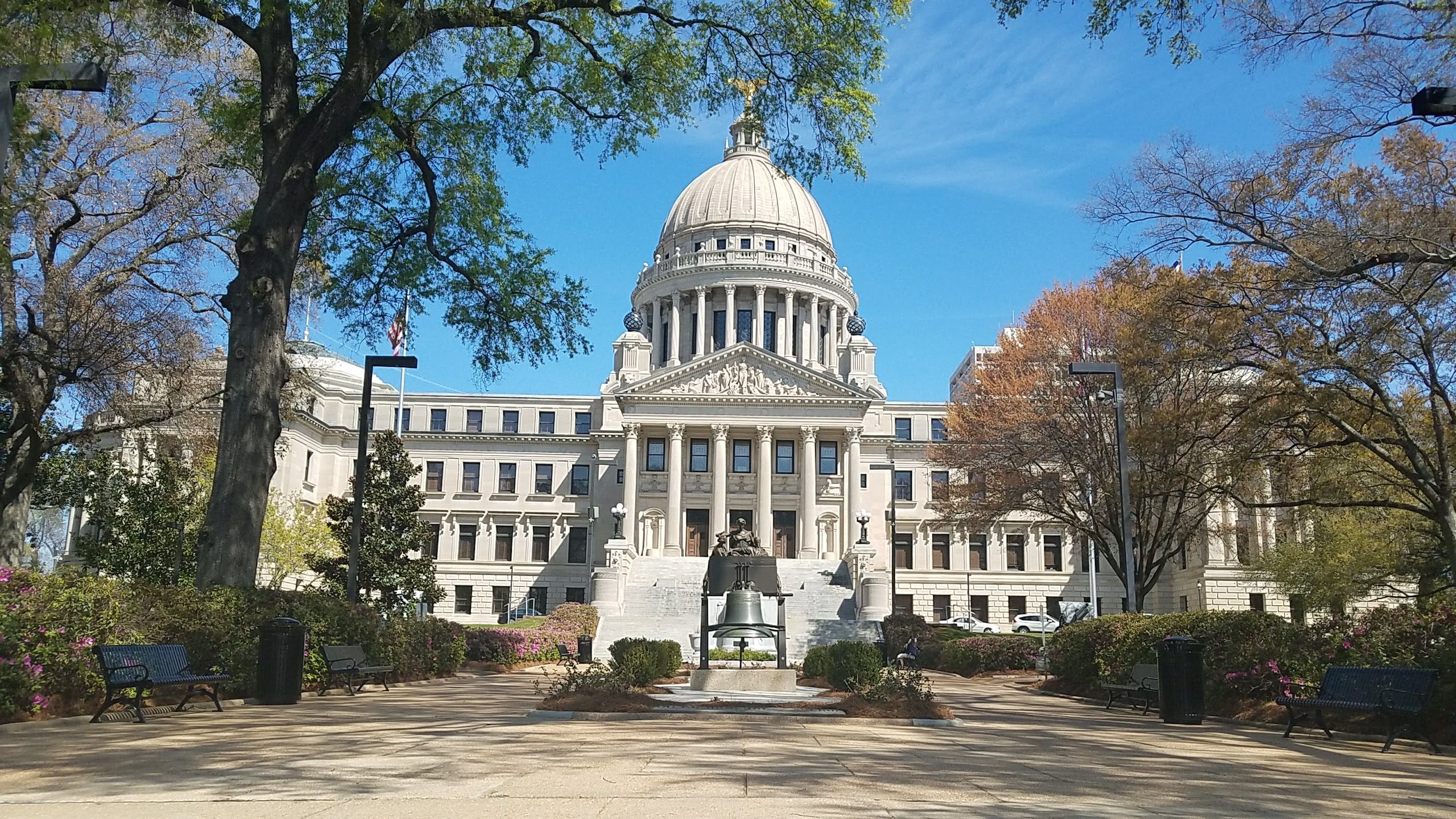
Image: Mississippi State Capitol (R.L. Nave)