


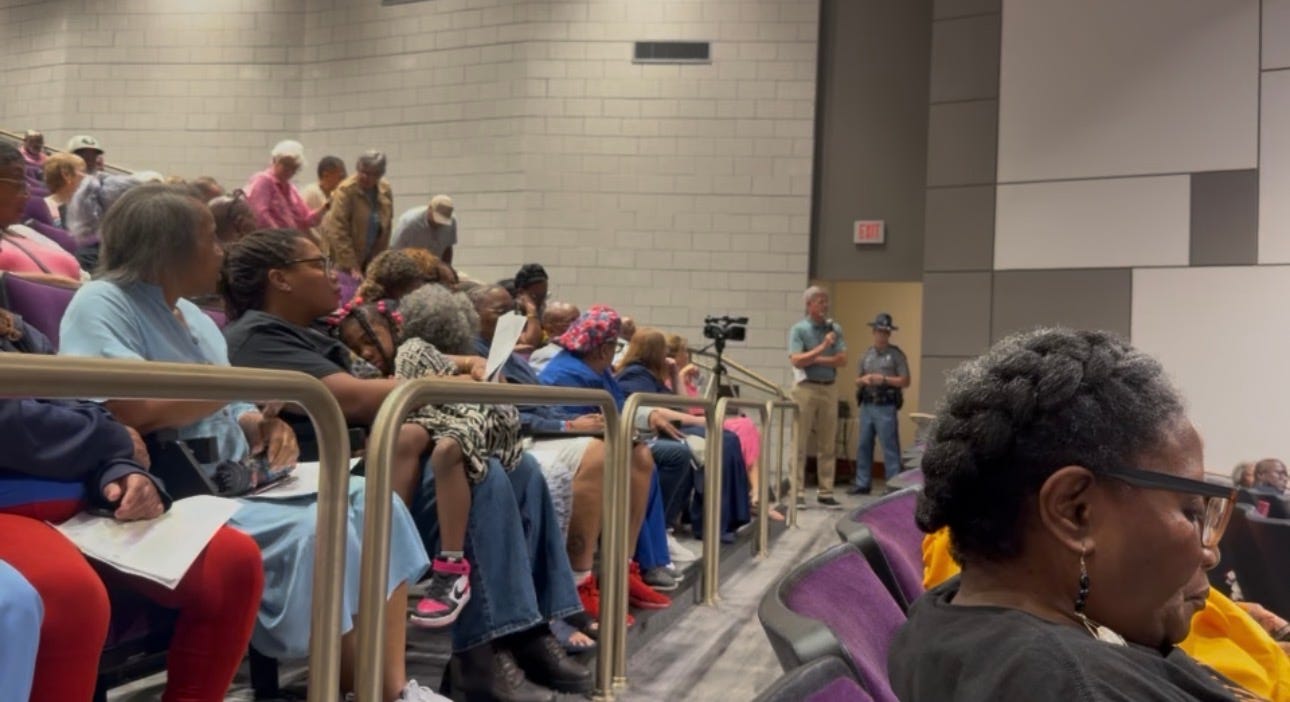
NATCHEZ, Miss.—The state’s redistricting hearings reached this Mississippi River city on Sept. 8, 2026, and the sharpest objection came from a Black legislator who told the committee its maps were indefensible even before their planned redrawing.
“This map ain’t worth a damn,” said state Rep. Robert Johnson III, the House minority leader, from the floor of the auditorium at Alcorn State University’s Natchez campus. “One congressional representative in a state that has 40 percent black population.”
Johnson said he opposed redrawing the lines now, before the 2030 census, then turned on the argument that the fight is partisan. He said he had been through three redistricting cycles and that in each of them white Democrats had told mapmakers the same thing Republicans did. “They tell you that this is about partisan politics. It’s not. It’s about race,” he said. He also disputed the premise that Black voters are the ones being packed into a single district. The 1st District is 73 percent white, he said; the 3rd, 68 percent; and the 4th, 78 percent; while the 2nd is 61 percent Black.
The hearing was the fourth of eight that the Joint Committee on Reapportionment and Redistricting is holding before the Mississippi Legislature takes up new legislative, congressional and judicial maps in the wake of the U.S. Supreme Court’s decision in Louisiana v. Callais. It was the first held at a historically Black university, on a campus in Adams County at the southern end of the Second District. State Sen. Dean Kirby of Rankin County, the chair, opened the hearing as he has at every stop, telling the audience the committee came to listen and would not answer questions, and giving speakers five minutes to talk.
Speaker after speaker asked why the state is redrawing the maps at all. Joyce Arceneaux-Mathis of the Natchez NAACP asked whether Mississippi had ever engaged in mid-decade redistricting before and what the cost would be. “They do not heal, they reopen wounds,” she said of the older maps. She reminded the committee that it was in a city where George Metcalfe, then the local NAACP president, was maimed by a car bomb in 1965.
Walter Brown, a former legislator and Adams County supervisor, told the committee that seizing an opening to redraw lines mid-decade is “just bad policy,” whichever party did it. “I don’t think in the history of Mississippi since 1817 has there been a mid-cycle, mid-decade redistricting of the legislature,” he said.
Bob Strader asked the same question and added a request. If the committee does redraw, he said, “please make the legislature, Congress look like the face of Mississippi.”
Philip West, who was at one time president of the Natchez NAACP, an Adams County supervisor for 17 years, a state representative and later mayor of Natchez, told the committee he had nearly been killed by the Ku Klux Klan in 1965. “I don’t want to go back,” he said. “We have to admit to our mistakes and overcome our mistakes.”
Ben Tucker of the Natchez NAACP said any map that reduces Black voting power is racial discrimination. “I’m not going back,” he said, “and we as a people, we are not going back.”
State Rep. Jeffrey Harness, who represents House District 85 in southwest Mississippi, addressed the committee as colleagues. He said he had read Callais, disagreed with it yet respected it as a U.S. Supreme Court ruling, and noted that the decision did not order Mississippi to redraw anything. “If the purpose is political, we should not hide a political decision behind the language of a court decision,” he said.
He noted that state Rep. Willie Bailey had told the committee at its Cleveland hearing that the decisions had already been made, said he understood why, and argued the state should be spending its time focusing on beleaguered cattle producers, rural hospitals and schools. “Donald Trump does not live in Mississippi. We do.”
One speaker argued for redrawing. James P. McKinney, a retired U.S. Army Corps of Engineers mathematician and newly elected chair of the Warren County Republican Executive Committee, upriver in Vicksburg, said the Second District was created with race in mind and has grown from 22 counties to parts of 30 as the Black-majority Delta has lost population. He said conservatives that he canvassed across the district told him not to bother voting because the seat could not be won by a candidate of their choosing. “That is a form of voter suppression,” he said, and asked the committee to redraw the maps on race-neutral criteria.
Kathleen O’Byrne of Ridgeland delivered her entire statement in the form of sarcasm, saying it would be “fabulous” for Mississippi to gerrymander itself further and running through the state’s hospital closures, dismal farm economy and high infant mortality rate as evidence of what white lawmakers had already delivered.
Kathleen Bond, director of the National Park Service’s Natchez National Historical Park, who said she has lived in Natchez more than 30 years, took the opposite view of Johnson’s regarding the existing map and said the Second District had been good for the city, because it tied Natchez to Vicksburg, Greenville and Cleveland, and noted that the need to address racial injustice had prompted a recent local reckoning of the city’s dark history as the site of the second largest antebellum slave market in the Deep South.
Mary Jane Riggode, who said she taught at the segregated Sadie V. Thompson school in Natchez before it was integrated and whose father served in the legislature in the 1920s and 1930s, asked the committee why it was meeting at all. “Why, why waste one dime on a stupid redistricting in the middle?” she asked. Committee members did not respond, in keeping with Kirby’s comment about members not taking questions.
Kelvin Butler, a former state senator from southwest Mississippi, closed the testimony against redrawing. “The district belongs to the people, not the politicians,” he said.
The committee then adjourned. Four hearings remain, in Meridian on Sept. 10, Hattiesburg on Sept. 17, Gulfport on Sept. 22 and Jackson on Sept. 24. Written comments may be sent to the committee’s counsel, Ted Booth, at ted.booth@peer.ms.gov.
Image: Attendees at the Natchez hearing (credit Derrion Arrington)
