


NATCHEZ, Miss.—Until July, it was easy to miss the Forks of the Road.
What was once a massive antebellum human trafficking hub was lost amid a jumble of nondescript buildings—an empty church, rundown houses, modern apartments and a muffler shop—or buried beneath advancing kudzu vines.
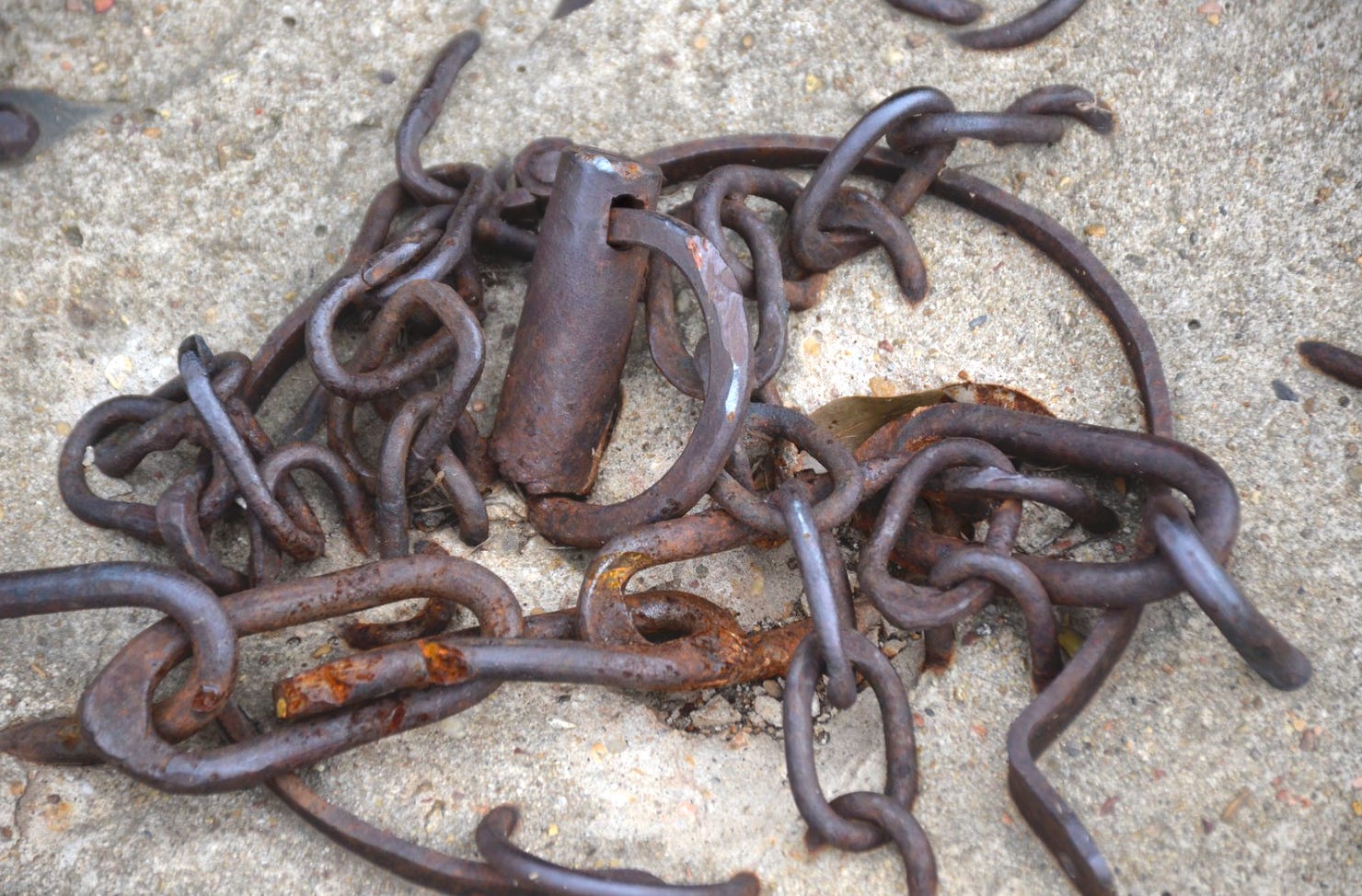
Commanding far more attention were three nearby antebellum mansions that beckoned tourists with imposing colonnades and lush, landscaped grounds. The only visible reminders of the Deep South’s second largest slave market were a weathered kiosk, a few wayside markers and, for anyone who took the time to explore, symbolic iron shackles cemented into the ground. Most people drove past without noticing.
“Easy to miss,” observed local activist Ser Seshsh Ab Heter-C.M. Boxley, who spearheaded a decades-long campaign to commemorate the slave market. “The signage is just not there. The promotion is not there.”
Boxley, 87, said he felt a calling to focus more attention on the market known as the Forks of the Road, and after decades of twists and turns, the National Park Service this summer unveiled a new set of historical markers as part of an ambitious long-range plan to develop the site and make its wrenching story impossible to ignore.
The new displays are only “the tip of the iceberg,” said Kathleen Bond, superintendent of the Natchez National Historical Park, which includes the Forks of the Road among five local historic sites. The next step will be to install exhibits in the former church, which has been renamed Freedom Hall.
The project represents a radical departure from the city’s traditional approach to highlighting its antebellum history.
“Natchez has been so cramped by the mythology,” Bond observed. Historically, local movers and shakers romanticized the Old South at the expense of other sites that embodied alternative stories. Tour guides typically glossed over the lives of enslaved people who enabled construction of the city’s fabled mansions and the luxurious lifestyles of their owners, which suited some visitors only too well but put others off.
As Boxley put it, “I came to think the powers-that-be were not capable of dealing with such a subject.” He said he took on the task of promoting the Forks of the Road out of a sense of responsibility toward “the ancestors,” whose voices were largely suppressed. “My reason for doing it was to have an equalizer to all the presentations of history that were prevailing in Natchez,” he said.
Bond described the Forks of the Road as “a site of conscience” and said the park service’s first priority is to tell the city’s story truthfully, and more fully, and to provide what she calls “a major corrective to our historic record.”
Hundreds of thousands of enslaved people were bought and sold at the Forks of the Road from 1833 until the market was demolished by occupying Union troops during the Civil War. Only one slave market in New Orleans eclipsed it in size. Parts of its extensive slave pens were repurposed for wartime military barracks and construction of a handful of later area houses. Over time, commercial development and roadbuilding projects overshadowed or erased most of what was left.
In an ironic twist of fate, some of the soldiers who participated in the market’s destruction had been sold into bondage there. Their pension records, as veterans of what was known as the U.S. Colored Troops, inform the texts of the new markers unveiled in July.
Perhaps unsurprisingly, given the region’s long and conflicted racial history, the project has had its detractors, but it has also garnered notable support, including from the late U.S. Sen. Thad Cochran and current U.S. Sen. Roger Wicker, who spoke at a ceremony announcing the park service’s first acquisition, a small parcel donated by the city of Natchez. Also on hand that day were U.S. Rep. Michael Guest and Mayor Dan Gibson.
The project comes at a time when the Trump administration seeks to whitewash the nation’s slave history. Last year, in a fit of pique, the president complained that the Smithsonian museum was “OUT OF CONTROL” in part because it promoted exhibits that focused on “how bad slavery was,” which, in his view, were distasteful.
Human enslavement was obviously beyond bad, but the effort to commemorate the Forks of the Road benefited from the strategic support of the state’s congressional delegation. Cochran, in particular, was instrumental in getting the necessary congressional authorization and funding.
The main question was how best to address such a malevolent history. The park service’s answer was head-on.
Starting in July 1863, soldiers in the U.S. Colored Troops were stationed at the Forks of the Road and nearby Fort McPherson. When the park service began deliberating how to interpret the site, its chief Natchez historian, Jeff Mansell, scoured the Black soldiers’ pension records for relevant accounts and ended up finding a motherlode.
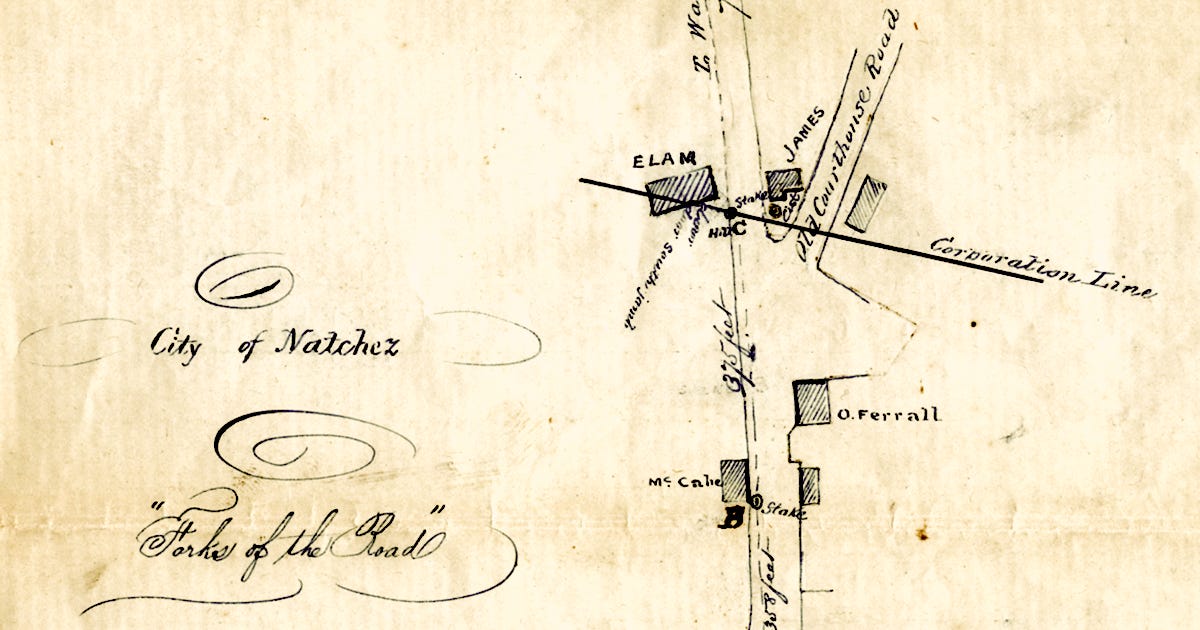
The Forks of the Road was not a single market but a trading district straddling the eponymous intersection. The records of what transpired there evoke intense societal and individual trauma, the consequences of which still ripple through American life today. At its core are two profoundly different experiences: of whites who grew fabulously wealthy off human enslavement and of enslaved people who had almost no power to control their own destinies. As one park service consultant noted in its report, the market represents a time when “the rights of African-Americans were at absolute zero.”
Bond said that when people ask her what’s most significant about the antebellum history of Natchez, “I start with the opening line of A Tale of Two Cities: ‘It was the best of times. It was the worst of times.’ Because it was two different worlds.” For too long, she said, the city focused its preservation and tourism efforts on a sanitized version of only one of those worlds—that of wealthy slaveowners. It was considered “gauche” to talk about the darker side of the city’s past. “That would have made people uncomfortable,” she said.
Those oversights both shortchanged history and limited the city’s tourism market to a comparatively narrow and now-declining demographic.
Bond credits Boxley with galvanizing support for commemorating the site, but he met his share of resistance, including from one property owner who “fought me tooth and nail,” he said. In the early years, the city’s former mayor and city council were unreceptive and returned a third of a $200,000 grant the Mississippi Department of Archives and History had awarded to buy part of the site, Boxley said. What he described as “the old boy school” at the National Parker Service initially seemed underwhelmed by his idea. Boxley earned a reputation as a burr under everyone’s saddle. Why obsess over this troubling, misbegotten site?
“The breakthrough,” Boxley said, “came in 1998 when the National Park Service had to implement the Underground Railroad Network to Freedom program,” he said. “After that, the park service started paying attention.” The same year, the state installed the first historic marker. But the full payoff was still decades away. “They plan and they plan and they plan and they plan,” Boxley said. “And finally, somewhere down the road, something happens.”
That something has now happened.
Forced laborers were bought and sold at the Forks of the Road during the antebellum cotton boom that began in the 1830s, including many who joined the Union army after being freed in 1863. Yet, owing to emancipation and the market’s destruction by Union troops, one of the city’s most lucrative and depraved historical episodes was afterward consigned to the archives. That is where Mansell and intern Destiny Wiley Yancey found the pension records—in the bowels of the National Archives in Washington, D.C. Pension applications filed by veterans and their heirs include detailed descriptions of everything from births and deaths to the experiences of the enslaved on area plantations and elsewhere. The records represent a detailed yet narrowly focused slice of life related to the Forks of the Road, which posed both opportunities and challenges.
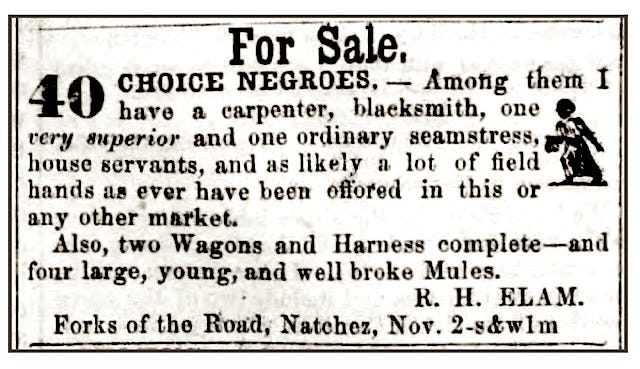
Rev. Tracy Collins, who operates Rev’s Natchez Tours, an alternative to the city’s more conventional moonlight-and-magnolias excursions, said that he welcomes the commemoration of the Forks of the Road but is less enthusiastic about what he sees as an overemphasis on postwar soldiers’ accounts. Many details highlighted on previous markers that Boxley had installed at the site, which the park service has since removed, have been lost in the current telling, Collins said. Those include damning newspaper ads published by slave traders, revealing letters they exchanged, and details about the humans they trafficked.
“There were ads urging planters to buy more slaves to grow more cotton to make money to buy more slaves to grow more cotton,” Collins said of the compounding role the Forks of the Road played. “There were notices about runaway slaves. Without those, it feels watered down.”
One justification for focusing on the pension records is that they are at once illuminating and readily available. But Collins pointed to a plethora of books and articles that cite other relevant historical sources. A 2015 Smithsonian article about the slave trade by historian and author Edward Ball tells a larger tale, focusing on the movement of forced laborers from the Eastern Seaboard to slave markets in Natchez and New Orleans, and cites a manifest that Boxley acquired which lists more than 100 people transported in chains to the Forks of the Road. The list, which notes the enslaved people’s names, heights, ages, gender and skin coloration, was basically a detailed product inventory.
Collins said three of the main slave traders who operated at the Forks of the Road—Isaac Franklin, Rice Ballard and John Armfield—“were writing letters between Natchez and Virginia and New Orleans,” which include shocking references such as to the marketing of captive women as sex slaves. Franklin, he said, “was the Jeffrey Epstein of the day. We’re talking about children. Mulatto girls and boys were the preference of wealthy planters. You got that much money, there’s no consequences for your behavior.”
The park service’s official assessment of the Forks of the Road notes that Franklin & Armfield was the largest slave trading firm in the United States and from 1828 to 1837 alone moved an estimated 10,000 enslaved people to Natchez from Virginia and Maryland. The firm owned or leased properties in Natchez, New Orleans, Baltimore and Alexandria, Virginia, and according to the report, letters between Franklin and Ballard record numerous slave deaths from disease that were viewed merely as a cost of doing business. The report notes that the Forks of the Road was responsible for “a significant portion” of the increase in enslaved populations in Mississippi and neighboring Louisiana from about 100,000 in 1820 to well more than 750,000 in 1860, and estimates the number sold at the Natchez market was in the hundreds of thousands.
Bond said the pension records of the U.S. Colored Troops are invaluable for zeroing in on a subset of the population of enslaved people with ties to the Forks of the Road, and that future exhibits will expand the scope of stories.
There has been some pushback against highlighting the site, whatever the sources. Gene Williams, owner of the muffler shop that occupies the site of one of the larger slave pens, argues in the recent documentary film “Natchez” that it makes no sense to draw attention to the site. “I don’t know what the Forks of the Road is supposed to prove,” Williams says. Slavery, he says, is “over and done with.”
Which is true. Yet supporters argue that showcasing the site is a necessary acknowledgement of the human suffering that took place there on an unimaginable scale, and that in a state that still celebrates Confederate Memorial Day, the argument could be made that the distant past is far from over and done with.
Mississippi has long been on the front lines of American history when it comes to race, but the prevailing historical narrative has often diminished, distorted or omitted Black perspectives. As Collins put it, “Y’all are telling the story from white people’s perspectives. It’s a subtle exclusion but it’s still there.”
The new markers provide a rare, if comparatively limited window into the history of enslavement through the eyes of people who experienced it. Significantly, most of the key characters in the pension records are fully identified, which Mansell noted is rare in the realm of antebellum African American genealogy and makes it possible to say their names. It also makes the human history of the Forks of the Road more vivid and less abstract.
Natchez is the oldest city on the Mississippi River and derived its astounding antebellum wealth from slavery, both for cotton production and through the sale of forced laborers. It claimed more millionaires per capita than any other U.S. city before the Civil War. The homes the slaveowners built are undeniably stunning and have been the chief tourism lure. Yet there are those glaring historical oversights.
Before the National Park Service stepped in, Boxley and a group called the Friends of the Forks of the Road Society tended to a small portion of the site next to the church and, previously, to a bar that flew a Confederate flag over its door. Marking and maintaining the plot of land was a labor of love, but with a limited audience. Its comparative obscurity was a sore subject.
Boxley began lobbying for greater recognition in the mid-1990s, when he returned to Natchez, his hometown, after having lived for decades in California. Around that time, he gave himself an African-inspired name alongside the one he was assigned at birth. As part of his effort, Boxley sought to have the site listed in the National Register of Historic Places, but failed because the U.S. Department of the Interior concluded its historical integrity was too compromised. A similar attempt to have it designated a National Historic Landmark foundered in the face of property owners’ objections. The city of Natchez eventually designated it a local landmark, as far as that went.
In the early stages, Boxley saw to the installation of a handful of markers and chains supplied by the late Cavett Taff, a historian at the Mississippi Department of Archives and History. Then, in 2005, he convinced Cochran to support the effort and the senator concluded the park service was the logical custodian, given its operation of the Natchez National Historical Park, which includes the antebellum estate known as Melrose; the William Johnson House, built by a free man of color before the Civil War; Fort Rosalie, where the Natchez Indians annihilated a colonial French garrison in 1729; and a visitors’ center near the Mississippi River bridge along with an area designated a federal preservation district. It took until 2017 to get congressional approval to establish a Forks of the Road commemorative site within a boundary encompassing a little more than 18 acres. Additional funds and expertise came from the National Park Foundation, the Trust for Public Land and the Archeological Conservancy.
The first step in developing the site was to highlight its history in a more visible way, and the decision was made to use the trove of documents that Mansell and Yancey unearthed. Bond said the park service plans to continue acquiring property from willing sellers within the authorized boundary and hopes to build a museum. Mansell would also like to see a genealogical center. The result will be a powerful counterpoint to the prevailing local narrative. In a Black-majority city with a tourist economy built around antebellum grandeur, the imprimatur of slaveowners is everywhere you look. Yet, as Collins pointed out, in addition to painting an incomplete picture that approach tapped what is today a declining tourism market.
“Natchez tourism has dropped 40 percent in the last six or seven years,” Collins said. The reason, he suggested, is that tourists attracted to the grand lifestyles of slaveowners are aging out. “Millennials are not as interested in history, and the older people here are telling the same old story and kind of refusing to diversify.” In that context, the stories associated with the Forks of the Road represent a vast, largely untapped historical resource and tourism opportunity.
Among the documents that Mansell and Yancey uncovered was a letter penned by an unidentified writer in the fall of 1863, when members of a Wisconsin infantry and the newly formed 58th Regiment of the U. S. Colored Troops received orders to tear down the slave pens for lumber to build military barracks. The letter, from a Wisconsin soldier to the Milwaukee Sentinel newspaper, noted: “Our first quarters were in a long range of barracks used for a number of years as slave pens. Very many of the men composing the regiment had been sold in them; brought from Kentucky, Tennessee, Virginia and other slave States, in large gangs ironed, they were placed in these dungeons until a sale could be effected. These buildings were situated in outskirts of the city and owned by an Irishman, the worst secessionists [sic] in the whole country.”
The writer observes that the order to demolish the pens “was hailed with the wildest enthusiasm by these men who had been chained, gagged and whipped, and suffered tortures unutterable within these same walls, and through that long night they worked with a terrible earnestness and the morning saw the slave pens of Natchez leveled to the ground, never, it is hoped to be again reconstructed. During this work many a thrilling remimbrence [sic] was recalled of the cruelty of traders, of sad partings of husband and wife, of inhuman fathers selling their own children, and a thousand other incidents illustrating the detestable [state] of society at the South.”
The Irishman cited in the letter was John O’Ferrall, one of several traders who operated stands at the Forks of the Road. O’Ferrall’s family home, built after the war, survives on O’Ferrall Street within the larger park service site boundary, yet the park service plans for the home “not to be there,” Bond said, meaning it will be moved or razed. She said the house, which the park service assessment concluded could be eligible for designated historic status, is not integral to the Forks of the Road story and stands on a site that is comparatively undisturbed and could yield a major archaeological windfall. It is also possible there are graves beneath or around the house, she said, adding that during a survey using cadaver dogs, “When the dogs went around that house, they went crazy.” Such graves could contain the remains of slaves, but it is more likely they would be for U.S. Colored Troops, Bond said, given that, “Many slave traders just threw dead bodies in the bayous.” Slave corpses were also dumped in a moat that once surrounded the site of Fort Rosalie, she said.
“Turnover” was the word traders used when referring to the deaths of the enslaved, illustrating a disregard for human lives that Bond said was rooted in “brutal capitalism and white supremacy.”
Acknowledging the comparatively limited sources used for the new interpretive markers, Bond said they represent only the start. The next step will be to design and install exhibits in the former church, Freedom Hall, which stands on the spot where U.S. Colored Troops were recruited into the Union army. “We would like to build a museum where the O’Ferrall house is,” she said.
Other long-range plans include returning as much as possible of the landscape to a closer approximation of its period condition, which would require significant property purchases and demolitions. There are no plans for reconstructing slave pens or other market structures, Bond said. All the relevant original structures are gone, including a slave hospital used by slavers nearby, the site of which is today under a former car dealership. Yet a portion of an original roadway that comprised part of the physical fork of the roads remains intact just north of the core parcel, and a postwar brick bridge on its track across Spanish Bayou will be bolstered and preserved, though the bridge, like the O’Ferrall house, was not part of the original Forks of the Road landscape.
Among the new interpretive panels is one that highlights the story of a formerly enslaved woman named Elzira Bright, who was born in Kentucky and wrote in her application for her late husband’s military pension, “I was sold to a negro trader when I was 19 years old and he brought me to Natchez with a gang of a hundred head and I was sold at the forks of the road to Faultneroy of Jefferson County and lived on his place until the war came.” Frank Faultneroy, a cotton planter near Church Hill, also owned her husband, Allen Bright, who joined the U.S. Colored Troops when the Union army arrived.
Slave sales were still being held at the Forks of the Road a few months prior to the Union occupation, but as another interpretive panel notes, “The arrival of Federal troops brought freedom to the tens of thousands of enslaved people in the Natchez District. Freedpeople (persons recently released from slavery) flocked into town from the surrounding countryside.” Many of the refugees settled at the Forks of the Road near an encampment of U.S. Colored Troops. Today, the neighborhoods surrounding the site remain predominately Black.
During his research, Mansell located a few Natchez descendants of soldiers who served in the U.S. Colored Troops and remained in the city after the war. He said the documents are particularly valuable for Black genealogists, given that records of such family lines typically reach dead ends prior to 1870, when people of color were first included in the U.S. Census. To go further back usually requires perusing tangential documents like the wills of slaveowners that cite enslaved workers, and even then, names and other details are often left out.
The temptation, under the circumstances, is to disappear down the rabbit hole of those voluminous, illuminating pension records, which is what worries Collins. But, as Mansell noted, the stories always circle back to the Forks of the Road. Among the soldiers documented in the pension records is Michael Bearden, who enlisted in the U.S. Colored Troops at the Forks of the Road. Another is Thornton Holmes, who reportedly met his future wife and her mother in the Natchez “corral.” Then there is Martin Jenkins, who met his own future wife on a slave ship transporting them from Virginia to Natchez, after which the couple married at the Union army’s nearby Fort McPherson. Featured in one of the new markers is Matilda Morris, married by her owner to Dandridge Morris, who joined the U.S. Colored Troops, then died of measles in the military barracks at the Forks of the Road. Matilda Morris recalled caring for her sick husband for eight days at the site before he died.
Among the other documentation that could be used to expand the site’s interpretive scope are municipal and county court records, newspaper articles, letters, wills, diaries, corporate ledgers and books that cite source materials in reference to the Forks of the Road.
Prior to 1832, slave trading took place at numerous locations around Natchez, but that year the fear of a cholera epidemic prompted officials to force the traffickers outside the city proper. Cholera is a lethal, highly communicable disease and a public outcry followed the discovery of hastily discarded bodies of slaves who had contracted it during passage to Natchez aboard overcrowded ships. Though some sales afterward continued to take place in town, the majority of slavers set up business at the Forks of the Road, at the intersection of what is today Liberty Road and Devereux Drive, a mile east of downtown, near the original terminus of the Natchez Trace, down which slaves bound in groups called coffles were marched in journeys of up to 1,000 miles.
Writer Joseph Holt Ingraham, who visited the market in 1834, described it as a group of “rough wooden buildings” enclosing a central courtyard where slaves were sold individually rather than being auctioned en masse. At the time of his visit, “A line of negroes… extended in a semicircle around the right side of the yard. There were in all about forty. Each was dressed in the usual uniform of slaves, when in market, consisting of a fashionably shaped, black fur hat, roundabout and trousers of coarse corduroy velvet” with vests and white cotton shirts. “This dress they lay aside after they are sold, or wear out as soon as may be; for the negro dislikes to retain the indication of his having recently been in the market,” Ingraham writes. “With their hats in their hands, which hung down by their sides, they stood perfectly still, and in close order, while some gentlemen were passing from one to another examining for the purpose of buying.” Ingraham notes the importance to the enslaved of attracting a “good” buyer who would keep their families together and not abuse them, “for every stranger may soon become his master and command his future destinies.”
Ball cites a local resident, Felix Hadsell, describing a group of slaves who were similarly gussied up for presentation. The men, Hadsell recalls, were “dressed in navy blue suits with shiny brass buttons” and made to march in circles before prospective buyers. “The women wore calico dresses and white aprons” with pink ribbons around their necks and their hair carefully braided. The entire display was strangely silent. “No commands given by anyone, no noise about it, no talking in the ranks, no laughter or merriment,” Hadsell observes. After an hour or so of this, the enslaved stood in rows on long porches, sorted by sex and size, in descending order of height and weight—a curated and choreographed collection of human beings that Ball notes increased the likelihood that separately-positioned children would be sold away from their parents.
Buyers then moved inside to inspect individual slaves and often required them to undress while studying their appearance and posing questions about their work histories. Inspections of the slaves’ bared backs “made or broke the deal,” Ball writes. “Many people had scars from whipping. For buyers, these were interpreted not as signs of a master’s cruelty, but of a worker’s defiance. A ‘clean back’ was a rarity, and it raised the price.”
Collins cited other accounts which indicate that the enslaved were sometimes stripped bare during public presentations and the skin of strong, young males greased with pig fat “to delineate their musculature.” It all depended on what kind of task the person was being bought to do.
William Johnson, the free Black man who owned slaves and whose home is now maintained by the park service as a museum, also reports visiting the Forks of the Road in a diary entry from May 14, 1841. “I rode out this afternoon to the Forks of the Road to try and swop [sic] Stephen off for someone else, but could find no one that I like,” Johnson writes, with a casualness that is unsettling to modern sensibilities.
Other accounts note that white Natchez residents sometimes visited the Forks of the Road to witness what they saw as an entertaining spectacle.
During the period, enslaved men, women and children were transported to Natchez for sale from older slave states including Virginia, Maryland, Kentucky and the Carolinas, partly because the lower Mississippi River valley was booming following the development of Eli Whitney’s cotton gin and the outlawing of the transAtlantic slave trading in 1808. The domestic slave trade was a lucrative business and grew more so in the decades leading up to the Civil War. According to this site, the average price for a young adult in the 1820s was $400, but by early 1861, prices for field hands at the Natchez market were advertised from $1,600 to $1,650, or about $50,000 to $65,000 today (depending on the calculation used).
The park service’s site assessment notes that the enslaved were brought to Natchez from the Eastern Seaboard by ship, riverboat and overland via the Natchez Trace, and that about 500 people were held in the pens on an average day. Typically, the trafficking began with headhunters rounding up “human cargo” from plantations across the Upper South. Once between 100 to 200 people had been bought, they were chained together in coffles and forced to march South or transported by boats. Those who were loaded onto steamboats were said to be “sold down the river.” The coffles were driven by armed men with whips on horseback and the sales documented by inhouse accountants and clerks. The assessment notes that letters between Franklin and Armfield “describe obscene and brutal acts of atrocity, as they joked about regularly raping the women they bought and sold.” Some of the names in Boxley’s manifest are displayed at the Natchez National Historical Park visitor center “but deserve to become a prominent part of interpretation at the [Forks of the Road] site itself,” the assessment notes.
The assessment references an author and former enslaved worker, William Wells Brown, who describes landing at Natchez on a steamboat with his owner, identified only as Mr. Walker. The slaves were transported to pens and kept there for a week, during which several were sold. Brown writes that Walker’s slaves were better fed en route than slaves generally were in Natchez, “so far as my observations extended.” The steamboat later traveled upriver to St. Louis, and Brown describes the process of buying a “cargo of human flesh” over the course of two months and on the journey back downriver Walker fed them large amounts of food to “fatten them up” for sale. The men’s beards were shaved and the hair of older slaves was died black to make them look younger.
Females marketed as sex slaves for wealthy planters were frequently raped by slave traders multiple times before being sold, the assessment notes. “The rape of females at Forks of the Road was monstrous,” Collins said. Males were also sometimes raped to demonstrate slaveowner power, he added.
Slave traders referred to sex trafficking as “the fancy trade” and the female victims as “fancy girls.” Most accounts note that the women were almost always of mixed race, some of whom could have passed for white, and sold for four or five times the amount of field laborers, according to an article in American Historical Review. Women were frequently traded between members of Franklin’s firm for their own use.
In his Smithsonian article, Ball recounts the observations of a man who came upon one of trader John Armfield’s slave caravans on its way to Natchez and described him as “a raw man in nice clothes.” Armfield comes across in the account as a caricature of a loathsome villain, dressed in a large white hat, striped pants and a long dark coat, sporting a mustache-less beard, who was “sordid, illiterate and vulgar,” with “overpowering bad breath, because he loved raw onions.”
The traders were often looked down upon at the time as a necessary evil, but they grew fabulously wealthy from their trafficking and seem to have been perversely proud of their work. Franklin owned three ships for transporting slaves south, one of which he named for himself, with a masthead carving of his own head and torso attached to the prow. He also built a grand mansion in Tennessee on a 2,000-acre plantation that is now a historical site, the owners of which reportedly do not cotton to the idea of talking about how he made his millions.
Collins said that when he brings up the subject of slave rape to people on his tours, he tries to engender empathy. “I ask women what they think the relationship was like between a white woman and a Black woman her husband is having sex with more than her, and she’s powerless to do anything about it. What was the relationship like between those two women?” He said highlighting the Forks of the Road lends itself to such reflection.
“I’m a storyteller, not a historian, Collins said. “There’s a scholarly way to look at history and there’s a way to look at the realities of human lives in history.”
He recalled that after the park service took over the site, the agency enlisted architecture students to submit design proposals as part of a competition. The students built models that, in Collins’s view, were “too pretty. That place was ugly. It was horrible. The presentation needs to include that horror.” He noted that hundreds of thousands of people “suffered and bled and anguished at this place. I want you to feel that as much as you can.”
In his tours, Collins drives people around Natchez and the surrounding countryside in a van, giving them a synopsis of the entire local history, starting with prehistory and making its way to the modern era. There are three different types of tours, two of which include stops at the Forks of the Road, which he said is the site that elicits the strongest reactions. Occasionally, people on his tours complain that he places too much emphasis on slavery, Collins said, as if it’s a matter of letting bygones be bygones. He tells them it’s important to recognize how profoundly wrong things can go in the world and how best to respond when that happens. “I ask people how they can change the world,” he said.
All of which, Collins said, reinforces the importance of amplifying the stories associated with the Forks of the Road.
Boxley said that when he hears people say it’s time to move on from talking about slavery, his response is, “It’s not your call.” The importance of the Forks of the Road, he said, is not simply local. “It’s national, it’s international. You can’t ignore the Forks of the Road. The ancestors will not allow it.”
Prior to reading the book The Black Experience in Natchez, 1720-1880 by historian Ronald Davis, Boxley said he had not heard of the Forks of the Road, though he had grown up nearby. In 1995, when he was planning to move to Africa, he returned from California to Natchez to store his possessions, and while meditating, “The thought came: Who would tell the ancestors’ story? Who would stand up for them and fight for them? My response was: I will. The Forks of the Road site met that requirement. And so, I embarked on this campaign.”
For Collins, it’s about opening people’s eyes.
“At the Forks of the Road, I’ve had white women get down on the ground and sob,” he recalled. “I’ve had men cross their arms in a defensive posture, walk around while I’m talking, tell me you need to let this go. It’s been a myriad of different reactions, but it always evokes some kind of emotional response.” Though there is little physical evidence to see or touch, Collins said, “It’s a powerful place.”
Image: Slave trader ad (Creative Commons); map of Forks of the Road (courtesy National Park Service); chains at site (via Flickr, credit Earl Leatherberry)
Mansell going to the pension files is the part of this to copy. A Civil War pension application is a federal record in which a formerly enslaved woman like Elzira Bright narrates her own sale in her own words, and that is how the names on the new markers run back past 1870.
Very well written article. I agree. Those mansions didn't get built by the owners' hands. That is typically glossed over.
The only mention of Black slaves was the exception of William Johnson, a freed man. He was wealthy, owned 2000 acres, and a barber shop. As if every person of color had the same opportunity! In a paradox, he owned slaves himself.
His home is preserved by the National Park Service and had just been opened to the public in 2005 when we visited. LSU digitized his diary which covered the last 16 years of his life.