


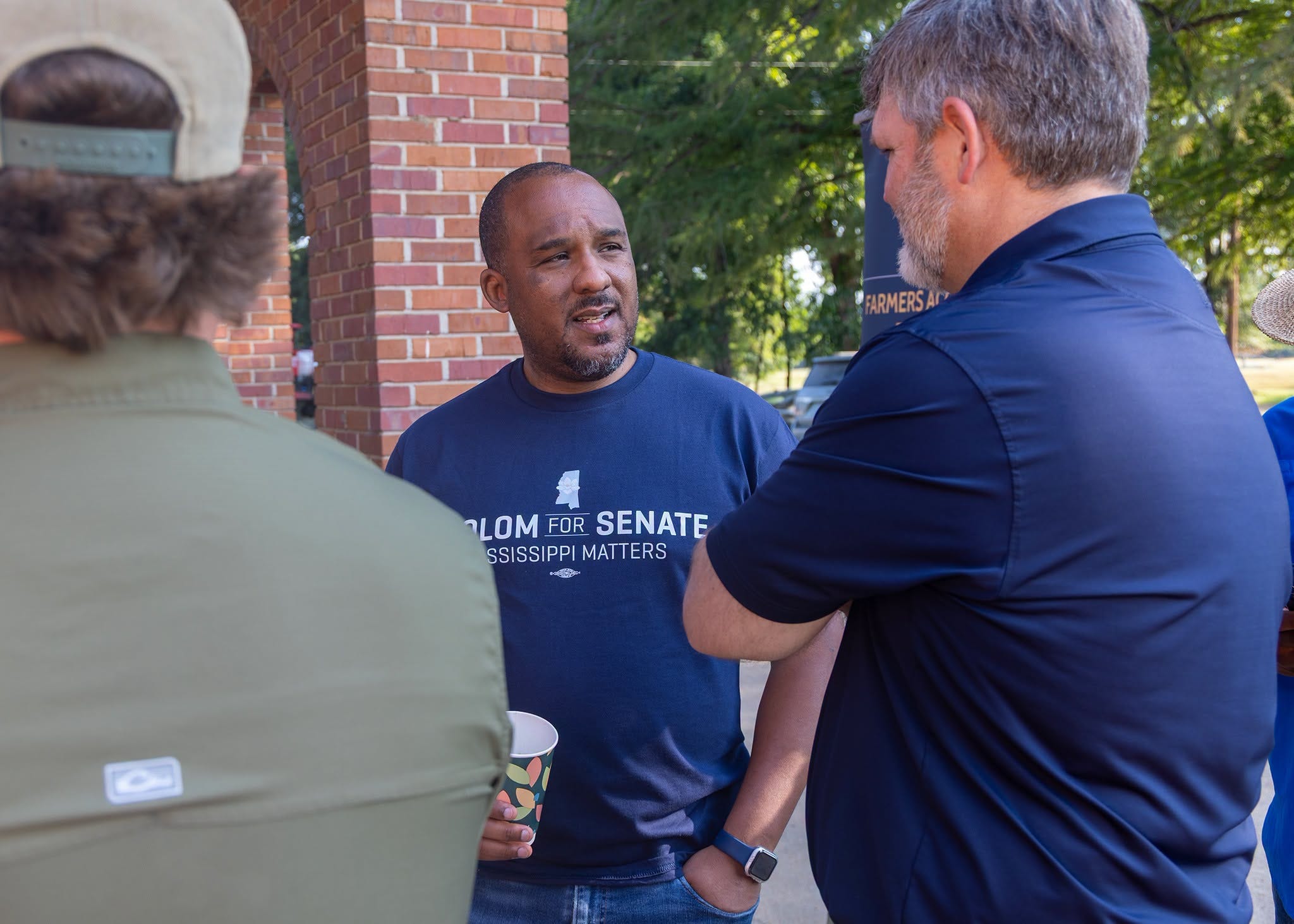
Scott Colom, the Democrat challenging U.S. Sen. Cindy Hyde-Smith this year, is running well to the right of his national party at a moment when the party is moving in the opposite direction. His campaign says he opposes abolishing ICE and supports securing the border, cutting taxes for police and teachers, and a two-state solution in the Middle East.
Colom’s campaign manager, Gerard Henderson, described him to The Mississippi Independent as “common-sense, pro-law-enforcement” and pointed to the three terms voters have given him as a local district attorney.
That positioning contrasts with a national Democratic Party that has drifted leftward. Since Zohran Mamdani won the New York City mayor’s race in November, candidates backed by the Democratic Socialists of America have gained ground in primaries around the country, among them Abdul El-Sayed, running for a U.S. Senate seat in Michigan.
The Democratic Socialists movement has almost no footprint in Mississippi. It lists a single chapter in the state, in the Jackson area, and no Mississippi Democrat in office is aligned with it.
Henderson brushed off the comparison, saying a Democratic primary in Michigan matters less to Mississippians than Hyde-Smith’s record, which he has attacked over healthcare and her vote to confirm U.S. Attorney General Todd Blanche, who refused to promise not to use the U.S. Department of Justice to target people whom the president considers his enemies.
Holding the national party at arm’s length is the standard bet for a Democrat seeking statewide office in Mississippi, and it has a long history. The state has not elected a Democrat to the U.S. Senate since 1982. To run at all in one of the most Republican states in the country, Democratic candidates have positioned themselves well to the right of the national party, particularly on guns, the border and law enforcement.
Mike Espy, the last Democrat to come close, made that bet twice. A former congressman and U.S. agriculture secretary, Espy challenged Hyde-Smith in 2018 and again in 2020 on what observers across the spectrum called a moderate, commonsense platform—the same strategy Doug Jones had used to win a Senate seat in Alabama. Espy drew 46 percent in 2018, a stronger showing than Mississippi Democrats had managed in years. He lost by more in 2020.
Espy’s races also showed the ceiling on the strategy. However he positioned himself, Republicans tied him to the national party. In Mississippi, as one account of his 2020 campaign put it, any Democrat, “even one with moderate platforms,” gets strategically paired with national progressives who poll poorly among the conservatives and independents that a Democrat would need to win. Colom faces the same bind, and a national left more visible now than it was six years ago gives his opponents more to tie him to.
Colom, the district attorney for Lowndes, Oktibbeha, Clay and Noxubee counties, would be the first Black senator from Mississippi since Reconstruction if he won. The seat has not been competitive for a Democrat in modern times, and nonpartisan handicappers rate the race Republican. Colom, on the other hand, points to the SPLC Action Fund/Impact Research poll from mid-April, which had him within 3 percentage points of Hyde-Smith (and ahead 41–38 in a three-way race when voters had full candidate info). Hyde-Smith’s unfavorable rate in that poll was 55 percent.
Colom’s path runs through the same ground Espy worked: an appeal to Black voters and to the slice of white moderates willing to split a ticket, built on his own record and not the national party’s. The path is complicated by the presence of independent candidate Ty Pinkins, who could split the Democratic vote.
Image: Scott Colom meets with unidentified voters (via his campaign’s Facebook page)

Trump won Mississippi by 217,366 votes in 2020, and on the same ballot, CHS beat Mike Espy by only 130,820 votes. To me that says the Espy campaign did an outstanding job competing against CHS but not enough to overcome the enthusiasm of voters who went to the polls to support Trump. This year, Trump isn't on the ballot to carry CHS across the line, and he has a negative approval rating in MS now anyway.