


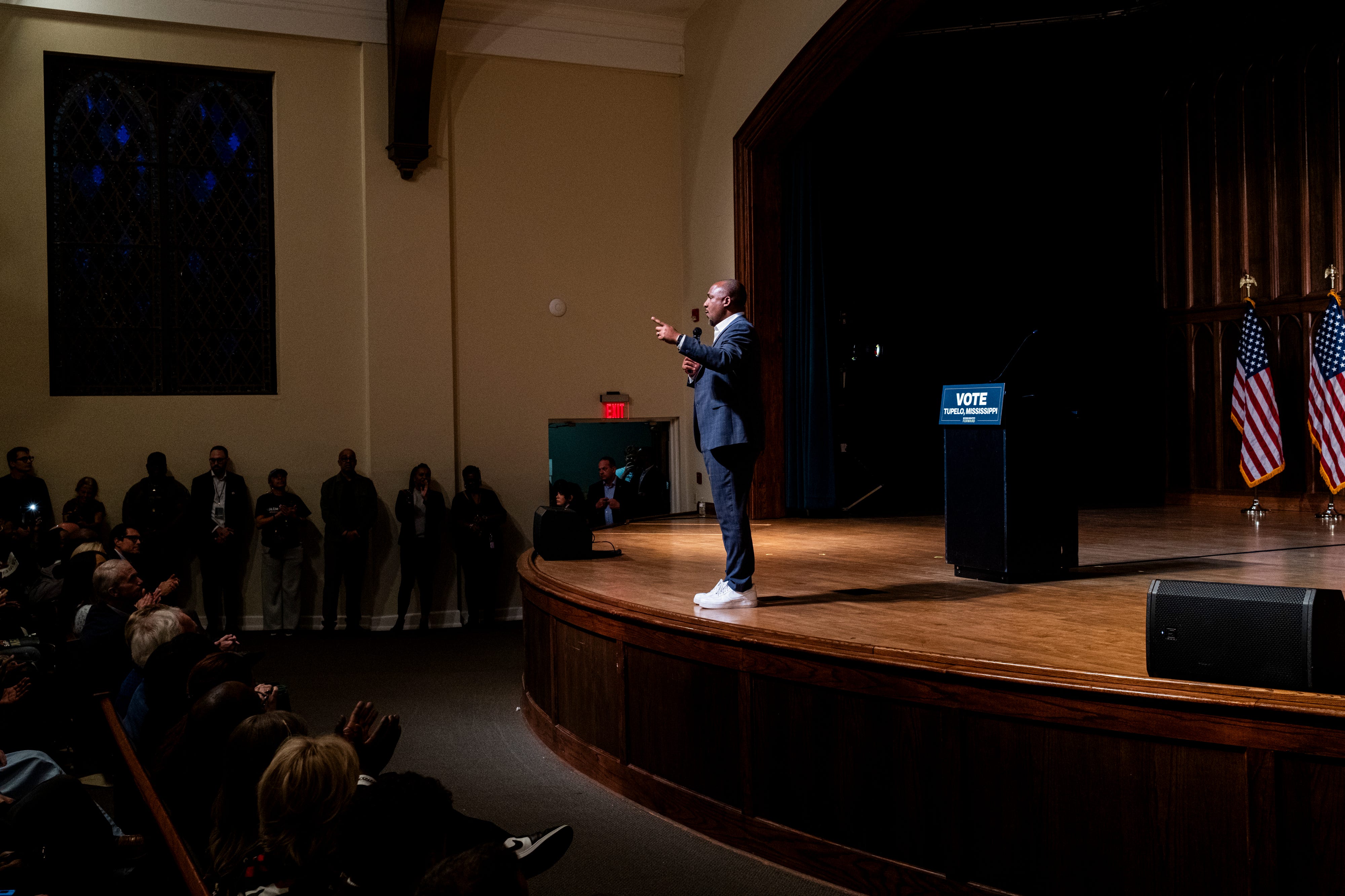
The saga of an historic Mississippi election now has an ending. CNN and other media outlets are projecting Scott Colom, the elected district attorney from Columbus, to be the winner of the U.S. Senate race that has gripped the nation’s attention during the past week.
After days of counting absentee and affidavit ballots, Colom’s lead over incumbent Republican U.S. Sen. Cindy Hyde Smith continued to grow.
Mississippi has not had an African American in the U.S. Senate since Reconstruction. The state has never elected an African American in a statewide election. In the post-Civil War era, Hiram Revels and Blanche Bruce were chosen by the legislature. Colom is also the first Democrat to win a U.S. Senate seat in Mississippi since 1982.
For a week after the polls closed, the race remained too close to call.
On Election Day, incumbent Republican Cindy Hyde-Smith remained in the lead most of the day until early the next morning when Colom took a 28-vote lead. For the rest of the day and for a week after, as the counting of absentee votes and affidavit ballots commenced, Colom’s lead gradually widened.
On Nov. 5, lawyers for Hyde-Smith’s campaign and the National Republican Senatorial Committee sent demand letters to all 82 counties asking them to separate and preserve every affidavit ballot cast Nov. 3 as potential evidence in a ballot box examination, an election contest or a Senate proceeding. Hyde-Smith’s campaign said on social media that it believes thousands of votes remained to be counted in Republican counties.
Colom campaign manager Gerard Henderson called the letters a stunt. “We’re confident that when every lawful ballot is counted, Scott Colom will be Mississippi’s next U.S. senator,” he said.
As Colom’s lead mounted, it became clear that there were few avenues for the Republican to dispute the outcome. Mississippi has no recount law; only a court can order one. Under state law, mail ballots postmarked by Election Day count if they arrive by Nov. 10, which is also the deadline for affidavit voters without photo ID to show it to a circuit clerk. Counties must certify by Nov. 13, and the secretary of state declares final results Dec. 3. Candidates have 20 days after the election to file a contest.
Under Article I, Section 5 of the Constitution, each chamber of Congress is the final judge of its members’ elections. The Senate has no fixed procedure for such disputes. Democrats take majority control of the chamber when the new term begins Jan. 3, 2027, along with the U.S. House of Representatives.
The home stretch
For months, the finish line of the Senate horserace was unclear.
National pundits continued to insist that, while close, the Mississippi contest still leaned Republican. Almost no public polling was published after a spring poll showed Colom trailing but within striking distance of Hyde-Smith and Independent Ty Pinkins poised to play spoiler.
The race tightened visibly in October, at least in terms of enthusiasm. That month, Colom nailed down endorsements from luminaries of the Democratic Party, including former President Barack Obama, former Vice President Kamala Harris, Biden Transportation Secretary Pete Buttigieg and other sitting U.S. senators.
Hyde-Smith’s only national endorsement from her party was President Donald Trump’s. Trump had said she turned down his offer of a rally, quoting her saying: “I don’t need any rallies, sir.”
The week before the election, the Cook Political Report moved the race from “solid Republican” to “likely Republican.” Senate Majority PAC announced a $1.2 million ad campaign against Hyde-Smith. Her campaign manager, Jake Monssen, dismissed the shift as “Washington insiders making a last-ditch effort to give life to Scott Colom’s failing campaign.”
Colom said, “We clearly have the momentum to win on November 3.”
In what looked like a last-ditch effort to bail out Hyde-Smith, Trump came to Corinth on Oct. 26 anyway. In a roughly 90-minute speech, he touted tax cuts, farm relief and shipbuilding. Hyde-Smith took the stage more than an hour in, spoke fewer than 10 words (”Is this not the best president in our lifetime?”) and exited the stage. Colom, meanwhile, drove about 100 miles to work the line outside, taking selfies with rally-goers. No debates between the candidates took place.
This was the first federal election under the U.S. Supreme Court’s June ruling in Watson v. Republican National Committee, which preserved Mississippi’s five-business-day window for mail ballots. An analysis by the Mississippi Free Press counted 138 polling place changes since 2024, a net loss of 16 precincts, and found errors in the state data that feeds its online polling-place locator.
Trump carried Mississippi by 23 points in 2024, and in a year when the national mood favored Democrats. Trump’s approval had fallen to 34% by July, according to Pew Research Center, and his support in Mississippi had also slipped. Voters said they were worried about the cost of living, the war in Iran and tariffs that have hurt the state’s farmers.
Hyde-Smith’s tight alignment with the president became a liability. Her remark that shoppers facing high beef prices had “so many proteins to choose from” inspired a counter-ad that passed 1 million views by late October. The White House press release about the Corinth trip didn’t even mention her by name.
Colom’s coalition
Colom, 43, held more than 60 town halls, many on college campuses. His campaign leaned on homegrown ads, including a “Sinners” parody starring his twin brother, Andrew. Black turnout across the Deep South had run above historical levels since the Supreme Court weakened Voting Rights Act protections in Louisiana v. Callais. “Scott didn’t surge—Scott’s been building,” said Stacey Abrams, whose affiliated groups have spent or raised more than $5 million in Mississippi over eight years.
The enthusiasm came with Mississippi-bred caution. “I am feeling enthusiastic, but being in Mississippi, you just learn how to not get your hopes up too much,” said Jasmine Williams, a young voter.
Women organized, too. More than 100 packed Hal & Mal’s Red Room in Jackson for a pre-election rally. State Rep. Earle Banks showed up in a red cap bearing a profane anti-Trump message. “Some Mississippi women are telling me that they are finally voting against their husbands’ wishes,” comedian Rita Brent said.
Nadia Colom, the candidate’s wife, sent them off with a charge: “Whatever you’re doing, do it times 10 to get us to the finish line.”
Republicans stayed confident almost to the end. Strategist Hayes Dent had predicted Hyde-Smith would win by “probably 10 points.” The prediction market Kalshi had given her about an 89% chance in late October. The returns showed a far closer race than either suggested, whoever ends up holding the seat.
2027 looms
The next test will come quickly.
The legislature convenes in January, and state legislative and statewide offices are on the 2027 ballot. In 2023, Democrat Brandon Presley held Gov. Tate Reeves to 50.9% and lost by 26,619 votes out of more than 820,000 cast. “Close doesn’t count,” Presley said.
A poll released in October by House Speaker Jason White hints at the frustration lawmakers will face. Cygnal surveyed 501 likely general election voters Oct. 1–2. The margin of error was 4.38 points. The sample leaned Republican: respondents had backed Trump over Harris 56.6% to 34.6%.
Even so, more respondents said the state was on the wrong track (45.4%) than headed in the right direction (42.8%), a gap within the margin of error. Black voters said wrong track 76–14, and independents 54–34.
Some findings cut across party lines. Seventy-two percent supported restoring the ballot initiative process, which the state Supreme Court struck down in 2021. Only 7.9% were opposed, and Republicans backed restoration 78–4. Lawmakers let all 17 restoration measures die in 2026.
Voters also opposed continuing to recruit data centers, 47.9% to 28.3%, after hearing about tax exemptions and electricity-cost concerns. Republicans split 39% in support and 37% opposed. On property taxes, 56.6% supported eliminating the homestead tax, and 70.2% supported eliminating it for residents 65 and older. Support for school choice accounts depended on how the question was worded.
Inflation ranked as the top issue at 22.2%, followed by crime and public safety at 19.1% and healthcare at 14.7%.
Those are the same pocketbook anxieties that made the Senate race close.
Image: Scott Colom at a campaign stop (via Getty)