


Darrin Givens learned to vote the way a lot of young Black Mississippians did: from his mother. She’s an educator, and when he was growing up she brought him to the polls and walked him through who was running and what they stood for. Well into adulthood, she was still where most of his research on candidates came from.
This year, Scott Colom got to him first.
“I started seeing him on my social media feeds, and that made me want to tune in,” said Givens, 36, who grew up around Jackson. “It wasn’t smear ads or smear campaigns against Cindy [Hyde-Smith]. It was more so him talking about what he brings to the table.”
The contest between Republican U.S. Sen. Cindy Hyde-Smith and Colom, the elected district attorney from Columbus, has drawn the kind of national attention rarely paid to a Deep South state that Donald Trump carried by 23 points.
News organizations from decidedly progressive outlets like The American Prospect and The Nation to legacy papers like The Washington Post and New York Times have profiled the race, centering Colom’s Sisyphean assignment to knock off a Republican incumbent and become the first Democrat elected statewide since the days when Dixiecrats reigned in Mississippi and across the South.
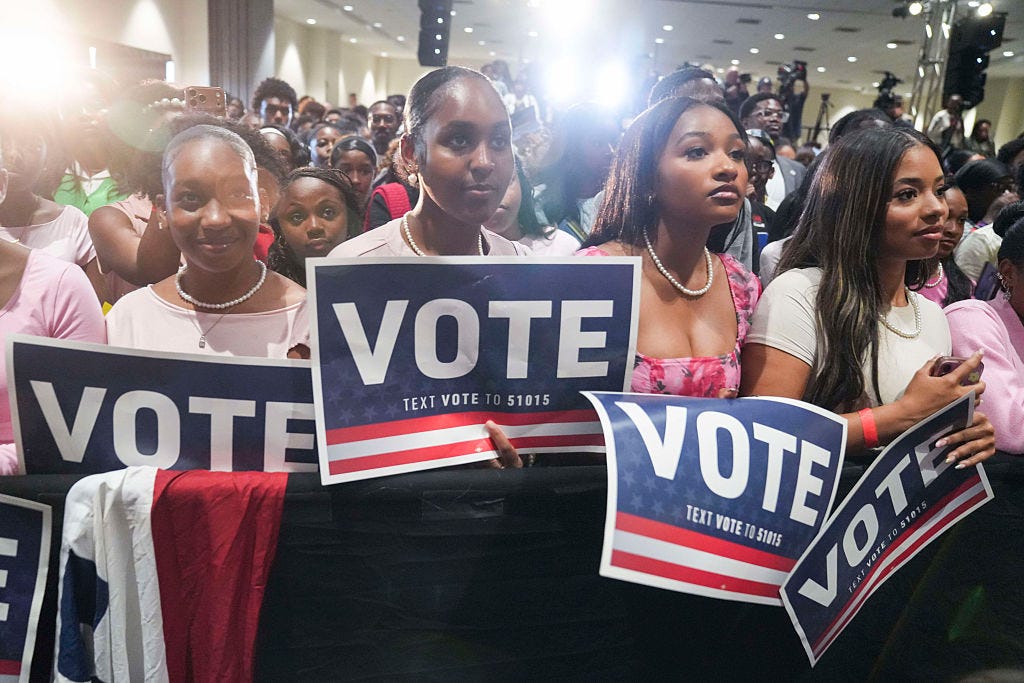
Even as progressive-minded Mississippi voters fear disappointment—the state has not elected an African American to statewide office since Reconstruction—many Black millennial-age Mississippians, both those still living here and expatriates are monitoring the race from out of state, say this race is generating a kind of electricity they’ve not seen in their lifetimes.
“I am feeling enthusiastic, but being in Mississippi, you just learn how to not get your hopes up too much,” said Jasmine Williams, who lives in Jackson’s Belhaven neighborhood. “I’ve been to so many events and I see Scott Colom. So, I think he’s doing the work on the ground to get his name out there.”
Part of that, she said, is generational—at 43, Colom is among Mississippi’s youngest major-party statewide nominees in recent memory—and part are the issues Colom is willing to talk about. She pointed to his positions on the war in Iran, on Gaza and on LGBTQ Mississippians.
“A lot of candidates that run, even as Democrats, shy away from [those issues] because of how conservative Mississippi is,” Williams said. “It’s really exciting to see somebody just say the things that a lot of young professionals, progressive folks are thinking anyway.”
A campaign that is Mississippi made — and made for smartphones
Much of that connection runs through Colom’s social videos, several of which have gone viral. When Hyde-Smith told a TV interviewer in February that “you have so many proteins to choose from,” his campaign countered with an ad in which voters retorted that they would rather “pick another senator instead.” By late October it had surpassed one million views across X, Facebook and Instagram, according to the Gulf States Newsroom.
More recently, the campaign dropped a Halloween parody of Ryan Coogler’s Sinners. Shot at Tallahatchie Flats in Greenwood, the spot features Colom alongside his real-life twin brother, Andrew, and a figure resembling Hyde-Smith who shows up to a shack begging voters to give her another chance, playing on the film’s depiction of vampires attempting to enter a juke joint.
Colom credited the ad to a Jackson content creator, Ryan Sayles, and his twin brother. “That was Mississippi,” the candidate told the Gulf States Newsroom. “That wasn’t some big D.C. consultants.”
The American Prospect noted that while such ads may not change minds they could move some voters, especially young ones, to show up. Colom has paired them with more than 60 town halls, according to the campaign, stops on college campuses, homecoming tailgates and even at a Trump rally for Mississippi Republicans in Corinth.
To Williams, the appeal is plain. The ads are “funny and catchy,” she said, “and he’s talking directly to Mississippians.” What he’s running on, including rural hospitals, higher wages and lower costs, comes without “political jargon.”
Adds Givens: In this day and age, somebody who is reaching out, making content that we understand as millennials and generations even younger than myself—it’s just cool to see. You don’t see people try to put themselves toward us. I don’t know why not, because at this point we’re a big part of the voting base.”
Millennials, now roughly 30 to 45, are beyond the age range tracked in most polling of young voters, but they are the voting bloc that showed what a midterm surge can look like. Their turnout nearly doubled from 2014 to 2018, from 22 percent to 42 percent, according to Pew Research Center. Many of them are now voting as parents, homeowners and people who have watched friends and classmates leave the state, which is how Givens describes his path: “As I got older, had children, and just started to care more in a different light, as a father, that’s when it got to a point where I’m paying attention [to politics] on a different level.”
In Mississippi, Millennial voters grew up inside a culture where Black residents already outvote counterparts. In 2024, 70.8 percent of eligible Black Mississippians voted, compared with 69.4 percent of white Mississippians, the widest such gap in the country, according to KFF. What young Black Mississippians say they haven’t had is a statewide candidate who campaigned like he wanted their votes specifically. Nationally, the fall Harvard poll found that 91 percent of young voters cite the cost of living as important to their vote, and this year’s candidates’ pitches on wages, prices and healthcare speak to that.
“It’s refreshing to see a young Black candidate. I don’t know him personally, but the way people I know are supporting his campaign just shows me that the people supporting it are people that I like,” Givens said.
The math still mathing for Republicans
Several factors could be behind the uptick in interest.
First, grassroots organizations have been quietly building infrastructure in Mississippi and other parts of the South. Organizations built by Stacey Abrams, who spent her teenage years in Mississippi and twice won the Democratic nomination for governor in Georgia, have spent or raised more than $5 million in the state during the last eight years, digital news outlet the Grio reported.
“Scott didn’t surge—Scott’s been building,” Abrams told the outlet.
Plus, recent efforts to blunt Black political power may be backfiring and motivating parts of the electorate. After the U.S. Supreme Court’s Louisiana v. Callais decision weakened Voting Rights Act protections for majority-Black districts and Republican legislatures moved to redraw Black congressional seats, Black turnout across the Deep South ran well above historical baselines, The Mississippi Independent reported in August. Analysts at VoteHub said the ruling “appears to have reenergized Black political participation across much of the Black Belt.”
Givens sees the same pushback from where he sits. “Honestly, we face some voter suppression tactics in Mississippi still,” he said. He described lines that seemed to move slowly “because of the way it’s being controlled.”
Williams has seen that investment up close. She said a friend from the Coast who worked for a national labor-rights organization on Capitol Hill has urged her employer to invest in Mississippi. This year, Williams said her friend’s employer paid for her to come home and knock doors.
The optimism isn’t confined to Williams’s generation. “I was talking to my mama last night, and she was like, ‘I think he’s gonna win it,” Williams said.
By all accounts, Mississippi Republicans aren’t benefitting from the same surge in enthusiasm. That’s not to say they don’t remain confident about Hyde-Smith hanging on to the seat. The math is still mathing for the GOP. “There’s a lot of laws of physics in politics,” longtime GOP strategist Hayes Dent told Newsweek.
He noted that Black Mississippians, about 37 percent of the population, can’t alone carry a Democrat to victory, and predicts Hyde-Smith would win “by probably 10 points.” As of late October, the prediction market Kalshi gave her roughly an 89 percent chance.
Still, Trump flew to Corinth, in northeast Mississippi near the state’s borders with Alabama and Tennessee to rally for Hyde-Smith and warned his own crowd that “sometimes when you think somebody is doing so well, nobody votes.”
The trial balloon for 2027?
The bigger test for this enthusiasm may come next year, when Mississippi holds its off-year statewide and legislative elections. Although these contests draw far less attention and turnout than federal elections, Democrats have gotten within striking distance.
In 2023, Brandon Presley, a north Mississippi utility regulator and a cousin of one of Mississippi’s most famous sons, Elvis, held incumbent Republican Gov. Tate Reeves to 50.9 percent of the vote and lost by 26,619 votes out of more than 820,000 cast.
That made it the closest governor’s race in Mississippi since 1999, according to Mississippi Today’s tally of final county results. For his part, Presley has spent this fall on the trail making the case that the near-miss should be read as a warning, not a ceiling. “Close doesn’t count,” he said at a rally with Colom. “You’re looking at living proof of that right here.”
Jasmine Williams thinks the energy of the midterms will spill over into 2027 if voters keep connecting policies in Mississippi to what’s happening in Washington, D.C.
“We have to keep the conversation going and connect the dots to the issues we see. I think people have given up, even internally, on Mississippi, because we just think, ‘Oh well, this is just how things work.’
“But the more we connect the dots—we see the Nolan Wells case and we see Baby Kohen [Wiley]—to who these people are and how they impact the everyday lives of Mississippians, I think [enthusiasm] can carry over.”
Image: Young voters attend a recent voter rally in Atlanta, Ga. (via Getty Images)