


The youth court overhaul that the Mississippi Legislature passed in special session on Thursday will change how the state houses and spends money on children in its care, but its most consequential change may be one that costs nothing.
For the first time since the system was created in 1979, Mississippi’s youth courts will be presumed open to the public and the press. The proceedings that decide what happens to abused, neglected and/or delinquent children have been closed for nearly half a century. Under the bill headed to the governor, the default flips.
The change arrives inside a much larger package. Reeves called the special session after confidentiality statutes governing youth court records expired July 1, a lapse that triggered lawsuits and forced the Mississippi Supreme Court to issue an emergency order to keep the courts running. The bill that resulted adds nine judges to a system in which fewer than a third of the state’s 82 counties have a full-time youth court judge, expands the Oakley Youth Development Center, funds two new juvenile detention facilities and carries $29.5 million in new spending. The open-courts provision rode along with the rest.
Under the new law, a youth court judge keeps the discretion, common to other courts, to seal sensitive records, close a particular hearing or remove a disruptive person. What changes is the starting point. A system that presumed secrecy will now presume access and a judge who wants a proceeding closed will have to decide to close it.
Sen. Brice Wiggins, a Pascagoula Republican who chairs the Senate Judiciary A Committee, made the case for openness in the language of open government. “Open courts are a hallmark of our democracy,” he said. “If you’re for good government and transparency, you should be supportive of open courts.” Supporters of the change argue that visibility is what produces accountability, that a system operating in the dark is a system whose failures no one outside it can see, and that scrutiny tends to improve outcomes for the children who move through it.
The objection did not fall cleanly along party lines. Some of the sharpest worries came from lawmakers concerned about the children whose lives the records describe. “I’m concerned about the safety of children and their information,” said Rep. John Hines (D-Greenville).
The original confidentiality rules were implemented to protect children. A public criminal accusation could follow a child for years, into adulthood, potentially locking them out of educational and job opportunities. Likewise, a child who is the victim of abuse or neglect can be re-traumatized, stigmatized or exposed to the person who harmed them in open court proceedings.
The bill leaves the balance between those interests to individual judges, which is the part worth watching. Whether a given hearing is open will depend on the judge presiding over it, without a uniform standard written into the law for when a court should close its doors. In a system the state itself has called fragmented, where more than half of counties lack a full-time youth court judge, discretion distributed across dozens of courtrooms can produce dozens of different answers to the same question.
Democrats also flagged procedural problems. Under the bill, if a judge closes a hearing and does not reduce the oral order to writing within 48 hours, the closure is nullified, which could leave sealed records open to outside parties. Lawmakers warned the same 48-hour mechanism could send children back to dangerous settings if a judge fails to put an order in writing in time. The provision is the kind of detail that surfaces when a far-reaching bill moves quickly.
The legislature took up the overhaul under a court deadline and passed it in two days, and the compression drew objection from members of both parties who said they had little time to read what they were voting on. Sen. Hob Bryan (D-Amory) supported the intent of the bill but criticized the process, telling the Senate it had rubber-stamped the governor’s request instead of deliberating as a separate branch.
“I don’t know what the rest of you said when you ran for public office,” Bryan said, “but I didn’t run on a platform of ‘I’ll do what I’m told.’”
Sen. Bradford Blackmon (D-Canton) pushed back on the idea that an agreement among the governor, lieutenant governor and House speaker settled the matter. “Just because the governor, lieutenant governor and speaker come to agreement, we as a legislature, the Senate, we decide,” he said.
For all the arguing over process, the open-courts change is the one whose effects will be visible, because visibility is the point. Reeves, in a statement after the session adjourned, framed the transparency fight as a victory over Democratic resistance, saying Republicans had rejected efforts to “reduce transparency.” The record of the debate is more tangled than that. The lawmakers most worried about opening the courtroom doors were often those most focused on the children inside it, and the question the new law leaves open is whether a system built for secrecy can be made to serve children better in a public light. Beginning now, the public will be able to watch it try.
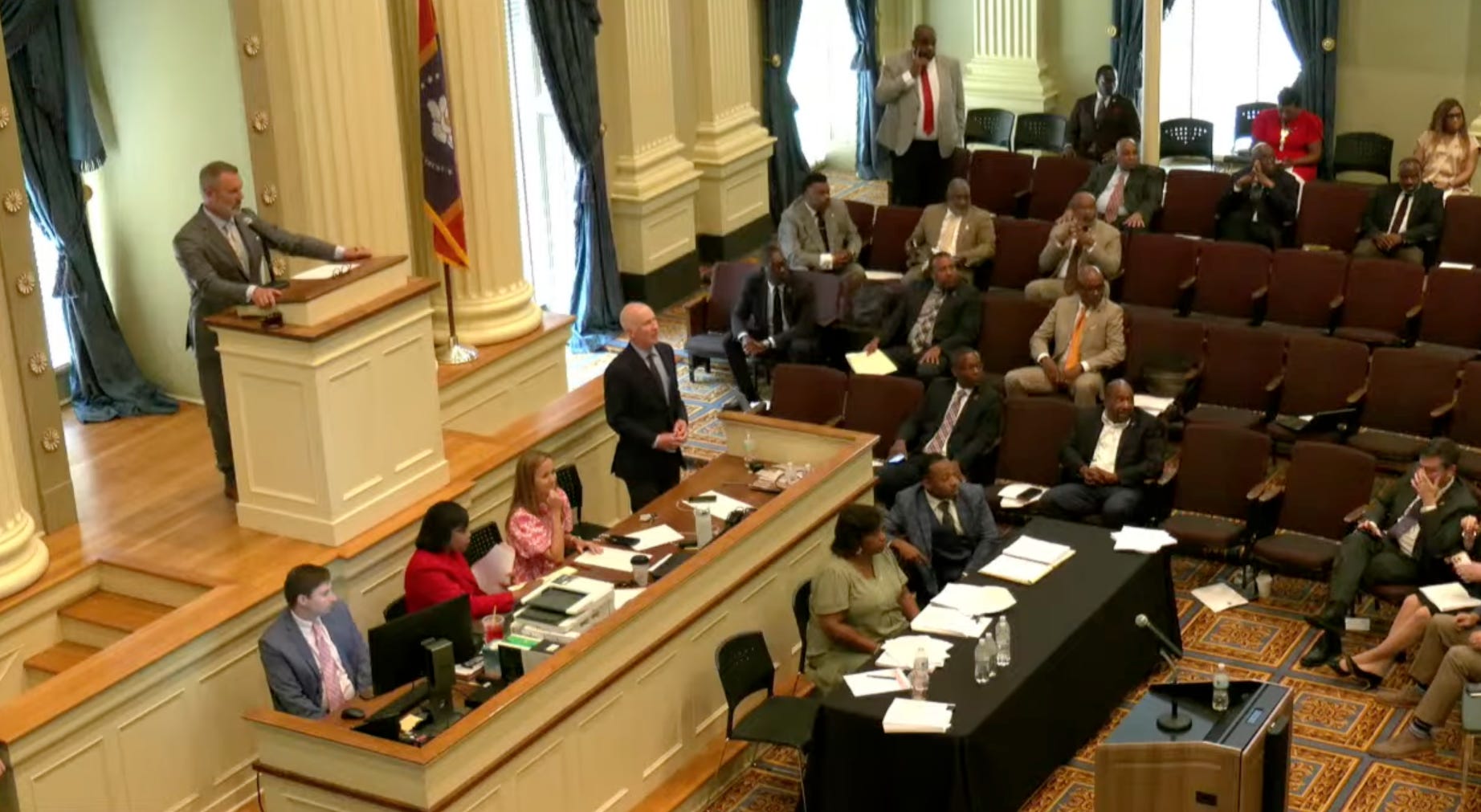
Image: House floor debate (via Mississippi Legislature YouTube channel)
