


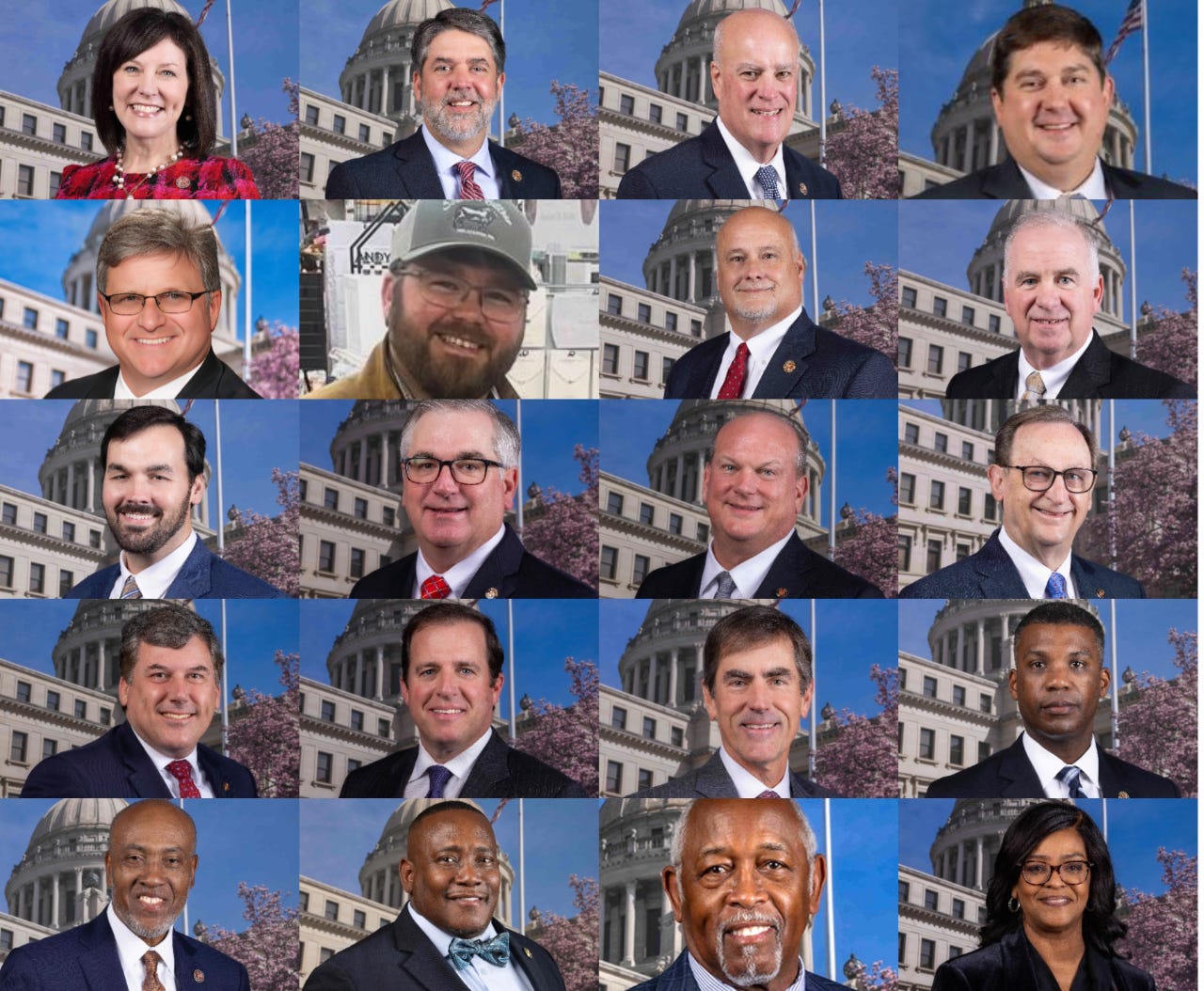
The Joint Legislative Committee on Reapportionment and Redistricting holds the last of its eight public hearings on Thursday, Oct. 1, 2026, at the New Capitol in Jackson. Speakers at the first seven hearings asked the committee repeatedly what comes next and were told at every stop that the members were there to listen and would not answer questions.
State law and the record of the last two times Mississippi redrew its congressional map answer some questions.
The committee itself is a permanent body created by Mississippi Code Section 5-3-91. It seats the chair and vice chair of the House apportionment and elections committee, the chair and vice chair of the Senate elections committee, 10 additional House members appointed by the speaker and 10 additional senators appointed by the lieutenant governor, two from each congressional district in each chamber. Nothing passes the committee without a majority of its House members and a majority of its Senate members.
The two kinds of maps follow different processes.
Legislative districts are adopted by joint resolution. A joint resolution does not go to the governor, so the House and Senate can redraw their own seats without Gov. Tate Reeves signing anything. He has no veto power over it.
Congressional districts are different. They are enacted as an ordinary statute, which means the governor can veto the map, and overriding him takes two-thirds of both chambers.
Mississippi law already sets criteria for legislative districts, several of which speakers at the hearings asked the committee to adopt. Districts must be contiguous and compact and must cross political boundaries as little as possible, with county lines given priority. Federal law adds equal population and the Voting Rights Act on top of that.
If the legislature cannot agree on legislative districts, the job passes to a five-member commission, made up of the chief justice of the state Supreme Court, the attorney general, the secretary of state and the majority leaders of the House and Senate. That commission has 180 days to produce a plan.
There is no equivalent backstop for congressional districts.
In 2002, the legislature could not agree on a congressional map. A three-judge federal panel drew one instead and released it on Feb. 26 of that year. The U.S. Supreme Court upheld that in Branch v. Smith on March 31, 2003, confirming that a federal court may impose an interim congressional map when a state fails to produce a usable one before candidates have to qualify.
The legislature deadlocked again in 2011, and a federal court drew the congressional districts a second time.
State legislative seats next go before voters in 2027. Congressional primaries for this year were held in March 2026, and the general election is in November, so a congressional map redrawn now would first be used in 2028. Nothing the committee does this fall changes the ballot Mississippians will receive in six weeks.
State law sets no deadline for congressional redistricting. The practical limit is candidate qualifying, which falls on March 1 of an election year. For legislative districts, the legislature’s own deadline runs to the end of the regular session in the second year after a census.
The committee has not produced the material many of the speakers asked for. No proposed maps have been released. No criteria have been published. The committee’s website carries no meeting notice for any session after Oct. 1, and its page describing the committee’s own authority and duties reads, in full, “More info coming soon.”
Written comments may be sent to the committee’s counsel, Ted Booth, at ted.booth@peer.ms.gov.
Image: Redistricting committee members via Mississippi Legislature site
