


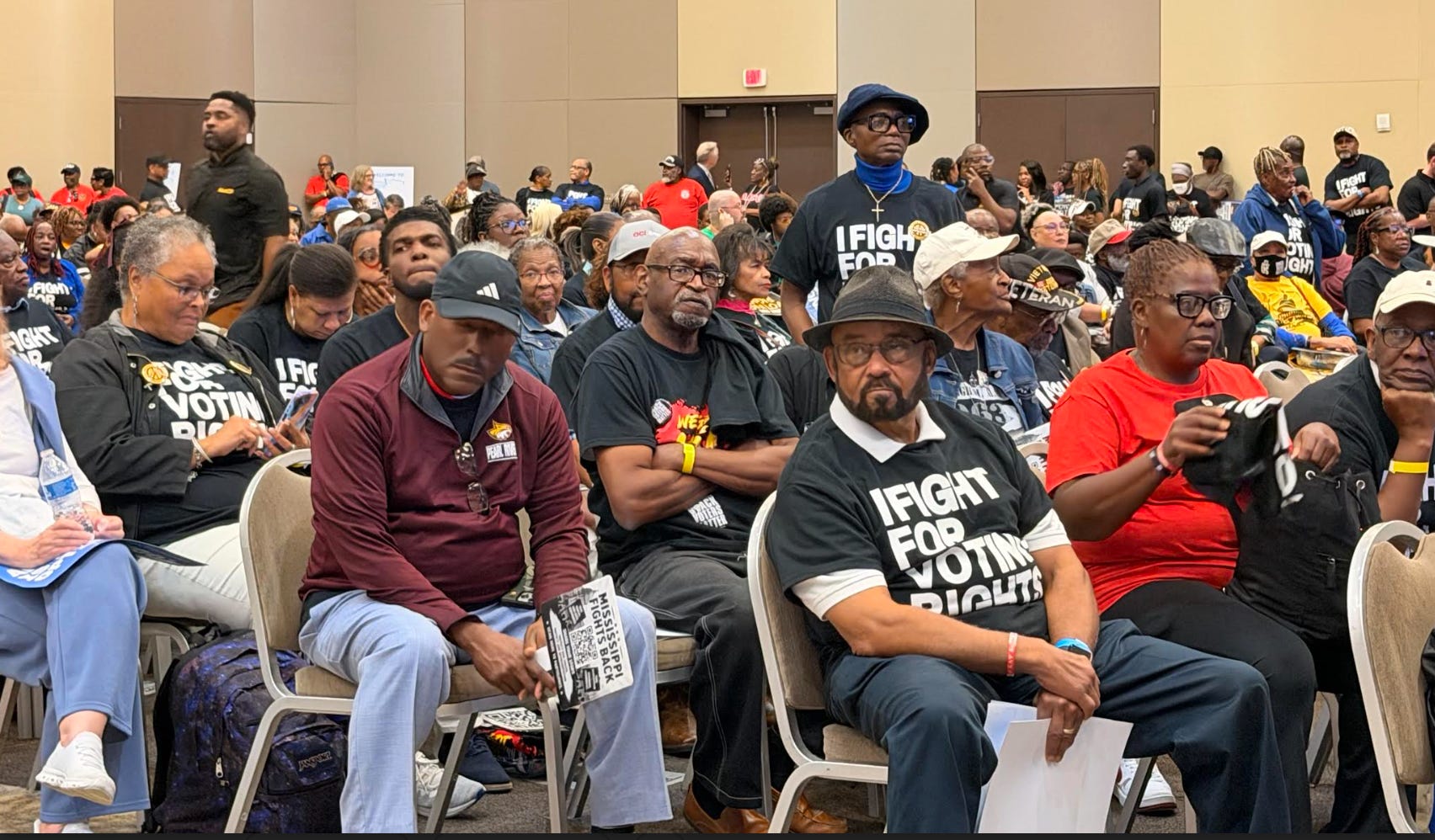
The ballroom at the Jackson Convention Complex was loud before the first speaker finished a sentence. Hundreds of people in matching black T-shirts reading “I FIGHT FOR VOTING RIGHTS” filled the rows from the stage to the back wall on Wednesday, answering speakers with call-and-response that rolled through the room.
Among those who attended the rally, some were old enough to have marched in the 1960s and others young enough to be voting in their first elections, all packed shoulder to shoulder before bright yellow banners that read “VOTING RIGHTS.” Hands went up in fists when a line landed.
More than 2,000 people, by this reporter’s estimate, turned out across the day for the rally against the U.S. Supreme Court’s ruling weakening the Voting Rights Act. The rally, organized by the Mississippi Voting Rights Act Rapid Response Coalition and billed as “Mississippi Fights Back,” drew national civil rights leaders, elected officials and media figures to the state capital, along with Mississippians who traveled from across the state to attend and some from other states.
The day began at the War Memorial auditorium, where a coalition of organizations including the NAACP, Mississippi Votes, One Voice and the Poor People’s Campaign gathered before marching through downtown Jackson to the convention complex, where the larger rally was held. Signs the marchers and rallygoers carried read “No More Jim Crow,” “We will not go back” and “No Jim Crow Maps.”
The rally drew a lineup of national figures. Among them were U.S. Rep. Bennie Thompson, whose 2nd Congressional District has been the focus of redistricting pressure from President Donald Trump and state Republicans; NAACP President Derrick Johnson; Reena Evers-Everette, daughter of slain civil rights activist Medgar Evers; Princeton University professor Eddie S. Glaude Jr.; and Scott Colom, the Democratic nominee for the U.S. Senate seat currently held by Cindy Hyde-Smith.
Also scheduled to participate were Cheryl Turner, international president of Delta Sigma Theta Sorority, and commentators Angela Rye, Roland Martin and Joy Reid. Buses brought attendees from Memphis, and members of the Georgia NAACP traveled to Jackson for the event.
The rally was a response to the Supreme Court’s April 29 ruling in Louisiana v. Callais, which narrowed the use of race-conscious remedies under Section 2 of the Voting Rights Act. Justice Elena Kagan wrote in dissent that the decision renders Section 2 “all but a dead letter.” In the three weeks since, two Mississippi cases challenging electoral maps under Section 2 have been vacated and remanded by federal courts under the new framework, and Gov. Tate Reeves has said he expects the Mississippi Legislature to take up redistricting in 2027.
For the Mississippians in the room, the ruling carried particular weight. Lydia Grizzell, the 24-year-old president of the Young Democrats of Mississippi, said the narrowing of Section 2 was a step back toward the state’s past.
“Narrowing Section 2 means starting the tread back to Jim Crow Mississippi,” Grizzell said. “Section 2 was created to diminish the effects and intentions of Jim Crow laws and Mississippi had one of the worst cases of it.”
Grizzell said lawmakers should do more to educate residents about how laws are made, how federal funds are distributed across the state, and why representation matters.
Chauncey Spears, who manages the Beloved Community Innovation Hub at the International Museum of Muslim Cultures in Jackson and has worked in Mississippi education policy, said the consequences of diluted voting strength are concrete, particularly for schools.
“Educational equity and the resegregation of our schools hit home when we need students to be able to leverage education for social mobility,” Spears said. “That doesn’t happen when schools that serve them are divested and are ill equipped to provide them access to the knowledge, skills and experiences that will prepare them for the 21st century world of work and democracy.”
Spears, who framed the work in terms of the Rev. Dr. Martin Luther King Jr.’s vision of the Beloved Community, said the ruling was a setback in a long struggle. “In a democracy, justice means voice, it means votes and the peaceful transfer of power,” he said.
Marian Allen, a social worker from Jones County, said the conversation feels different away from the capital.
“From Jones County, this conversation feels very immediate and personal because people here understand that political power shapes everyday life, even when it doesn’t always make headlines,” Allen said. She added that rural communities “often already feel overlooked by state leadership and larger political centers.” Allen said the country was at risk of forgetting how hard-won voting protections were. “The country doesn’t necessarily forget all at once,” she said. “It forgets gradually, by treating past struggles as settled or disconnected from the present.”
The rally took place on the 65th anniversary of one of the movement’s more violent days. On May 20, 1961, a white mob of more than 300 people attacked a group of Freedom Riders at the Greyhound bus station in Montgomery, Alabama. The riders continued on to Mississippi, where they were arrested in Jackson and many were sent to the Mississippi State Penitentiary at Parchman.
The two Mississippi cases vacated this month return to federal district courts for reconsideration under the Callais framework, where plaintiffs have said they will continue to litigate. The state’s congressional, legislative and Supreme Court maps are expected to be taken up by the Mississippi Legislature in the 2027 regular session.
The Mississippi Voting Rights Act Rapid Response Coalition, which organized the rally, describes itself as a statewide coalition of civil rights organizations, community leaders, advocates, attorneys and grassroots organizers working to protect voting rights and ensure fair representation for all Mississippians.
Image: Participants during the rally at the Jackson Convention Complex (credit Derrion Arrington)

Thanks for continuing to cover VRA stories in MS! The words of Mr. Spears and Ms. Allen make this a must read for anyone who wonders why Mississippi can't shake it's racist reputation.
Democrats & NAACP Fighting and Dying for Segregation. Go Figure.
https://torrancestephensphd.substack.com/p/fighting-and-dying-for-segregation