


In early September, Mississippi Secretary of State Michael Watson inserted himself into an election dispute unfolding a thousand miles from Jackson.
The case, now before the U.S. Supreme Court, centers on two Arizona laws passed in 2022 that require voters to prove citizenship and allow election officials to remove noncitizens from voter rolls within 90 days of an election—a period during which federal law restricts large-scale removals of registered voters.
The case isn’t exactly about what those laws do, but more about the principle of whether the state or the federal government has primary authority over voter eligibility, and to what extent.
Watson disagreed with the U.S. Court of Appeals for the Ninth Circuit’s ruling that the Arizona laws were preempted by the National Voter Registration Act of 1993.
“The Constitution gives States exclusive authority to define and enforce voter qualifications,” Watson argued in the Sept. 4, 2026 friend-of-the-court brief jointly filed by the secretaries of state of Kentucky and Nebraska. Oral arguments are scheduled for Dec. 8, 2026.
It was a familiar position for Watson to take. In six years as Mississippi’s chief elections officer, he has built a substantial record of defending states’ constitutional authority to decide the “Times, Place and Manner of holding Congressional elections,” as noted in the nearly 240-year-old Elections Clause. He has defended that against previous presidents and even his own party—and he won in the Supreme Court earlier this year. But there’s a notable absence among the names Watson has vanquished to protect this constitutional right: President Donald Trump.
Watson’s seemingly contradictory position comes as Trump continues attempts to commandeer a far larger executive role in how federal elections are administered. In using executive orders and regulatory rule changes within agencies under his control, the president has sidestepped Congress and been accused of undermining the very Constitutional election laws Watson has spent years defending.
These interventions have raised an uncomfortable prospect that many of the nation’s secretaries of state have been preparing for as the highly divisive midterms rapidly approach. If Trump invoked emergency powers, or directed federal agencies to intervene in how Mississippi runs elections or even to alter results, would Watson treat it as the kind of federal intrusion he has consistently fought, or would he cooperate?
Watson, who is running for the office of lieutenant governor, did not respond to multiple requests for comment about what Mississippi plans to do if Trump declares a national emergency involving the midterms.
State Sen. David Blount told The Mississippi Independent it is difficult to determine what Watson has planned, but he was adamant that state officials have to do everything in their power to ensure that all elections are free from unconstitutional and outside interference, particularly from the highest office in the country.
“There is no law allowing the president to run our elections,” Blount, who worked as a communications director under former Democratic Secretary of State Eric Clark for 13 years, observed. “The federal government doesn’t run elections. The GOP doesn’t run elections. The states do.”
How it started and how it’s going
Watson’s Arizona intervention arrives amid heightened anxiety about the impending midterms and their potential consequences for the long-term stability of American democracy.
The story of how the nation arrived at this remarkable confluence of legal and political questions began in Arizona, after President Joe Biden unexpectedly carried the state by slightly more than 10,000 votes in 2020. Maricopa County quickly became the epicenter of President Trump’s election-fraud claims despite a GOP-ordered forensic audit of more than two million Maricopa County ballots finding 99 more votes for Biden and 261 fewer for Trump.
The audit failed to quell election-fraud claims and later helped give rise to the same election laws Watson is defending in the Supreme Court six years later. Federal courts found that Arizona’s legislature failed to produce evidence that any noncitizens were registered to vote before enacting the laws. Since then, extensive investigations into noncitizen voters have found almost no evidence of voter fraud.
Yet those unfounded claims have helped fuel a political movement that has produced new laws, new litigation and new assertions of federal power over elections—an ironic outcome given Watson’s passion for state election rights.
For now, Watson has not indicated whether or how he is preparing for potential unrest, including as a result of election interference by Trump.
Reuters interviewed more than 50 officials, including 12 secretaries of state, and found that nearly all were taking new precautions against political interference, federal investigations, misinformation, cyberattacks or violence.
Dozens of election officials and government attorneys attended training on responding to federal subpoenas and search warrants, while officials in Marin County, California have rehearsed what to do if immigration agents appear at polling places. Attorneys in Dane County, Wisconsin have drafted legal filings in advance in case the Trump administration attempts to seize voting equipment or election records. Some states have even passed new laws banning armed federal agents from polling places.
This stems from repeated efforts by the Trump administration to find ways to improve his party’s chances of prevailing in the midterms.
Former Trump advisor Steve Bannon predicted that Trump would declare a national emergency ahead of this year’s midterms, while activists with links to the White House produced a 17-page draft executive order that recommends blaming China for election interference in 2020 to unlock unprecedented presidential powers around voting.
More recently, the Trump administration has begun using passport data for citizenship checks, according to court filings.
Trump has had little success in pursuing his agenda through the courts. In mid-September 2026, the Supreme Court blocked an executive order aimed at using the U.S. Postal Service to screen mail ballots using state voter data, concluding that Congress had not given the postal service the election authority the administration sought to exercise.
Watson’s deference for Trump
Watson took a starkly different approach to Biden’s election initiatives.
He and 14 other secretaries of state wrote to the Biden Administration in August 2022 demanding the president rescind his voter-registration executive order signed in March 2021, describing it as a “gross federal overreach” and saying federal agencies would “infiltrate state-run elections.”
“Neither the U.S. Constitution nor the National Voter Registration Act (NVRA) include any such grant of executive authority to the President to require federal agency involvement with state-level voter registration processes,” Watson’s co-signed letter argued in response to the order, adding that changes to state voter-registration responsibilities “must be authorized by Congress or the states themselves.”
Watson was blunter in a March 2024 letter to then-U.S. Attorney General Merrick Garland. “I will not let the Biden Administration break the law in our state,” he wrote. He later described the executive order as a scheme to “weaponize the vote.”
Biden’s order directed federal agencies to consider ways to provide registration information and assistance through their existing interactions with the public, required them to formulate plans, and encouraged cooperation with states, provided they complied with existing laws.
Mississippi and eight other states took the Biden administration to court in August 2024, using much of the same rhetoric contained in the letter, but with one notable statement: The federal government risked becoming “an unregulated—or, at best, a lesser regulated—player in the state electoral process,” the lawsuit noted.
The lawsuit was voluntarily dismissed Jan. 27, 2025, after Trump returned to office. Biden’s order was never deemed unlawful.
Two months after the Biden lawsuit was dropped, newly sworn-in President Trump issued his own executive order, which was considerably more prescriptive about election administration than his predecessor’s. And Watson was significantly quieter. Rather than directing federal agencies to facilitate voter registration, Trump’s order sought to impose specific registration requirements, citizenship verification, voter databases, voting equipment and the receipt of mail ballots.
Watson said in a July 2025 press release he was “extremely pleased to see the prioritization of free and fair elections,” while noting that he had been invited to the White House to share election safeguards that his office had implemented in Mississippi and to discuss the president’s focus on “election integrity across the country.” Watson added: “However, whether there is a Republican or Democrat in the White House, my goal has, and will always be, to follow the law.”
Trump’s order requires documentary proof of U.S. citizenship as part of the federal voter registration form—the same voting registration requirement that Watson told the Supreme Court in his September 2026 brief is assigned exclusively to the states by the Constitution.
Trump’s order also declared it his administration’s policy that ballots in federal elections must be both cast and received by Election Day. The order directed the U.S. attorney general to act against states that counted ballots received after Election Day and directed the Election Assistance Commission to condition federal funding on compliance.
Mississippi law allows mail-in ballots to arrive up to five days after Election Day, provided they are postmarked before polls close. Watson defended that state law before the Supreme Court in June. He didn’t just win; he beat his own party, the Republican National Committee.
Watson has drawn a line at some Trump proposals. When Trump suggested in early February 2026 that Republicans should “nationalize” elections, Watson called it a “terrible idea.”
A year later, Trump added another executive order instructing the federal government to compile state-by-state lists of confirmed U.S. citizens from federal databases and directing the postal service to develop nationwide mail-ballot requirements, including unique tracking barcodes and state-specific participation lists that could determine whether the service woul transmit particular mail ballots.
The March 2026 order caused an uproar among those who believe Trump was, and still is, trying to circumvent the election clause by creating new rules for how mail-in ballots would be regulated.
Mikel Bolden, executive director of the Mississippi Democratic Party, told The Mississippi Independent that Watson has been slow to respond to Trump.
“Secretary Watson has shown he can move quickly and proactively when he sees something on the horizon,” Bolden said, pointing to his office’s preparations in June for a possible return to Mississippi’s 2022 legislative maps. “We’d like to see that same urgency applied here.”
“This rule could directly affect how absentee ballots reach Mississippi voters this November, and his office has been silent,” Bolden added, noting fears of executive orders and public confusion over how the postal service will handle mail ballots.
The voter rolls
The handover of Mississippi’s voter files is perhaps the clearest test of Watson’s deference to Trump.
The federal government requested states’ full and unredacted statewide voter-registration lists, to assess compliance with federal voter-list maintenance laws. The U.S. Department of Justice proposed sharing the lists with the Department of Homeland Security to cross-check voters against federal databases and identify noncitizens or others potentially ineligible to vote. DOJ argued that the Civil Rights Act of 1960 gives it authority to demand the records despite state privacy protections.
Watson’s office initially sought clarification from DOJ about the respective roles of the federal government and the states before Mississippi entered the confidential arrangement.
Eventually, Watson complied. DOJ has since sued 30 states for refusing its request. Twenty-five of those lawsuits have since been dismissed.
Mississippi law ordinarily restricts public access to some of the most sensitive information contained in voter files. Dates of birth, Social Security information, driver’s license numbers and other fields are subject to various statutory or regulatory protections.
It is not clear if Watson’s move was legal.
But other Republican election officials reached a different conclusion about the Trump administration’s request for voter data. On the same day that DOJ announced Mississippi’s cooperation, it sued Georgia, where Republican Secretary of State Brad Raffensperger had declined to turn over confidential voter information.
“I will always follow the law and follow the Constitution,” Raffensperger said.
Republican officials in New Hampshire, West Virginia and Utah also resisted providing protected voter information.
Trump’s DOJ has taken legal action against dozens of states that declined to turn over voter information. DOJ is yet to prevail in any of the 30 voter roll data lawsuits. Courts have rejected most and are considering appeals.
Mississippi reached a different conclusion the last time Trump sought large quantities of state voter information.
In 2017, then-Secretary of State Delbert Hosemann forcefully rejected a request from Trump’s Presidential Advisory Commission on Election Integrity for voter data.
“They can go jump in the Gulf of Mexico and Mississippi is a great state to launch from,” Hosemann, who is now the state lieutenant governor, and is expected to run for governor, said in a statement at the time. “Mississippi residents should celebrate Independence Day and our state’s right to protect the privacy of our citizens by conducting our own electoral processes.”
Watson did not respond to questions about any material differences that prompted him to share the unredacted voter data years after Hosemann refused.
Watson’s record leaves little doubt about the constitutional principle he says governs elections. States retain substantial authority; Congress possesses some powers of its own; and a president cannot simply rewrite that arrangement through executive action. What remains considerably less clear is where Watson believes federal involvement becomes federal interference—and, more consequentially, what he would do when that line is crossed.
Watson’s record cannot be reduced simply to partisan loyalty. He has demonstrated that he is willing to defend Mississippi’s election laws against Republicans as well as Democratic presidents. What makes his more accommodating response to some of the Trump administration’s election initiatives consequential is precisely that record. Watson has spent years defining the constitutional boundary between state and federal power but refuses to say what Mississippi would do if Trump crossed it when it matters most, during an election.
That question is no longer fear-mongering. Trump has repeatedly challenged the boundaries of presidential authority over elections. Blount doesn’t expect that onslaught to slow down ahead of Nov. 3, 2026.
“I am very concerned about further actions the president may take,” Blount said. “He has refused to acknowledge the election that he lost. He has repeatedly tried to interfere in the electoral process that is left to the states, left to be governed by law, not by executive order. He has a track record of undermining Americans’ ability to vote and undermining Americans’ confidence in the basic system of our government. I fully expect that to continue given the type of person Donald Trump is.”
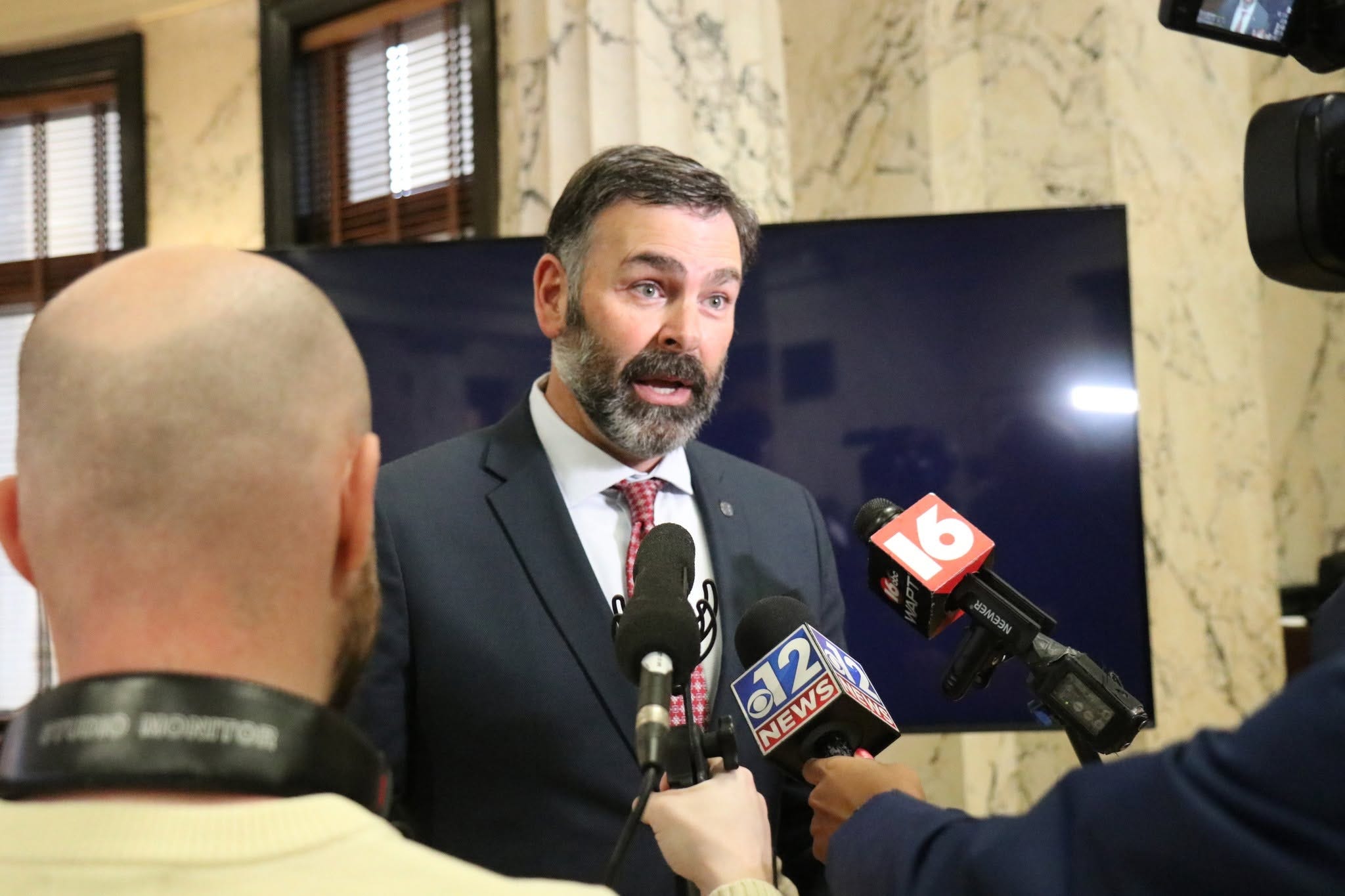
Image: Secretary of State Michael Watson (via SoS Facebook page)
