


Correction: A previous version of this article erroneously reported the number of Black Mississippians disenfranchised by restrictive voting laws. It is about five percent, not one in 10.
In 1982, under the administration of President Ronald Reagan, a then 26-year-old John Roberts served as a special assistant to Attorney General William French Smith.
In this role, Roberts was tasked with devising the administration’s argument, in a way that avoided racist allegations, against a proposed amendment to the Voting Rights Act that would nullify City of Mobile v. Bolden—a case that weakened Section 2 of the Voting Rights Act by requiring voters to prove the “intentionality” of officials in measures that resulted in minority discrimination.
Crafting the administration’s argument against the amendment was an assignment that Roberts pursued fervently, even as colleagues recalled his frustrations with the administration’s reluctance to take stronger action against the proposal.
Despite his best efforts at the time, Congress effectively overruled the Mobile v. Bolden ruling, reauthorized the Voting Right Act and clarified that Section 2 provides protection against discriminatory voting practices regardless of a plaintiff’s ability to show intent.
Now, 44 years later, after weakening the protections outlined by the Voting Rights Act as a federal judge and now as the chief justice of the Supreme Court, Roberts has an opportunity to deliver the final blow to Section 2 and break the promises originally made in the Voting Rights Act.
The Voting Rights Act was enacted to fulfill the guarantee of the 14th and 15th Amendments, ending Jim Crow-era voter discrimination in the South and expanding minority political opportunities nationwide. Section 2 is a key component of the act, necessitating minority opportunity districts where such communities account for enough of the population to have a true chance of electing their choice candidate. Despite the historical and democratic purpose of the Voting Rights Act, and this section specifically, it has now come under attack as the Supreme Court prepares to make a decision on Louisiana v. Callais.
One Voice Mississippi, a civic-engagement nonprofit that gives voice to marginalized and vulnerable communities across the South, specifically by “democratizing public policy,” observed in a statement provided to The Mississippi Independent: “Ultimately, this is about whether the courts will continue to protect equal representation or continue to allow political systems that silence marginalized communities.”
Following the 2020 Census, with Black people accounting for nearly one-third of Louisiana’s population, the state’s legislature drew a congressional map with just one majority-Black district out of six. The lack of adequate representation given to minority interests resulted in civil rights groups and Black voters taking legal action (Robinson v. Landry), arguing that the 2022 map was in violation of Section 2 of the Voting Rights Act by diluting Black voices in the political process.
While federal judges unanimously ordered the state to remedy the likely Voting Rights Act violation by drawing a second majority-Black district to provide the state’s Black population with the representation to match, the victory was short-lived. Arguing that the 2024 map with two majority-Black congressional districts was a racial gerrymander, a group of self-described non-Black voters filed a federal lawsuit (Callais v. Landry). Simply put, this group of non-Black voters, with control of four districts, felt that they were being discriminated against by the creation of a second majority-Black district. As such, they saw the district’s creation as unconstitutional and in violation of the Reconstruction Amendments.
Although state legislators stated that their top priority was protecting powerful GOP incumbents, including U.S. House Speaker Mike Johnson and U.S. House Majority Leader Steve Scalise, through redistricting, in April 2024, a three-judge panel struck down the map with two majority-Black congressional districts, citing race as the predominant factor in drawing the lines. The lower court’s ruling was put on hold by the Supreme Court, allowing the 2024 election to take place with the two majority-Black districts as Louisiana state officials and the original Black plaintiffs in Robinson v. Landry appealed to the Supreme Court.
With this appeal, the Supreme Court consolidated the cases under Louisiana v. Callais and heard arguments in March 2025. Instead of issuing its decision by the end of its term in June 2025, the Supreme Court took the unorthodox step of ordering a rehearing for the next term, with a decision now expected to come in June 2026.
When arguments were heard on Louisiana v. Callais in March 2025, the state of Louisiana defended its map that provided necessary representation to its Black population according to the Voting Rights Act. By the time the case was re-heard in June, Louisiana had changed its tone, deciding not to defend the state’s current congressional map and not to urge the court to overrule a 1986 ruling in Thornburg v. Gingles that has for years been understood to require states with significant minority communities to create districts that fairly reflect their voting power.
Louisiana v. Callais comes on the heels of other recent attacks on the Voting Rights Act. Shelby County v. Holder (2013) invalidated Section 5 of the Voting Rights Act by removing the necessity of Department of Justice pre-clearance for states with long histories of discrimination in changing voting laws. In John Roberts’s majority opinion, he asserted that “things have changed dramatically” since the Voting Rights Act, making these protections no longer necessary.
After dismantling Section 5 of the Voting rights Act, Roberts joined the majorities in Abbott v. Perez (2018) and Brnovich v. DNC (2021), both of which make it more challenging to prove intentionality in discriminatory practices. In Rucho v. Common Clause (2021), Chief Justice Roberts also authored an opinion that allowed partisan gerrymandering and found that courts are incapable of determining whether such gerrymandering is illegal or unconstitutional.
Although Allen v. Milligan (2023) supported Section 2 of the Voting Rights Act by reaffirming the creation of minority-majority districts, Roberts made a point of bringing attention to the fact that he and the other justices “took the precedent as a given.” However, in the case of Louisiana v. Callais, the justices have acknowledged that they are reconsidering whether the existing precedent was ever constitutional in the first place.
From the rehearing of the case to the changing tone of the state of Louisiana to Chief Justice Roberts’s history of eroding the Voting Rights Act, all signs point to the Supreme Court potentially issuing a ruling that would weaken if not obliterate the protections on minority representation outlined by Section 2 of the Voting Rights Act.
“We don’t know if the Supreme Court is going to dismantle the Voting Rights Act by holding that it violates the Constitution itself, or still leave it in place but weaken it, or leave it in place as it is,” Rob McDuff, attorney for the Mississippi Center for Justice, told The Mississippi Independent.
Similar to the court’s previous ruling in Students for Fair Admissions v. Harvard (2023), which is also key to the state of Louisiana’s argument against the Thornburg v. Gingles ruling. If the court does rule that the use of race to remedy proven racial discrimination is in conflict with the Constitution’s promise of equal protection and is thus unconstitutional, the ruling would, according to Politico, threaten the very system of American democracy and undermine one of the nation’s earliest promises.
On a national level, the strike-down of Section 2 could result in 27 of the 33 congressional seats in Republican-controlled states that could be targets for mid-cycle redistricting being drawn into safe GOP territory with another six potentially becoming battlegrounds.
“For Mississippi, the state with the highest percentage of Black residents (about 38 percent), this could mean that the lone majority-Black district—District 2, which covers much of western Mississippi, including the Delta, southwest Mississippi and Jackson—could be eliminated, resulting in all four of the state’s congressional seats being held by Republican representatives. Black and other minority voices are already limited in Mississippi by permanent felony disenfranchisement laws that have resulted in more than five percent of the state’s Black population being disenfranchised, which represents about 60 percent of the state’s disenfranchised population. The laws include permanently revoke the voting rights of people convicted of one of these 23 felonies ranging from bigamy to tree larceny to receiving stolen goods.”
According to One Voice, Black and other minority representation could be essentially silenced with limited avenues to effect meaningful political change though “aggressive voter roll purges that remove eligible citizens without notice, strict ID laws that create unnecessary confusion, the targeted closure of polling places in majority-Black communities, underfunded election infrastructure, coordinated misinformation campaigns that seek to discourage participation and limited access to alternative voting method.”
One Voice’s position, as described in its statement to The Mississippi Independent, is that, “Voting districts are much more than lines on a map; they are the blueprints for our daily lives.”
The impacts of such a ruling would likely be felt most on the local level, where representation gives communities the capability to elect leaders who not only understand their needs but have the power to provide solutions and resources. Through the manipulation of districts, the synergy between representatives and the communities they represent is broken, resulting in misaligned objectives and strategies that don’t serve to benefit the communities they are supposed to serve. As outlined by One Voice, the loss of political representation in these communities, especially Black, rural, low-income neighborhoods, “manifests as underfunded classrooms, the closing of local hospitals and crumbling roads.” One Voice argues that when democratic processes work the way they are designed, there is fair access to resources and fair representation on a larger political scale.
“If we look at the number of resources for the state of Mississippi, on the state level, that are not fairly distributed to these areas in the Delta, in that particular district, what this ruling would do will be devastating. Almost like some of these areas aren’t on the map because of a lack of representation,” We Must Vote’s Toni Johnson told The Mississippi Independent.
In a red state with a history of racial stratification like Mississippi, an adverse ruling in Louisiana v. Callais creates concern that other civil rights protections could be adversely affected, such as in housing, employment and education, by suggesting that race can never be considered, even when used to remedy current discriminatory practices.
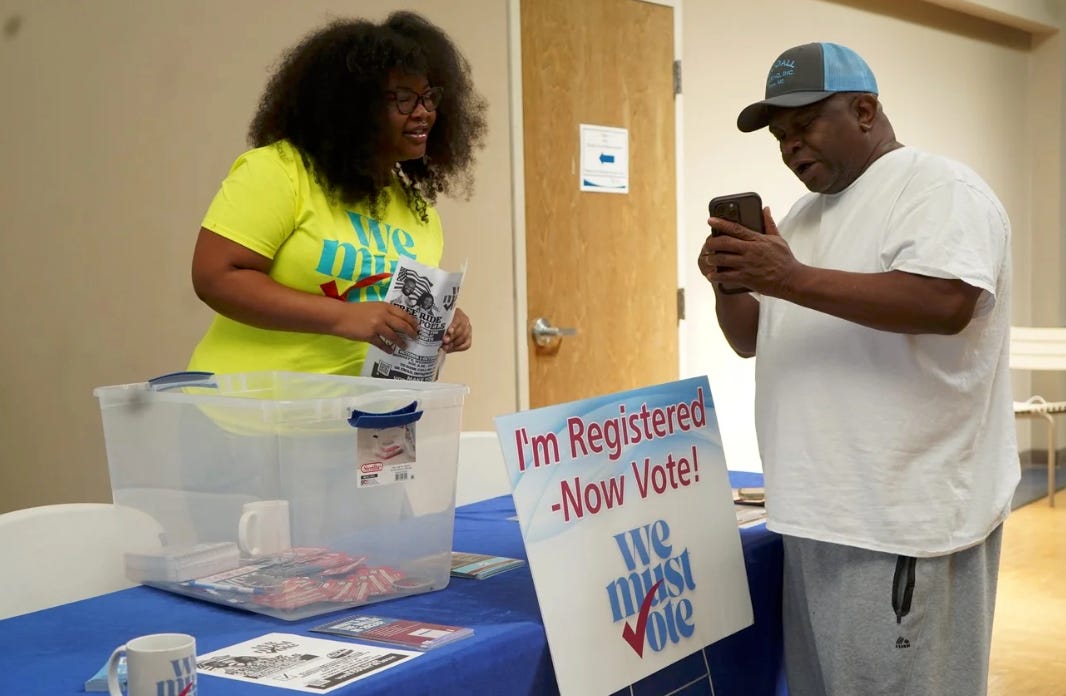
While the case—and, apparently, the constitutionality of forcing fair representation—rest in the hands of the Supreme Court headed by Chief Justice Roberts, Mississippi’s progressive organizations are not just waiting on a decision to be handed down. Groups such as One Voice and We Must Vote are conducting town halls across the state to inform people about the case, what their rights are and what’s at stake with a potential ruling.
The organizations are also undertaking massive voter education and registration campaigns. We Must Vote is engaging historically Black colleges and universities and other college and community-college campuses across the Delta and other rural areas to they help build and support local voting programs. They are also reaching out to older populations to ensure they are educated, registered to vote and have transportation to the polls.
Through Mississippi One Voice’s Election Protection work, the organization is working to ensure that “every Mississippian understands their rights before they ever enter a precinct.” That work includes supporting returning citizens in reinstating their voting rights, and over the course of the 2024 legislative session alone, they were able to assist 10 Mississippians in this restorative process.
With their focus on Section 2 of the Voting Rights Act, according to Politico, the GOP would strip political power from marginalized communities across the United States in an attempt to consolidate power in their hands, not just now, but for the foreseeable future.
Image: A voting rights worker assists a voter at an information table (via wemust.vote)
