


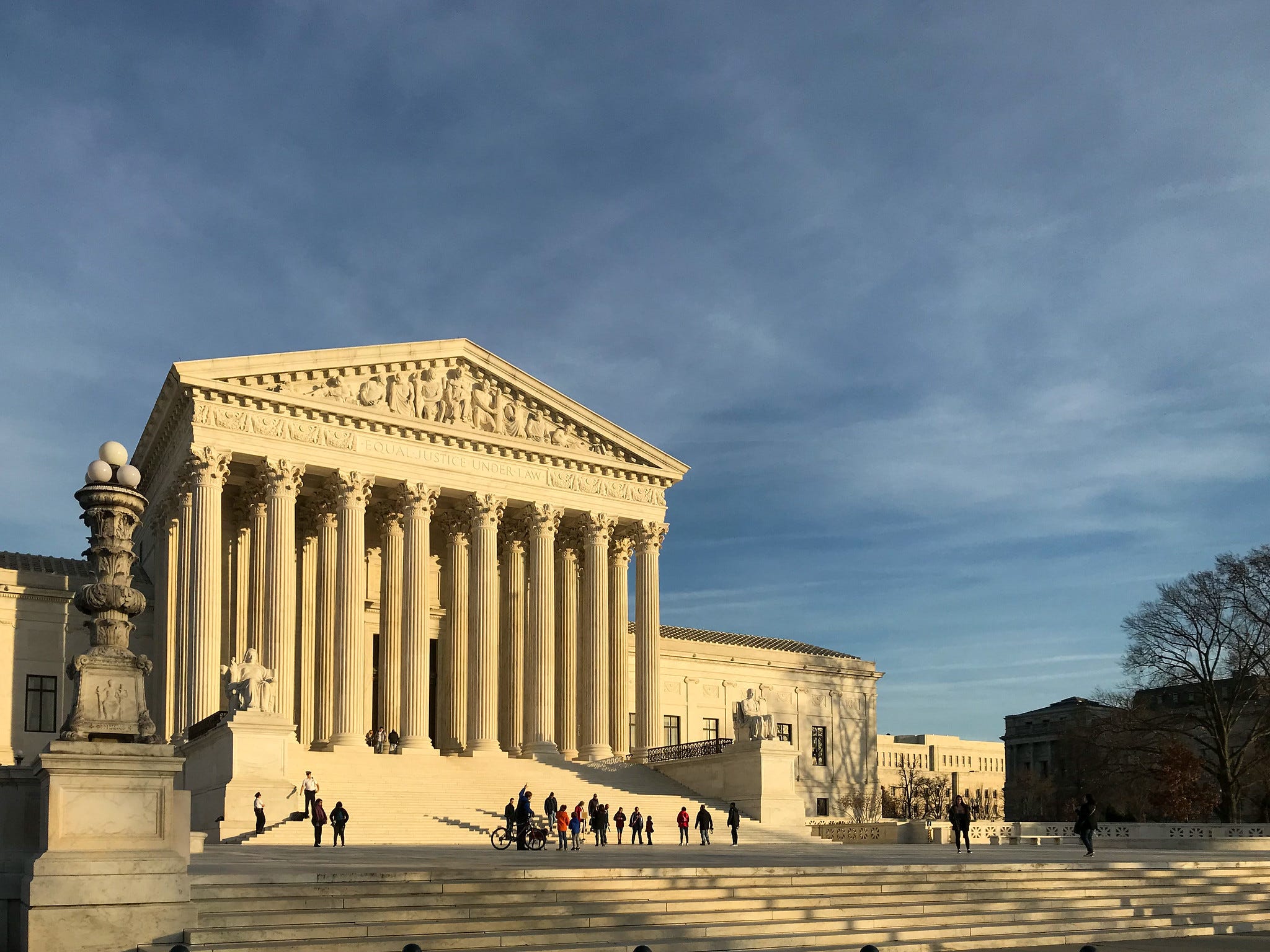
The U.S. Supreme Court on Monday vacated the federal court judgment that required Mississippi to redraw portions of its 2022 state legislative maps under Section 2 of the Voting Rights Act, remanding the case to the U.S. District Court for the Southern District of Mississippi for reconsideration in light of its own April 29 ruling in Louisiana v. Callais.
The summary disposition in State Board of Election Commissioners v. NAACP is the second Mississippi Section 2 case in eight days to be vacated and remanded under the Callais framework.
Justice Ketanji Brown Jackson dissented from the order.
“This case presents only the question of Section 2’s private enforceability, which our decision in Louisiana v. Callais did not address,” Jackson wrote. “Thus I see no basis for vacating the lower court’s judgment. Instead, in light of Morse v. Republican Party of Va., 517 U. S. 186 (1996), I would summarily affirm.”
Mississippi’s appeal to the Supreme Court had not challenged the lower court’s factual finding that several of the state’s 2022 legislative districts diluted Black voting strength. The state had instead asked the court to rule that private parties cannot sue under Section 2, leaving enforcement only to the U.S. Attorney General. The court’s order Monday does not resolve that question.
The Mississippi State Conference of the NAACP, joined by individual voters, sued the state in December 2022, alleging that the 2022 redistricting plans for the Mississippi House and Senate diluted Black voting strength in violation of Section 2 of the Voting Rights Act and improperly used race in drawing district lines in violation of the Equal Protection Clause. The lawsuit was brought by the American Civil Liberties Union, the ACLU of Mississippi, the Lawyers’ Committee for Civil Rights Under Law, the Mississippi Center for Justice, the Law Offices of Carroll Rhodes, and Morgan, Lewis & Bockius LLP.
A unanimous three-judge panel ruled on July 2, 2024, that the 2022 maps unlawfully diluted Black voting strength in three areas of the state. The court ordered Mississippi to redraw the maps, and special legislative elections were held in November 2025 under the court-ordered remedial plan.
Those special elections produced changes in the Mississippi Senate. Democrat Theresa Gillespie Isom won the newly drawn Senate District 2 in DeSoto and Tunica counties, becoming the first African American and the first woman to represent DeSoto County in the upper chamber. Her victory broke the Republican supermajority in the Mississippi Senate that had stood for six years. Isom was sworn in on Jan. 6, 2026. The Supreme Court’s order Monday returns the underlying legal basis for those remedial districts to the district court for reconsideration, but does not, on its face, affect elections already conducted or seats already filled.
The Callais decision narrowed the use of race-conscious remedies under Section 2 of the Voting Rights Act. The court ruled 6-3 that race-conscious redistricting under Section 2 cannot survive strict constitutional scrutiny solely because a state is seeking to comply with the Act. The decision has now been used as the basis for vacating two Mississippi Section 2 rulings within eight days. The Fifth Circuit Court of Appeals on May 11 vacated U.S. District Judge Sharion Aycock’s August 2025 order in White v. State Board of Election Commissioners, which had required Mississippi to redraw its state Supreme Court electoral districts. The Supreme Court’s Monday order vacates a separate ruling from the Southern District of Mississippi in a separate case challenging the state legislative maps.
Both Mississippi redistricting cases now return to district court for reconsideration under the framework Callais established. Plaintiffs’ counsel in both cases has indicated the litigation will continue. The ACLU of Mississippi said following the Fifth Circuit’s May 11 ruling in the state Supreme Court case that the organization is “ready to return to court” and will show that the state’s districts are discriminatory and violate federal law “even under Callais’ restrictive standards.” Plaintiffs’ counsel in the state legislative case has not publicly commented on Monday’s order at the time of publication.
The unanswered question Jackson identified in her dissent is whether private parties can bring lawsuits to enforce Section 2 of the Voting Rights Act, or whether enforcement is limited to the U.S. Department of Justice. Mississippi Attorney General Lynn Fitch’s office told the Magnolia Tribune in July 2025 that the state’s Supreme Court appeal would not affect the special elections then being prepared for, but would instead challenge what her office called a “very narrow legal issue.” That narrow legal issue is the private enforceability of Section 2. Private litigants, not the attorney general, have brought the overwhelming majority of Section 2 cases over the past four decades. A Supreme Court ruling that private enforcement is not permitted would limit Section 2 challenges to whatever the Department of Justice chooses to file. The court did not address that question in Monday’s order.
The order also vacated and remanded a separate Section 2 case from North Dakota, Turtle Mountain Band v. Howe, for the same reason. Jackson dissented from that order as well, with substantially identical reasoning. The court is using the Callais framework to vacate prior Section 2 victories across the Southern and Plains states, including cases that, by Jackson’s reading, involve legal questions Callais did not actually decide.
Gov. Tate Reeves, who canceled the May 20 special legislative session on the state Supreme Court redistricting on Wednesday, said in that announcement that he expects the Mississippi Legislature to take up redistricting more broadly in the 2027 regular session, including the state’s Supreme Court, state legislative, and congressional maps. House Speaker Jason White announced a select committee on May 6 that will spend the remainder of 2026 studying redistricting in advance of the 2027 session. President Donald Trump publicly urged Reeves on May 2 to expand the redistricting work to include the state’s 2nd Congressional District, currently represented by Democratic Rep. Bennie Thompson. The court’s order Monday vacating the state legislative ruling gives Mississippi Republicans an additional area in which the legislature, rather than a federal court, will now set the terms of the next redistricting fight.
The Mississippi State Conference of the NAACP and its counsel will now refile or reframe their Section 2 case in the Southern District of Mississippi under the Callais framework. The Mississippi Independent submitted a request to the Office of the Attorney General Lynn Fitch for comment on Monday’s order and on the state’s position on the private enforceability question that Justice Jackson identified. The Attorney General’s Office did not respond by the time of publication. The remedial state legislative maps used in the November 2025 special elections remain in place. The 2026 regular elections for Mississippi state House and Senate are scheduled for November 2027.
Image: U.S. Supreme Court building (via Flickr/massmatt)
