


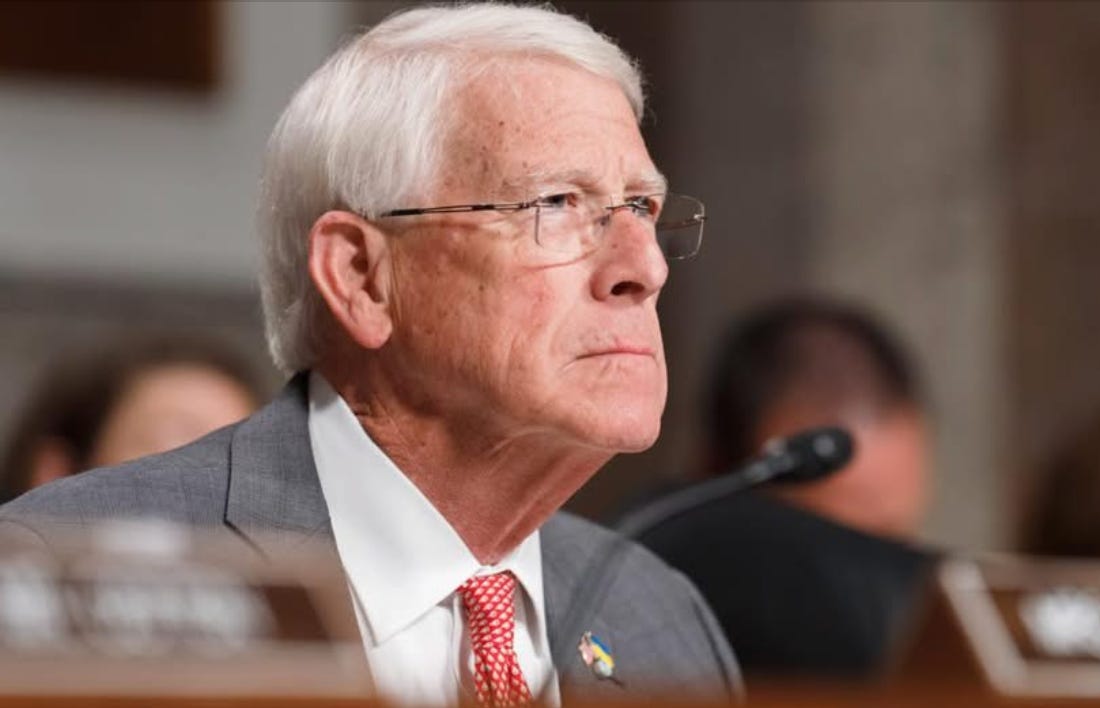
As chair of the Senate Armed Services Committee and Mississippi’s senior U.S. senator, Roger Wicker is navigating loyalty, dissent and congressional authority in response to President Donald Trump’s reshaping of executive power, raising questions about how much influence institutional Republicans can still wield.
Wicker pushed back recently against a proposed 8,500-bed immigration detention facility in the north Mississippi town of Byhalia, writing in a letter to the secretary of homeland security, Kristi Noem, that the project raised serious concerns about public safety, medical capacity and economic strain. At a time when GOP lawmakers routinely rubberstamp Trump initiatives, Wicker’s intervention marked the latest instance in which he has publicly broken with the administration on a high-profile policy issue.
For much of Trump’s second term, and, at moments, during his first, Wicker has positioned himself as a selective counterweight to the administration and the broader MAGA agenda. He has questioned the legality of controversial and deadly military operations targeting alleged Venezuelan drug-cartel boats and criticized elements of the administration’s foreign-policy posture. After Trump reposted a racist meme depicting former President Barack Obama and former first lady Michelle as apes, Wicker responded that it was “totally unacceptable” and wrote on X, “The president should take it down and apologize.”
Despite these departures, Wicker has largely remained one of Trump’s most dependable allies, advancing his defense priorities, praising the arrest of Venezuela’s authoritarian leader, Nicolás Maduro, and shepherding through contentious Pentagon confirmations.
That dual posture has placed Wicker in a unique position within today’s Republican party, allowing him to signal concern with aspects of the administration’s domestic and foreign policy while avoiding direct confrontation with a president who has shown little tolerance for dissent. The approach has also blurred the line between oversight and endorsement, intensifying debate over how far Wicker is willing, or able, to translate concern into concrete action to restrain executive power and protect Congress’s diminishing authority over the use of American military force.
“The way that Sen. Wicker is balancing praise and limited critique of the administration may give him access to the administration and more influence over the way his defense bill turns out,” observed Tori Bateman, director of advocacy at the Quincy Institute, a Washington, D.C.-based think tank that specializes in U.S. foreign policy and strongly advocates for diplomacy over war. “But it isn’t having a material impact on the big U.S. foreign policy decisions that are rocking the global system: threatening Iran, grabbing Maduro, boat strikes in the Pacific and Caribbean. Congress has the constitutional power of the purse, and of declaring war, but most in Congress, including Sen. Wicker, have gladly surrendered their power on these fronts.”
Appeasement in practice
The political tension is not unique to Wicker. It reflects a broader dilemma facing Republicans, some of whom are uneasy with Trump’s consolidation of power but unwilling to risk excommunication from a party he dominates. Wicker’s approach may represent the outer boundary of institutional resistance, or just diplomacy during an unusually volatile period in the nation’s capitol.
“Washington, D.C. is a small town with long memories and no permanent victories for either political party,” said Mackenzie Eaglen, senior fellow at the American Enterprise Institute, a center-right public policy research think tank based in the capital. “Professional relationships still matter in achieving policy goals. The tools available to members of Congress are many, including the soft skills of persuasion, coalition building, transparency and oversight, negotiation, and communication in a language other parties will understand and respect.”
Pros and cons
Wicker has helped advance many of the administration’s most consequential priorities, including backing a major increase in defense spending, supporting Trump’s executive-led invasion of Venezuela and Maduro’s arrest, and publicly dismissing allegations of war crimes tied to U.S. boat strikes against alleged drug traffickers. Arguably, his most controversial move was confirming Defense Secretary Pete Hegseth, drawing serious consternation from a prominent former Republican advisor.
“Witnessing the debasing spectacle of Wicker’s support for Hegseth is like watching a friend drink himself to death,” Stuart Stevens, a former GOP political Consultant from Mississippi who worked with Wicker and Republican politicians at all levels of politics, wrote in a Jan. 2025 New Republic article. “The sadness and pain are only enhanced by the knowledge that there is nothing to be done to stop the self-destruction.”
Stevens is now a senior advisor with the Lincoln Project, a moderate conservative pro-democracy organization based in Dallas, Texas.
As this article was going to press, Wicker’s office supplied the following comment to The Mississippi Independent: “Chairman Wicker has been able to work productively with the Pentagon and the White House to advance historic reforms and fund the rebuilding of the American arsenal. As Chairman of the committee, Sen. Wicker has been able to confirm national security nominees at a record setting pace while also passing a landmark NDAA the president enthusiastically signed into law.” Due to the timing of the response, the comment was not included in a previous iteration of the story, which noted in error that Wicker’s office did not respond to requests for comment from The Mississippi Independent.
The senator’s record of dissent extends back to Trump’s first term. In 2019, he voted against the president’s use of emergency powers to fund a border wall and raised concerns about White House skepticism of NATO, and warned against a rapid military withdrawal from Syria and Afghanistan.
During Trump’s second term, which is arguably a far more perilous environment for Republican dissent, Wicker has again stepped out of line at key moments. He rebuked Secretary Hegseth for what he called a “rookie” mistake in ruling out the return of Ukrainian territory seized by Russia, opposed proposals to restructure NATO and withdraw U.S. troops from Europe, urged the administration to abandon threats to annex Greenland, and called for an investigation into the use of encrypted messaging applications by Pentagon officials. He also expressed unease over a $400 million private jet reportedly given to Trump by Qatar.
And yet, somehow Wicker has managed to avoid a direct clash with the president.
“What you have to do when looking at issues today is ignore the media’s desire to force an us-versus-them construct and simply act on what you know is best,” said Hayes Dent of Hayes Dent Public Strategies, a public affairs and public relations firm based in Jackson, Mississippi. “Roger Wicker does that in an incredibly statesmanlike fashion. Where he can agree with the administration, he does… where they differ, he simply shows leadership that comes from a deep well of knowledge and smarts that he’s possessed over decades of political leadership for our state and nation.”
Though there is admiration aplenty for Wicker’s diplomatic style within the wider GOP family, questions remain about the effectiveness of his oversight, which, once launched, has often dissipated before it produces answers or actions. As chair of the Senate Armed Services Committee, he has the authority to compel testimony, demand documents and tie compliance to defense legislation. Yet the inquiry into the boat strikes, like other moments of apprehension with the administration’s conduct, stopped short of forcing a public reckoning over how and why American military power had been used without Congressional knowledge or approval—against people whose motivations were never proved, including the killing of survivors of one notable attack.
“If Sen. Wicker seriously wanted to take back these congressional powers, he could have supported any number of the War Power Resolutions or Joint Resolutions of Disapproval that came up in the Senate this past year,” Bateman argued. “He could have questioned, rather than praised, the insane suggestion that the military budget should be increased to $1.5 trillion despite the Pentagon’s continued failure to pass an audit. And he could have doggedly pursued real oversight and accountability on the boat strikes as he promised he would, rather than backing down after Administration briefings.”
However, Eaglen said, Wicker is operating within the narrow confines of what is politically viable. Angering Trump, in short, could leave him and Congress with even less influence.
“Choosing which battles to fight publicly versus privately often helps bolster one’s position for a more favorable outcome that endures,” Eaglen said.
Image: U.S. Sen. Roger Wicker (via Wicker.Senate.Gov)
