


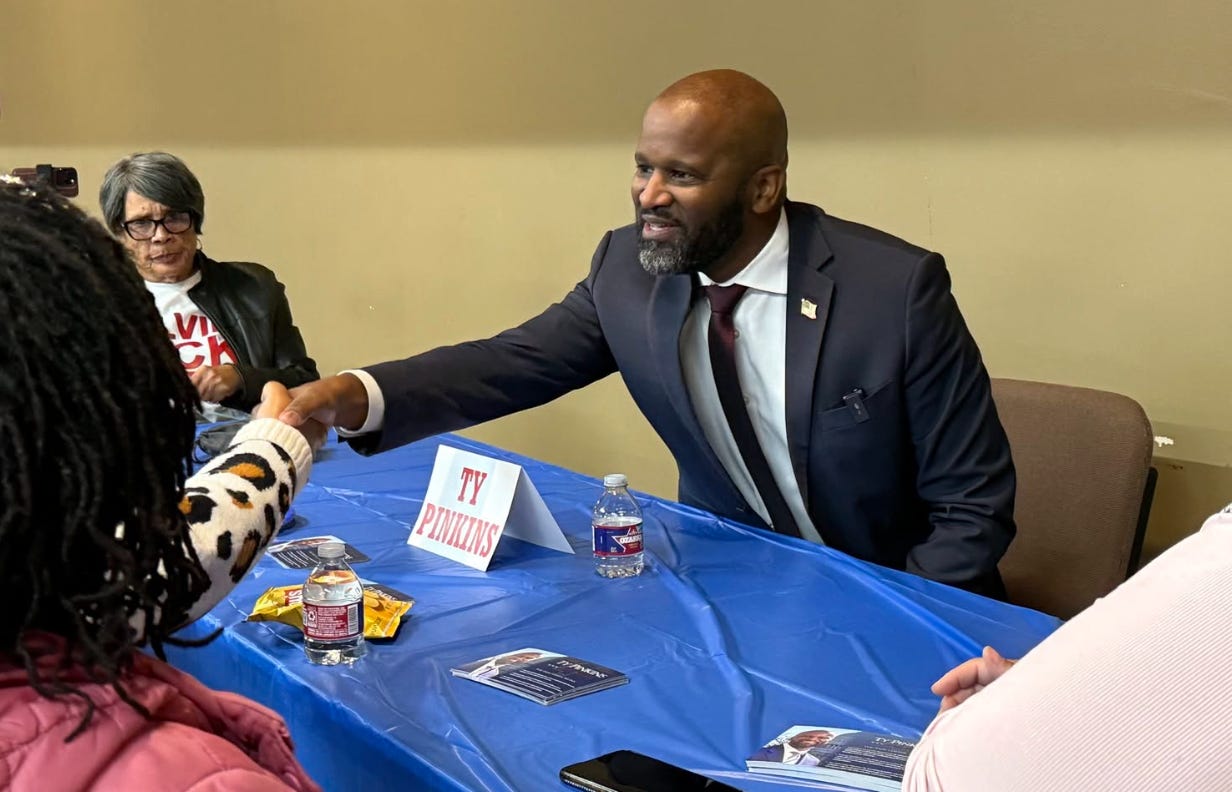
Ty Pinkins knows what movers-and-shakers in the state’s two political parties say about a Black independent running for the U.S. Senate in Mississippi: That he will split the Democratic vote and hand the seat to the Republican. Also: That someone must be paying him to do it.
In an interview with The Mississippi Independent, Pinkins rejected both ideas and turned the second charge back on anyone who makes it.
“Nobody has to pay me to stand up for the democracy that I love,” Pinkins said, noting that he served 21 years in the U.S. Army and practiced law for free in the Delta for the past six years. To suggest that a candidate must be a “bought” operative if he steps outside the two parties, he said, “is the most disrespectful thing you could say to a Black person that wants to be in a leadership position.”
Pinkins, an attorney and retired veteran from Rolling Fork, is running against incumbent Republican U.S. Sen. Cindy Hyde-Smith and Democrat Scott Colom in the Nov. 3, 2026, election. He was born in the Delta and raised poor, the first in his family to finish high school. He served in the Army from 1996 to 2017, deployed three times, and earned a Bronze Star, closing his career as a communications aide at the White House before earning a law degree at Georgetown. He returned to Mississippi and practiced law pro bono in some of the poorest counties in the state—work that included winning more than a million dollars for Black farmworkers who had been cheated out of their pay and suing the state over judicial district lines he argued diluted Black votes.
Pinkins was the Democratic replacement nominee for secretary of state in 2023 and ran for the Senate as a Democrat in 2024, when he lost to incumbent U.S. Sen. Roger Wicker. He left the party in 2025. In a public letter that year, he wrote that when he first entered the 2026 race, Democratic Party leaders urged him more than once to “make room” for another candidate and offered him undescribed incentives to step aside. He declined, and has said that national Democrats have continued to press him to leave the race, which he has refused to do.
The suspicion that trails him is not new to Mississippi. In 1978, Charles Evers, the Fayette mayor and civil rights figure, ran for an open U.S. Senate seat as an independent and drew about 22 percent of the vote, enough that many Democrats blamed him for taking votes away from the Democratic nominee and contributing to the election of the Republican, Thad Cochran, who won with a plurality and became the first Republican elected to the U.S. Senate from Mississippi since Reconstruction. Evers, who later moved rightward and endorsed Republicans, remains the cautionary tale Democrats reach for when a Black independent enters a statewide race. Pinkins embraces the comparison Democrats fear. Evers, he noted, pulled enough votes to deny the Republican a majority, which he reads as evidence of the leverage an independent can hold, not the damage of a spoiler.
Pinkins funds his campaign himself, from his military retirement and disability pay, and says he has taken no money from political action committees, super PACs or lobbyists, and has sent no fundraising emails or texts since January. His campaign reported about $630 in cash on hand in the first quarter of the year, against $2.5 million for Hyde-Smith and $560,000 for Colom. He argues the disparity is the point, that both major-party candidates answer to the donors funding them and he answers to no one.
A poll released this spring by the Colom-aligned SPLC Action Fund put the race at Hyde-Smith’s advantage. The poll put Hyde-Smith at 42 percent, Colom at 39 and Pinkins at 6, and found that a large majority of the voters open to Pinkins did not lean Democratic. Asked who he is drawing from, Pinkins said he takes votes “from across the spectrum,” and welcomes the finding that many of his potential supporters are conservative. The number that Democrats cite as proof he is a spoiler, he argued, is proof of the opposite, that he is reaching voters a Democrat cannot.
His larger argument is national. Pinkins says he is one of six independent veterans running for the Senate this year, in Idaho, South Dakota, Nebraska, Montana, Colorado and Mississippi, who mean to deny either party an outright majority and force both to bargain. In three of those states—Nebraska, Idaho and South Dakota, the Democratic nominee has dropped out to clear the way for the independent, a step Mississippi Democrats have declined to take for Pinkins. He points to the arithmetic of a state that has not sent a Democrat to the U.S. Senate since 1982 and asks why the party keeps running the same race. “Why don’t we try something different?” he asked.
Whether that argument moves voters is a separate question from whether it is sincere, and Pinkins insists the sincerity is the whole point. He is on the ballot regardless. “Nobody forced me to put my name on the ballot,” he said. “I did that, and when I put my name on the ballot, I have to be open to answering difficult questions.”
Image: Ty Pinkins (via Ty Pinkins for Mississippi Facebook page)
