


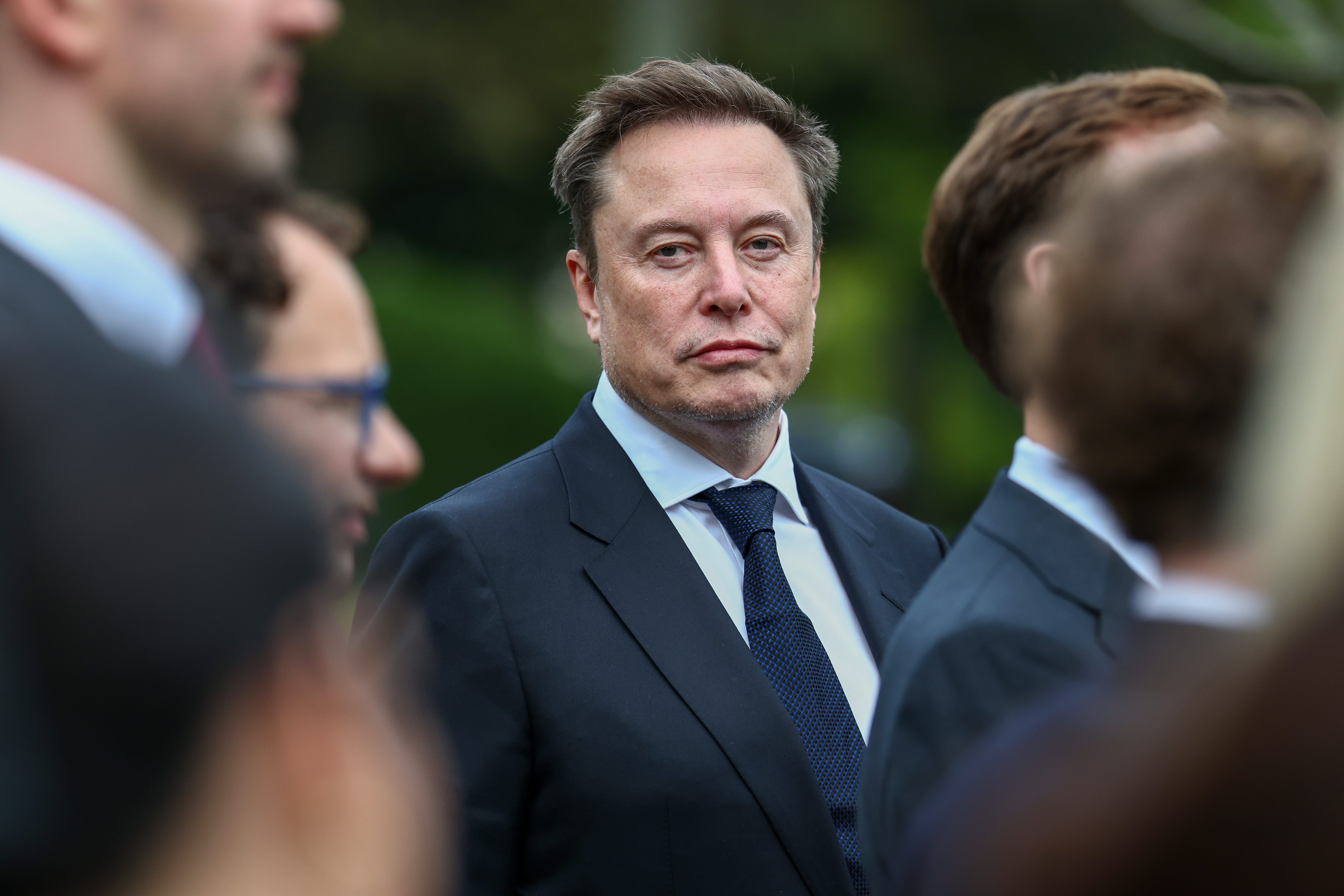
As Elon Musk announced two more data centers at his Southaven supercomputer site last week, Entergy officials have backed away from promises that its customers won’t foot the multibillion-dollar power infrastructure bill for a gargantuan project in neighboring Louisiana.
Meanwhile, a public backlash against data centers came to the fore in the Nov. 3, 2026, elections, when voters across the United States overwhelmingly rejected data center projects and initiatives.
Perhaps unsurprisingly, Musk is not backing down on the Southaven project, which has forged ahead despite local opposition.
“I walked the whole Colossus 2 site around midnight and again this morning,” Musk wrote on the social media site X, which he owns. “Good progress by the SpaceX team and contractors. Gun Range is tracking to be operational by end of November and Spam in December.”
The two developments will become part of the company’s Colossus 2 facility, spanning multiple sites along the Mississippi-Tennessee border south of Memphis.
The news came after The Mississippi Independent asked SpaceXAI, eight Southaven officials and the Mississippi Department of Environmental Quality to confirm plans for the previously unreported SPAM facility, named after the SPAM meat manufacturing plant it will eventually replace. None of the entities provided answers.
The flurry of activity sharpens questions confronting communities across Mississippi about who bears the financial and environmental cost of the state’s data center boom. Behind promises of jobs and billions in investment are enormous electricity demands, concerns about pollution and public health, and deals whose details remain hidden from the public.
As construction races ahead in Southaven, residents are pressing for answers about what they could lose, from affordable power to quiet neighborhoods, and whether they will get a meaningful say before the decisions shaping their communities for decades have already been made.
The broader Southaven development is expected to include six data centers and generate 100 jobs. But like numerous other data center projects unfolding across the state, the developments come with an array of massive, sometimes decades-long tax incentives, as well as concerns about the environment and electricity costs.
Who foots energy bill for data centers
Who pays for high data center electricity use and the infrastructure to support it has been one of the central questions residents nationwide ask. Entergy, the utility company that supplies power to consumers in parts of Mississippi, Arkansas, Louisiana and Texas, told The Mississippi Independent in October 2025 that data centers would drive “down electricity prices for everyone,” despite company documents clearly showing that wasn’t true. The company hasn’t budged from that position in Mississippi.
But in Louisiana, that promise has begun to crumble in recent weeks.
Entergy acknowledged during an Oct. 7 public service commission hearing that ordinary customers could end up paying part of the roughly $20 billion power infrastructure bill for Meta’s massive AI data center near Monroe, despite earlier assurances that the tech company would cover the costs. Entergy executive Ryan Jones said customers could face costs if Meta leaves early, and even if it stays for its full 20-year agreement, because some power plants would still not be paid off. Entergy maintains the project will save other customers $4 billion over two decades, but Jones conceded those savings are not guaranteed, WWL Louisiana reported.
That rare acknowledgment raises questions about whether Mississippi ratepayers will end up footing the power bill for data centers. Entergy did not respond to questions about whether its position in Mississippi had changed.
Multiple generators proposed for data center in Rankin County
The Mississippi Department of Environmental Quality is also weighing whether to grant a Rankin County-based data center developer a permit to use 50 diesel-powered backup generators during emergencies, testing and maintenance. If approved, MDEQ’s permit would allow AVAIO Digital to run the engines without limit during emergencies and for 100 hours per engine annually for maintenance. Each 3,000-kilowatt engine can burn through its 5,600-gallon tanks in about 27 hours. The permit doesn’t clearly define what constitutes an emergency. According to federal energy data, Mississippi had some of the nation’s most frequent power outages, ranking fourth among states in 2025 and fifth in 2024, averaging about 2.5 interruptions annually.
Running together, the 50 engines would consume about 250,000 gallons of diesel in 24 hours, according to a February 2025 California state government analysis of the same engine model. If all 50 diesel generators ran at full power for an hour, they could release roughly as much smog-forming nitrogen oxide pollution as 34,000 gasoline vehicles each driving 50 miles—even with their pollution controls working, according to California estimates for the same engine model and California vehicle emissions figures.
MDEQ opened a 30-day public notice period on the permit application on Oct. 28, 2026.
A federal judge ruled on Oct. 30 that SpaceXAI’s gas turbines, used to power its operational data centers while it refurbishes a power plant in Southaven, do require air permits to operate, rejecting the company’s argument that the equipment was exempt and allowing the NAACP’s Clean Air Act lawsuit to proceed.
While individual agreements vary, Mississippi offers qualifying data centers 10-year exemptions from sales and use, corporate income and franchise taxes, along with separately negotiated local property tax reductions that can extend across 30 years, though each piece of property qualifies for no more than 10 years.
Most financial details remain secret, including exactly how most energy-hungry data centers will be powered and who will ultimately pick up the bill. Some facilities will require as much power as a small city. In the case of Meta’s Louisiana plant, that could mean that ratepayers will be required to foot at least part of the bill while being shut out of the decision-making process.
The first public acknowledgment of Project SPAM appeared in state records on Oct. 16, 2026, when MDEQ’s Office of Pollution Control granted SpaceXAI subsidiary company MZX Tech a large construction stormwater permit for 2929 Stateline Road. An Environmental Protection Agency facility report also referenced the SPAM facility. The permit allows work that will disturb up to 32.5 acres on at the property.
The permit application, filed Sept. 14 by MZX, describes the project as a data center involving “partial demolition and renovation of existing structures and construction of additional industrial facilities.” The application requested Oct. 5 as the construction start date, 11 days before the permit was granted. MDEQ rules require permit applications to be submitted 30 days before construction.
Whether work began is not clear. The company faces potential penalties of about $6.1 million over alleged construction-permit violations at three other data center facilities, according to media reports. The state is currently fining the company $25,000 per day.
State records also list an Oct. 13 inspection related to a water permit. The Mississippi Independent could not find any other permits for Project SPAM in state records.
According to DeSoto County land records, SpaceXAI bought the SPAM property on Sept. 28, 2026, underlining the blistering speed of development at the site and raising questions about how city and state officials have been able to review and approve planning, design, construction and eventual operational plans, including a public comment period.
Southaven officials silent on SPAM data center approvals
Mayor Darren Musselwhite and Southaven’s seven aldermen did not respond to questions about which planning, design and construction approvals the SPAM facility had received. The project and its address did not appear in the meeting agendas and minutes that The Mississippi Independent reviewed, though city officials discussed other data center sites as recently as September.
The Mississippi Department of Environmental Quality has not said publicly whether its stormwater permit covers the full scope of construction, what other approvals might be necessary or what would be required to connect the facility to a nearby SpaceXAI power plant. Contacted by The Mississippi Independent, MDEQ said that information would require a public records request.
MZX Tech purchased more than 150 acres in Southaven during the last two weeks, according to recent DeSoto County land transactions. The company isn’t just buying up commercial properties. In an Oct. 1 blog post on the mayor’s website, Musselwhite said MZX Tech was offering to buy some homes near its industrial operations. He said the purchases would help address effects on neighbors and provide housing for company workers.
“This has been part of a comprehensive plan for many months for multiple reasons,” Musselwhite wrote. “Since my very first discussions with them, they’ve understood the importance of eliminating any invasive or disruptive impacts to the residential neighborhoods near their operations.”
Musselwhite acknowledged that noise had been a legitimate concern, while saying operations had not violated the city’s noise ordinance. The company, he wrote, had spent millions of dollars “to resolve this matter” as part of a parallel approach that includes the conversion to quieter turbines.
The mayor said in his post that in exchange for what he described as “favorable” real estate terms, SpaceXAI would expect homeowners to sign a litigation waiver. However, some residents claim the company, owned by the world’s richest man, is lowballing them.
County records show that about a dozen residents have sold their homes, with a steady stream of deeds being filed with the county during the last 10 days. The buyout program seeks to purchase 418 homes.
Image: Elon Musk at a September 2026 meeting of AI officials at the White House (Getty Images)
