


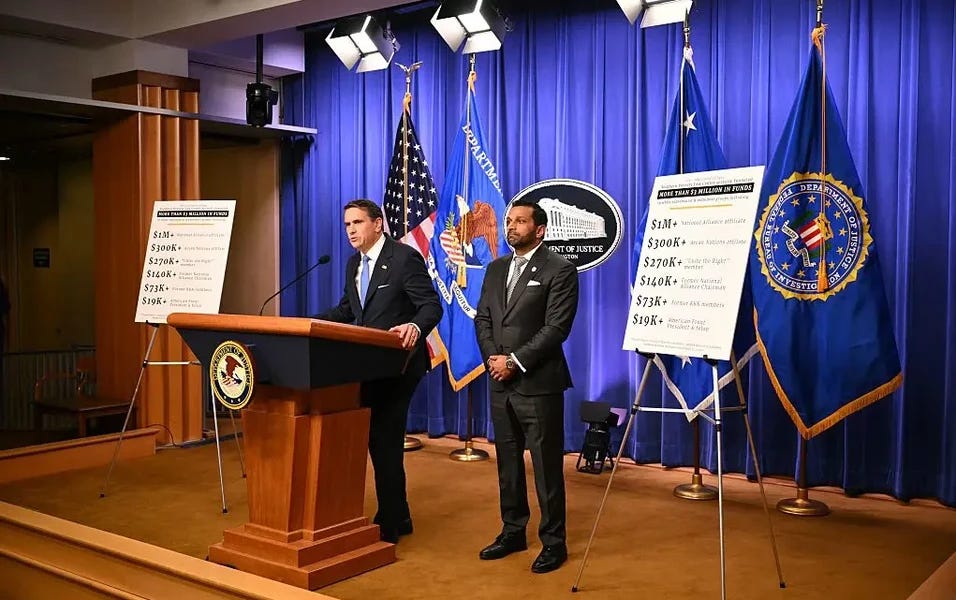
After a federal grand jury indicted the Southern Poverty Law Center for fraud and money laundering on April 21, 2026, the issue became whether a weaponized U.S. Department of Justice can bring down a venerable civil rights organization.
A federal grand jury in Montgomery, Alabama returned an 11-count indictment on April 21 charging the Southern Poverty Law Center with wire fraud, bank fraud and conspiracy to commit money laundering in connection with a confidential informant program that the 55-year-old civil rights nonprofit operated between 2014 and 2023.
The indictment alleges that SPLC funneled more than $3 million in donor funds to individuals associated with violent extremist groups, including the Ku Klux Klan, Aryan Nations and the National Socialist Party of America, without disclosing the payments to donors or to banks. Acting Attorney General Todd Blanche and FBI Director Kash Patel announced the charges at a joint news conference at the DOJ. SPLC has denied the allegations and said it will defend itself in court.
The indictment does not allege that any SPLC funds were used to carry out acts of extremist violence, and former federal prosecutors interviewed by CBS News have questioned the underlying legal theory, noting that it is not clear how SPLC’s use of paid informants to monitor hate groups—a practice that law enforcement agencies themselves routinely use—constitutes fraud against donors whose stated purpose was to fund the organization’s work against those same groups. FBI Director Patel said in October 2025 that the bureau would sever its long-running intelligence-sharing relationship with SPLC, which Patel called a “partisan smear machine.”
The indictment came in an environment in which the Trump administration has openly discussed using federal power to pressure nonprofits whose work the administration opposes. In September 2025, Vice President J.D. Vance singled out the Open Society Foundations and the Ford Foundation as possible targets for tax-exempt status revocation. Earlier in the year, President Donald Trump suggested Harvard University should lose its tax-exempt status and be treated by the IRS as a political entity. Administration executive orders have directed the IRS to ensure that no tax-exempt entity is directly or indirectly financing what the orders describe as political violence or domestic terrorism, and to refer organizations, employees and officers to the DOJ for prosecution.
Whatever the legal merits of the SPLC indictment, the prosecution sits inside an older American pattern. Presidents across parties have reached for the machinery of federal tax administration and prosecution to discipline political adversaries and civil-society organizations perceived as threats to their political projects. The most fully documented example is also the one whose central documents read most closely like present-day administrative rhetoric.
President Richard Nixon’s White House operated the most explicitly recorded presidential enemies program in United States history. Beginning in 1971, special counsel Charles Colson and his aide George T. Bell compiled what the administration itself labeled the Opponents List and the Political Enemies Project. A memo from White House counsel John Dean dated Aug. 16, 1971, described the purpose of the project in language that has survived six decades of federal document preservation: how the available federal machinery can be weaponized against perceived political enemies. The stated tools were IRS audits, manipulation of grant availability, manipulation of federal contracts, litigation, and prosecution. The list eventually included more than 200 people, among them Democratic members of Congress, journalists, academics, labor leaders and civil rights figures.
The enemies program had a structural limit. Internal Revenue Service Commissioner Donald C. Alexander refused to conduct the requested audits. His successor, Johnnie M. Walters, received the enemies list in 1972 and set it aside; he later provided it to Congress during the Watergate investigation. The 1974 impeachment articles against Nixon cited the enemies program as a basis for impeachment. The civil servants at the IRS who declined to execute the operation provided the bureaucratic friction that the formal oversight structures, on their own, would not have delivered. Nixon resigned. The memos survived. The statutes they relied upon remained in place.
Mississippi occupies a particular place in the history of the use of tax-exempt status as an instrument of federal policy toward nonprofits. The principle that the IRS can withdraw tax-exempt status from organizations based on the character of their activities was established in a 1971 federal case brought by Black parents in Holmes County, Mississippi. The parents sued the U.S. Treasury Department to bar tax-exempt status and deductible contributions for Mississippi segregation academies that had been established across the state after the 1969 U.S. Supreme Court ruling ordering public school integration. The three-judge district court panel, ruling in Green v. Connally, summarily affirmed by the Supreme Court as Coit v. Green later that year, established that neither Section 501(c)(3) nor Section 170 of the Internal Revenue Code permitted tax-exempt status or deductible contributions to any organization operating a private school that discriminated in admissions on the basis of race. The Internal Revenue Service implemented the ruling through nationwide procedures requiring private schools to operate on a racially nondiscriminatory basis to receive tax-exempt recognition.
The Holmes County case is the foundational American precedent for the idea that tax-exempt status can be withdrawn from nonprofit organizations based on the character of their work. Mississippi Black parents used the tax-exempt regime to defend civil rights against an organized white-supremacist response to desegregation. The same legal mechanism, now administered by a different administration with different priorities, is being turned the other way. The administration that is threatening to revoke the tax-exempt status of civil-rights organizations and that has now indicted the Southern Poverty Law Center is doing so under statutory authority that Mississippi civil-rights plaintiffs helped establish.
The SPLC indictment is not the first federal move against the organization under the second Trump administration. In the early months of 2025, the Department of Government Efficiency cut federal grants and contracts to organizations the administration identified as politically aligned against it, including SPLC. The FBI, under its director, Patel, ended its longstanding intelligence-sharing relationship with SPLC in October 2025. Congressional Republicans on the House Judiciary Subcommittee on the Constitution and Limited Government held a hearing in December 2025 titled Partisan and Profitable: The SPLC’s Influence on Federal Civil Rights Policy. Each step narrowed SPLC’s federal footprint before the April indictment put the organization itself on trial.
The ramifications extend beyond SPLC. A federal fraud prosecution against an established civil rights organization sends a signal to every nonprofit operating in politically sensitive territory about the reach of federal enforcement, the vulnerability of donor relationships to federal scrutiny, and the cost of operating programs that draw administration opposition. Tax-exempt status is an ordinary feature of American civil society, covering churches, universities, hospitals and civic associations across the political spectrum. The prospect of its revocation, even when revocation is legally unlikely, introduces an enforcement risk that affects how boards of directors, general counsels and major donors assess ongoing operations.
Kimberly Jones Merchant, president and CEO of the Mississippi Center for Justice, said in response to questions submitted by The Mississippi Independent that her organization understands the SPLC indictment in the context of a broader pattern, not as an isolated prosecution.
“At a time when organizations working to advance justice and civil rights are increasingly under attack, it is difficult to view this moment as isolated from a broader effort to discredit and silence organizations that challenge injustice and speak hard truths,” Merchant said. She said many in the sector understand the moment as “a larger environment in which organizations working to advance civil rights, voting rights, and access to justice are facing increasing hostility, scrutiny and attempts to undermine public trust in their work.”
Asked whether the Mississippi Center for Justice had made operational, programmatic or governance changes in response to the current federal environment, Merchant said the organization has been “intentional about protecting our mission, our staff and the communities we serve,” including through continued attention to “governance, operational integrity, security, internal systems and thoughtful decision making.” She framed the posture as proactive rather than defensive. “The goal is not retreat,” Merchant said. “It is resilience.”
Merchant said peer organizations and funders should understand that the pressures on the SPLC reach beyond the specific case. “These attacks are not just about one organization,” she said. “They are about weakening the broader ecosystem of groups working to build a more just and inclusive society.” She said the public may see a headline, but the less visible cost is “the strain these moments place on advocacy organizations, their staff and the communities that rely on them. This moment calls for steady support, partnership and resolve.”
The Mississippi Independent also reached out to four other nonprofit organizations with Mississippi operations or ties, none of which responded, perhaps indicating their reluctance to take a visible stance in the current environment.
The response to indictment illustrates a dynamic that has quietly unfolded across the nonprofit sector since the 2025 inauguration. Some organizations have adjusted their public language, withdrawn from coalition statements, renamed or reorganized programs, or scaled back external communications on issues the administration has identified as priority targets. Law firms, universities and major foundations have all faced public pressure to modify their commitments on diversity, immigration, and civil-rights-adjacent work. The adjustments have sometimes been characterized by the organizations making them as prudent risk management and sometimes by their critics as preemptive capitulation. The line between the two is contested and will be contested further as the SPLC case proceeds.
The Nixon enemies program contributed to the president’s resignation—it was an apologetic acknowledgment by the Justice Department and through a set of congressional reforms. It did not end the statutory authorities that the program exploited. The Holmes County plaintiffs established in 1971 that tax-exempt status could be an instrument of civil rights enforcement; the Trump administration is now treating it as an instrument of civil rights restriction. The SPLC indictment is the current occasion for that underlying machinery to be deployed. For Mississippi organizations whose work touches voting rights, legal aid and civil rights, the question is how to address this new outcropping of presidential retribution.
Acting Attorney General Todd Blanche beside FBI Director Kash Patel at a news conference in Washington, D.C., April 21, 2026 (via MSN.com)
