


Amid heightened concern about the potential for interference in the midterm elections, numerous sites offer guides to voters’ rights. The guidance applies to any Mississippi election but has taken on greater urgency in the current political environment.
Polls will be open from 7 a.m. to 7 p.m. on Nov. 3. Anyone who is already in line to vote by 7 p.m. has the right to cast a ballot even after the polls officially close.
Among the information provided in election guidance from the Secretary of State’s office and multiple voting rights organizations is how to ensure that a person is registered to vote and what to do if your name does not show up in the precinct list.
Should a voter’s name not appear in the precinct’s registered voter list for any reason (change of address, long voting inactivity, etc.), the person can request an affidavit ballot, which enables them to cast a vote, then prove their registration at the county circuit clerk’s office within five days. If the person is unable to prove they are registered to vote within that timeframe, their ballot will not be counted.
Voters can find their registration status here.
Mississippi also has a voter ID law, which means that everyone must present a valid photo ID to vote. The Secretary of State’s office provides a list of acceptable forms of ID. A valid driver’s license is not required if another acceptable ID is presented.
Voters can find their polling location and view sample ballots at the Secretary of State’s My Election Day page. Additional information can be found on the agency’s Y’all Vote webpage.
The website of the Fair Elections Center, a nonpartisan, national nonprofit, provides general guidance about voting rights and what to do if those rights are challenged. The site includes a specific Mississippi voting guide and a database of local elections officials.
The Fair Elections Center notes that SB 2588, known widely as the SHIELD Act, which took effect on July 1, 2026, creates what it describes as “an onerous and unfair citizenship checks process for Mississippi that could create barriers for many eligible citizens to register and stay on the voter rolls.” The Fair Elections Center, along with its voting rights partners in Mississippi, contend that the law violates the National Voter Registration Act of 1993 (NVRA) and could face litigation.
Does that mean a Mississippi voter is required to prove U.S. citizenship? The short answer is: Only if elections officials have been unable to match a voter’s name with a citizenship database, the latter of which is unfortunately not always a reliable source.
According to the Mississippi Center for Justice, “Most voters will likely see no immediate changes. However, if voter registration records cannot be matched with available government records, some individuals may receive a notice requesting additional proof of citizenship.”
The Mississippi Center for Justice notes that certain groups, including older adults, low-income residents, incarcerated people, naturalized citizens and individuals without easy access to personal records could face challenges if asked to provide proof of citizenship documentation. Anyone who faces such a problem is advised to call the MS Votes Hotline (1-833-678-4321).
The Fair Elections Center’s general voting guide includes the following:
Rights under federal law
All voters have the right to vote free of intimidation, including from law enforcement, military or other federal agents.
It is illegal for anyone to try to or actually intimidate, threaten or coerce someone who is voting or trying to vote, or someone who is helping a person to vote. By law, members of the military, state and local law enforcement, and federal agents, including ICE, may not intimidate or prevent a qualified voter from voting through force, threat or other action. It does not matter if the intimidation is deliberate, only that the voter, or the voter’s helper, feels intimidated.
Beyond the federal laws against intimidation, it is illegal for any person in the U.S. civil, military or naval service to order troops or armed federal agents to any place where an election is being held. By law, officers of the U.S. military may not interfere with the freedom of any election or the exercise of the right to vote in any state.
All voters have the right not to be discriminated against based on race, national origin or disability.
All voters who need assistance due to a disability or the inability to read and write in the language of the ballot may choose someone to help them vote, so long as the person is not an agent or representative of the voter’s employer or union.
If a voter has questions or needs assistance at the polls, the best person to speak with is a local election worker. Poll workers are members of the voter’s community and work for the municipal or county government rather than the federal government.
If a voter observes violations of any these rules, they are encouraged to call 1-866-OUR-VOTE, the Election Protection Hotline. Voters can report anonymously. If someone is voting in person and feels comfortable doing so, they can quietly report their concerns to an onsite poll worker. Voters are advised not to approach, speak to or otherwise engage a law enforcement officer.
Rights when checking in to vote
You have the right to vote by affidavit ballot if you have moved to a different address within the same county but did not update your registration information.
Only the following people can challenge a voter’s right to cast a ballot:
A candidate whose name is on the ballot
An official poll watcher for a candidate or party
A qualified elector (voter) from the precinct
A poll manager or worker in the polling place
The registrar in the registrar’s office where the person who is being challenged is registered to vote
Voters cannot be challenged at the polls by anyone else.
Voters may only be challenged on the following grounds:
Whether they are registered to vote in the precinct
Whether they are the registered voter on the rolls
Whether they have already voted
Whether they are a resident in the precinct
Whether they have legally registered to vote
Whether they have removed their ballot from the polling place
Whether they are disqualified to vote
If a voter is challenged, the poll managers in the precinct must consider the challenge when it is raised.
Challenges cannot be based on characteristics such as race, ethnicity, national origin or any other characteristics not relevant to voter qualifications.
Challengers cannot communicate with voters or touch any part of your ballot.
It is the burden of the poll watcher to prove that the voter is not qualified—not on the voter to prove that they are qualified.
Right to vote after a challenge
Poll managers will consider all challenges when they are raised.
If the poll managers unanimously agree that the challenge is well taken, the vote will be rejected entirely and not counted.
If the poll managers unanimously agree that the challenge is frivolous and not made in good faith, the poll managers will ignore the challenge and the voter can vote in the same way as everyone else in the precinct.
If the poll managers do not unanimously agree, the challenged voter can still cast their vote by paper ballot. That ballot will be marked “challenged” and counted separately.
If a voter does not appear in the poll books or does not have an acceptable form of photo identification, they can still vote using an affidavit ballot by voting with a paper ballot and signing a written affidavit saying they are qualified to vote.
Q&A: rights inside the polling place
What can poll workers ask me?
The poll worker will check for your name in the poll books, then ask for your ID. However, you have the right to vote even if you don’t have an ID, so long as you sign a statement as to your identity. Poll workers may ask for your address to confirm you are voting in the right precinct.
Who can I speak to if I am having any issues or problems with a poll worker?
You have the right to ask questions and can speak to the poll manager onsite. If that does not resolve the issue, call Election Protection.
I notice some poll watchers are taking photographs inside the polling place. Is that allowed?
Poll watchers may not interfere in the election process, compromise a voter’s privacy or intimidate a voter. They may not photograph poll books or receipt books while at the polling place. If you feel as if poll watchers are taking photographs in order to intimidate you, contact a poll manager or Election Protection.
Who gets to decide who is allowed inside the polling place?
The poll managers determine who may be inside the polling place. They may remove someone from the premises if they are hindering or delaying a voter or impeding the orderly conduct of the election. It is illegal to congregate or loiter within 30 feet of the entrance to any polling place, and poll managers are instructed to keep the area clear of all people except for election officials.
Who can I talk to if someone is trying to get in the way of me completing my ballot?
Talk to the chief poll manager on site. If this does not resolve the issue, call Election Protection. Challengers cannot speak to voters, who have the right to mark their ballot in private, free from intimidation or interference.
What are my rights if I need help voting?
Voters are entitled to assistance if they are blind, disabled or unable to read or write. A voter who qualifies for assistance may bring a person of their choice to help them vote. The person providing assistance can be anyone except for a candidate whose name is on the ballot; the spouse, parent, sibling or child of a candidate whose name is on the ballot; a poll watcher who is observing in the polling place on Election Day; the voter’s employer or a representative of the voter’s employer; or an officer or agent of the voter’s union.
A physically disabled voter who drives or is driven to the polling place but is unable to enter the polling place is entitled to vote curbside.
Election Protection is available to any voter who needs help, including with language assistance, at the following numbers:
1-866-OUR-VOTE (English)
1-888-VE-Y-VOTA (Spanish)
1-888-API-VOTE (multiple Asian languages)
1-844-YALLA-US (Arabic)
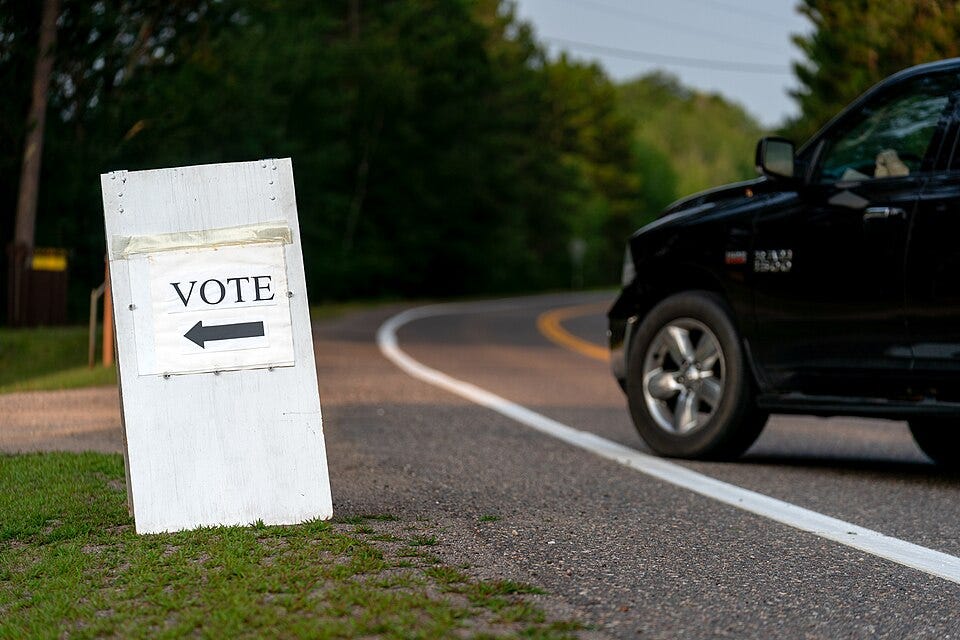
Image: Voting precinct sign (via Wikimedia Commons)