


Lawyers for a transgender woman held since January 2026 in the men’s dormitory of a Mississippi immigration detention facility are fighting a federal judge’s recommendation to dismiss her unlawful-detention claim, arguing that the government locked her up without due process.
The Center for Constitutional Rights, which represents Sabrina Carmona Sanchez, 41, filed objections on May 15 in the Southern District of Mississippi, asking the federal judge to reject the recommendation and release her from confinement, according to legal documents Sanchez’s legal team shared with The Mississippi Independent.
The lawyers filed what’s known as a habeas corpus petition, a challenge to the government’s authority to keep someone in custody and, more recently, one of the few ways detainees denied a bond hearing can seek federal court review of the legality of their detention.
“Ms. Carmona Sanchez’s detention is attributable to the government’s policy to categorically deny her (and thousands of others like her) the opportunity for release on bond or recognizance,” her lawyers wrote in the filing.
Sanchez’s court filings in the Southern District of Mississippi reveal the messy nationwide legal drama that has caused a constitutional crisis among the nation’s 13 federal appeals courts, which disagree on the constitutionality of the Trump administration’s July 2025 immigrant detention guidance, which states that any undocumented immigrant arrested could be held in custody without offering them the opportunity to contest their detention or seek bond.
Like anyone else in the United States, Sanchez is entitled to know why she is being detained and, not withstanding a narrow set of circumstances, an opportunity to be released on bond.
“The undisputed record before this Court demonstrates that Ms. Carmona Sanchez received no pre-deprivation process whatsoever to challenge her current detention, which began on January 3, 2026,” the filings noted.
Her case is not about whether she will ultimately be allowed to remain in the U.S. That is already in motion within the immigration courts. This case asks whether the government can detain her without the opportunity to post bond while those proceedings continue.
No-bond policy
For decades, immigrants arrested inside the U.S. were treated as eligible to seek bond from an immigration judge while their cases proceeded. The Trump administration adopted a broader interpretation. While most district judges rejected the guidance, federal appeals courts are split over the issue.
“District court judges across the country said, ‘You can’t just start interpreting immigration detention laws differently,’” said Brandon Riches, an Ocean Springs immigration attorney who represents many immigrant detainees with habeas cases in the Southern District of Mississippi. “But the big Fifth Circuit decision in February kind of foreclosed a big chunk of the claims.”
Several district courts have rejected the administration’s position, but in February, the Fifth Circuit Court of Appeals upheld Trump’s legal interpretation in Buenrostro-Mendez v. Bondi, sharply limiting bond eligibility for immigrants who entered the country without inspection.
“So, attorneys started filing habeas cases,” Riches said. “It was initially widely successful across the country.”
The ruling has created a bizarre situation where Mississippi, Louisiana and Texas have become a haven for the Trump administration’s harshest immigration policies.
Because habeas petitions are generally filed where a person is detained--not where they lived or were arrested, geography can decide the practical outcome. An immigrant arrested in New York but transferred to Mississippi is litigating in the Fifth Circuit.
That distinction is central to Carmona Sanchez’s case. Her lawyers are not relying only upon the statutory argument that the government has misread immigration detention law. They also argue that the government created liberty interests when it briefly detained her at the border, released her, and granted her work authorization—before detaining her again.
“Since Ms. Carmona Sanchez gained independent liberty and property interests when the government granted her release on recognizance and work authorization, the Fifth Amendment entitles her to individualized due process before the deprivation of those interests,” the filings argue. “The Report and Recommendation fails to recognize this.”
In short, if the government changes its mind about your freedom, it has to explain why.
Released, then arrested again
Carmona Sanchez fled Ecuador for Chile in 2011 and lived there for more than a decade, according to the court filings. She entered the U.S. “without inspection” in November 2023. She was later apprehended by Border Patrol authorities in California, who issued her a notice to appear in immigration court and released her.
Sanchez next moved to Queens, built ties in the local community, entered a relationship, volunteered, and began receiving gender-affirming care and psychological counseling, her lawyers wrote in the filings. In August 2024, after appearing in immigration court in New York, she was allowed to remain free while her case proceeded. She later received work authorization and attended all scheduled hearings.
On Jan. 3, 2026, immigration agents arrested Sanchez at a hotel on Long Island. Her legal team says she was not charged with a crime but was transferred to ICE custody. Two days later, she arrived in Adams County.
Held in men’s dormitory
Since arriving at Adams County, Sanchez has been housed in a men’s dormitory, according to court filings shared by her legal team.
“Ms. Carmona Sanchez fears for her safety at Adams,” her lawyers wrote. “Detained men at Adams have verbally harassed and threatened her, calling her slurs and making lewd sexual comments and advances. She is currently assigned to a men’s dorm where about 100 other people sleep on bunks in a large room.”
Although Sanchez is permitted to shower privately in the healthcare unit, her lawyers said, she must use toilets in the dormitory that have no doors or privacy screens.
“Because she fears for her safety in the communal restroom, she waits until everyone has gone to sleep to use the restroom,” her lawyers added in the filings.
Her legal team also says she struggled for months to obtain gender-affirming medication, and eventually received it after repeated advocacy with ICE and the Department of Justice.
Sanchez has separate immigration claims pending in other courts. Because she was assaulted in December 2023 and later certified by the New York Police Department as a victim of a qualifying crime, she is entitled to a U visa. She is also seeking a T visa, available to victims of human trafficking.
In addition to the habeas petition challenging the legality of her detention, her attorneys sought a temporary restraining order against Rafael Vergara, the warden at Adams County, and Brian Acuna, acting director of ICE’s New Orleans field office.
If the district judge adopts the recommendation and dismisses the habeas case, that request for emergency relief would likely become moot.
Judicial bottleneck
The Southern District of Mississippi has become a bottleneck due to the Fifth Circuit decision and detention geography. Mississippi, Louisiana and Texas hold large immigration detention facilities, often in rural areas far from where detainees were originally arrested and usually in areas with few immigration attorneys, as The Mississippi Independent reported in November.
“I do think that’s by design,” said C.J. Sandley, a senior staff attorney with CCR, who declined comment on the specifics of Sanchez’s case for this story. “There’s just not enough attorneys with habeas or immigration experience, period.”
Riches said he used to take two or three habeas cases a year between 2018 and 2024. That number has risen substantially.
“There’s not many immigration attorneys in Mississippi to begin with,” Riches said, echoing Sandley’s comments, “and there’s definitely not many of us who practice immigration and are admitted to practice in federal court.”
The massive backlog of cases compounds that shortage.
“There are over 400 habeas petitions pending in front of a single district court judge in Mississippi,” Sandley, who is based in Birmingham, Alabama, said.
Since June 23, 2025, 494 habeas corpus cases have been filed in the Southern District of Mississippi, where Adams County is located, according to a Mississippi Independent review of the docket. Of those, 479 remain active. No such cases have been filed in the Northern District of Mississippi. Nearly all are before U.S. District Judge David C. Bramlette III, an 86-year-old senior judge presiding over 475 of the cases. Only 15 have reached any resolution, and none have been decided on the merits of the detainees’ claims. Typically, the district judge has magistrate judges beneath him who help with his workload.
If Bramlette adopts the magistrate judge’s recommendation, Carmona Sanchez’s habeas petition could be dismissed without a ruling in her favor on whether her detention violates due process. Sandley said she cannot be deported while she appeals her deportation order, and her T visa and U visa applications are proceeding separately.
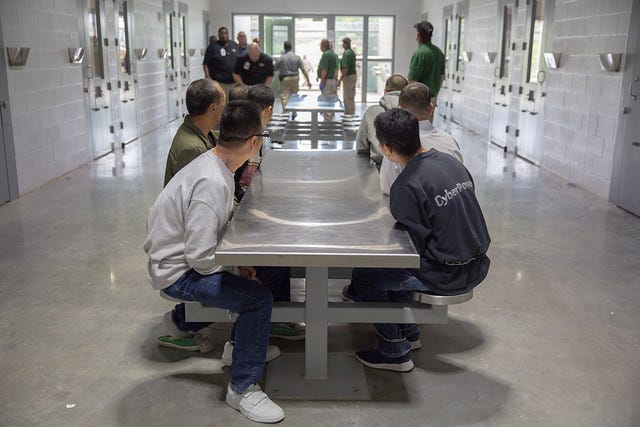
Image: Unidentified ICE detainees (via ICE Flickr account)

I do wish that Sanchez's case works out in her favor but the origin of the problem was the Biden Administration's policy of intentional violation of United States Immigration Law. The details of this violation are listed in House Resolution 1065. As far as I can see from this article Sanchez was not given legal status but was allowed to come into the U.S. as an undocumented person. In other words she was invited to become part of the servant/slave underclass that works in the shadows for cash in substandard conditions. The Biden Administration is at fault for allowing this circumstance to happen to Sanchez and many thousands of other undocumented individuals. Unfortunately it appears that Sanchez is also detained with illegals that are violent criminals
The author states:
" In short, if the government changes its mind about your freedom, it has to explain why."
Whatever the govenment is, it did not change its mind about the requirements for immigration into the U.S. Immigration Law was not changed but broken, and therefore Sanchez's freedom was not granted properly.
And Lady Liberty sobbed inconsolably as she remembered when America was a land of freedom for everyone !.....😭