


When Gov. Tate Reeves announced new investment by Amazon in planned digital campus development across several Mississippi counties in April of this year, the city of Jackson was under a temporary moratorium on new data center deals. Amazon’s Canton site was already operational by mid-2026 and construction has begun for centers in Vicksburg, Clinton and Ridgeland.
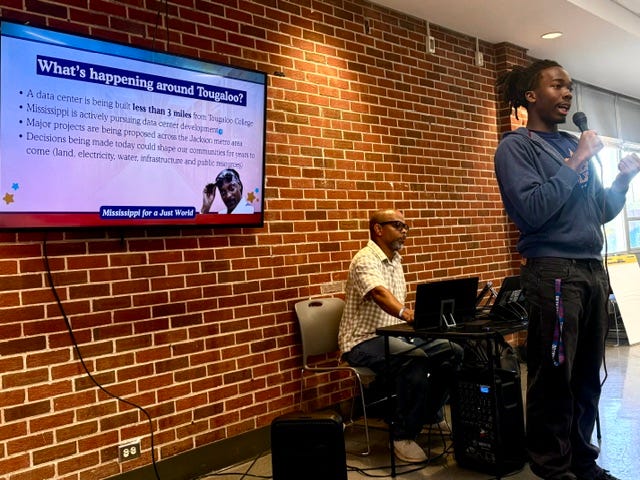
The Ridgeland campus occupies more than 300 acres of land less than three miles from Tougaloo on West County Line Road and was the focal point at a recent “Stop Data Centers” community training event, held on Oct. 20, 2026, at the college’s Warren Hall. The event, sponsored by local human rights nonprofit Mississippi for a Just World, was organized and led by Tougaloo alumni and current students.
The meeting, as the first “college edition” of MSJW’s “People Over Politics” series of free public workshops, had a single goal: to assess data center development, particularly its impact on marginalized communities, and to empower attendees to take action.
Aznii Welchlin, a senior at Tougaloo and president of its student government association, summarized that agenda in opening the meeting by leading about 20 students and a handful of others in a chant of “Free the Land! Not Data Land! By any means necessary!” Recent Tougaloo graduate Logan McClinton spoke next, expressing a need for student awareness and civic engagement around data center development as a new phase of Tougaloo’s rich activism legacy.
Invoking the Tougaloo Nine and civil rights icons Fannie Lou Hamer and Angela Davis, who once came to the college “to empower students for action,” McClinton told those present that “this is your opportunity to carry forward that legacy.”
Muarib Abdul-Tawwab focused on environmental risks and noise pollution, which he said can be a form of “psychological torture” for residents living near hyperscale data centers. He warned that nitrogen oxide, released into the air by gas-powered turbines sometimes used to power data centers is one of the “most dangerous” and “commonly felt” pollutants.
A recent report from Environment America Research & Policy Center draws on federal data and backs up Abdul-Tawwab’s claim. It cites increasing fossil fuel dependence and gas-powered pollutants as problems accompanying planned hyperscale development.
Sabir Abdul-Haqq, the tech lead for Mississippi for a Just World, said that polluted air from Amazon’s Ridgeland campus is “going to blow into Jackson.”
“These hyperscale centers are an extractive industry,” Abdul-Haqq said. “All of Jackson is going to feel the effects.”
Joycelynn McCoy, vice president of Tougaloo’s NAACP chapter, added that while some pollutants “in our soil and food may take years to discover,” there are immediate threats to “rights to clean air and water.”
“It’s not like we have access to affordable health care” to deal with these problems, McCoy told the group.
McCoy said it is “no accident” that these centers are being built in “majority Black communities,” where health problems and economic disadvantage are compounded. Several speakers reiterated the sentiment that Tougaloo students have an historic responsibility to address data center development precisely because of its outsized effects on Black and other often-exploited communities.
Before the event, Welchlin told The Mississippi Independent [correct?] that in the context of Jackson’s longstanding water crisis, education and advocacy around data centers matters because their development “is piling more and more onto communities” whose economic and political “impoverishment is already not being adequately addressed.”
The students’ emphasis on community impact and collective rights reflects, in part, Mississippi for a Just World’s own approach to “people-first” civic engagement and political advocacy. This approach builds on the Universal Declaration of Human Rights, one of the founding documents of the United Nations.
Faridah Abdul-Tawwab, Mississippi for a Just World’s director of research, education and culture, said that “it’s critical that we have young people, on their way to law school or other pursuits, who understand these issues from a human rights perspective.” Invoking Mississippi’s “brain drain” problem, she said the organization uses a “three-pronged approach of transformative education, community power-building and advocacy” to prepare young people for public leadership.
MSJW’s collegiate fellowship progam has sponsored students from Tougaloo, Millsaps College and Jackson State University, and has ambitions to train students “from Oxford to the coast,” Faridah Abdul-Tawwab said. “All over the state is the goal.”
Welchlin said she appreciates “how MSJW takes the initiative working with young people, because we are the future, and all these things are already impacting us.”
The rights-first, community organizing traditions informing MSJW and the Tougaloo activists stand in stark contrast to the economic rationale commonly expressed by pro-data center politicians and large corporations driving hyperscale development.
When Gov. Reeves convened the Mississippi Legislature to approve Senate Bill 2001 in early 2024, paving the way for Amazon’s initial $10 billion investment in Madison County, his office described it as “the largest economic development project in state history.”
Similarly, when voting against the temporary moratorium in the Jackson City Council earlier this year, Ward 1 councilman Ashby Foote stated that while data centers “may not be the perfect economic development,” they “can be very good economic development,” bringing “millions of dollars to the city government.”
Companies like Amazon and Eagle Rock Partners, the real estate firm behind the recently announced 800-acre Big Woods Technology Park project in Jefferson Davis County, have learned to mitigate public worry over increased utility bills by promising to foot the bill for increased electricity usage or to generate their own power. Yet some analysts and Mississippians have expressed skepticism about corporate guarantees to shoulder economic impact.
Regardless of who pays for increased energy costs or benefits from promised new jobs, other concerns about long-term environmental and health risks, and about transparency and community control, are being raised at Tougaloo and across the state.
At a board of supervisors meeting earlier this month, Jefferson Davis County residents presented a petition with more than 950 individual signatures requesting a moratorium on development projects. While some present spoke in favor of needed economic investment, others stressed lack of information, transparency issues and concerns about public health and enviromental impact.
At a recent Southaven roundtable with elected officials, noise and air pollution, as well as concern about public input being outweighed by corporate interests, were among concerns locals expressed, according to Action 5 News of Memphis. District Attorney Scott Colom, the Democratic challenger to U.S. Sen. Cindy Hyde-Smith’s seat, attended the roundtable and reiterated his call for a temporary moratorium on data centers, outlined in his campaign’s “Making AI Work for Mississippi Plan” released in September.
In addressing local economic impacts, the Tougaloo speakers focused on potential rises in tuition costs and strains on the local power grid. Absent from their remarks was any enthusiasm for the “jobs and investment” rhetoric expressed by Gov. Reeves, Councilman Foote, Brandon Mayor Butch Lee and companies including Amazon and Eagle Rock.
While McCoy and Welchlin both mentioned upcoming midterm elections and “get out the vote” campaigns as important next steps, this was cast in terms of empowering Mississippians to vote out pro-data center politicians and transform the mindset of public officials in regards to future development.
Image: Muarib Abdul-Tawwab addresses data center development near Tougaloo (credit Scott Prather)
