


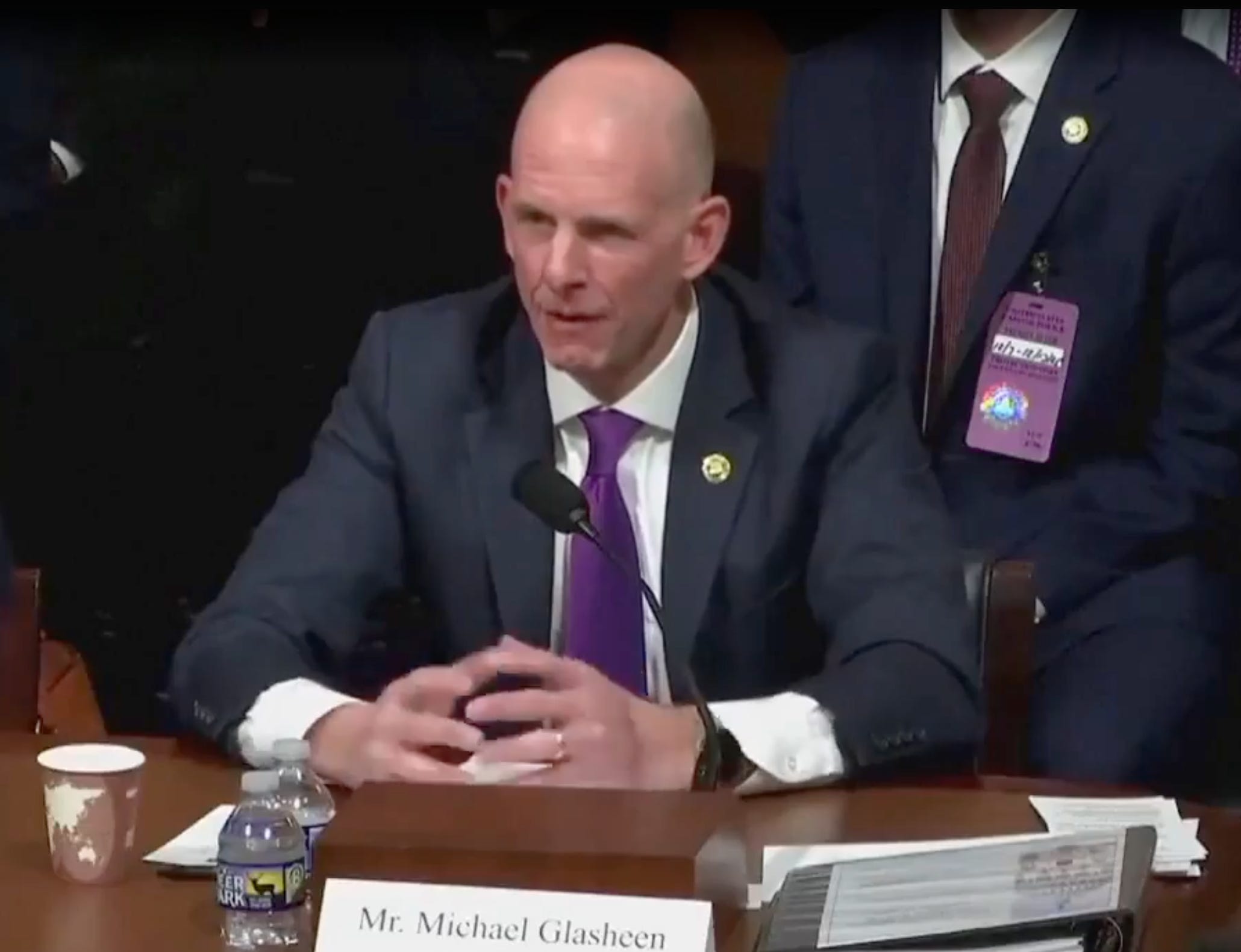
An FBI official on Thursday struggled to answer basic questions from U.S. Rep. Bennie Thompson about protesters who fall under the banner of antifa, after President Trump designated the ad hoc political movement a domestic terrorist organization.
Michael Glasheen, operations director of the FBI’s National Security Branch, claimed during a contentious congressional hearing that “the data” pointed to antifa being a terrorist organization but was unable to back that up when Thompson asked for specifics.
“Antifa” is a protest movement, not an official organization. The word itself is a portmanteau for “anti-fascist,” and could apply to anyone who opposes fascism. Critics argue that the president uses the designation to target anyone protesting against his administration. There is no such designation as a “domestic terrorist organization” under U.S. law, though there is for foreign organizations with clear structure and financial backing.
None of which has stopped Trump from claiming that antifa is a terrorist organization and targeting anyone who fits his own designation—an approach that Glasheen endorsed during the Dec. 11, 2025, House Homeland Security Committee hearing on worldwide threats to the nation. Glasheen told lawmakers he agreed with Trump that antifa is one of the greatest national security threats facing the United States.
“We share the same view,” Glasheen said. “When you look at the data right now, you look at the domestic terrorist threat that we’re facing right now, what I see from my position is that’s the most immediate violent threat that we’re facing on the domestic side.”
Faced with questioning by Thompson, the ranking member of the committee, Glasheen was unable to provide details about the protesters’ ostensible organizational structure. Thompson asked where the group was headquartered, and when Glasheen hesitated, followed up with, “Where in the United States does antifa exist?”
“We are building out the infrastructure right now,” Glasheen said, cryptically.
“What does that mean?” Thompson asked. “We’re trying to get information. You said antifa is a terrorist organization. Tell us, as a committee, how did you come to that? Do they exist? How many members do they have in the United States as of right now?”
“Well, that’s very fluid,” Glasheen said.
“Sir, I just want you to tell us—if you said antifa is the No. 1 domestic terrorist organization operating in the United States, I just need to know where they are,” Thompson said. He then asked, “How many people have you identified with the FBI that antifa is made of?”
“Well, the investigations are active,” Glasheen responded.
With that, Thompson suggested that the FBI had failed to establish why Americans who oppose fascism should be labeled domestic terrorists.
“Sir, you wouldn’t come to this committee and say something you can’t prove. I know you wouldn’t do that,” Thompson said, then added, “but you did.”
Antifa is a decentralized political movement that taps autonomous individuals and groups. Followers sometimes operate in concert, including through social media organizing, as with this Instagram page for what’s identified as “Central Mississippi Antifa.” But the movement has no hierarchical structure. Then-FBI Director Christopher Wray told Congress in 2020 that antifa was better defined as an ideology than as a formal organization.
According to a data-driven University of Maryland study, followers of antifa are actually less likely to resort to violence than right-wing extremists. Tactics employed by those who identify as antifa run the gamut, from flyer campaigns and peaceful protests to digital activism, vandalism and violence.
Critics argue that Trump uses antifa as a catch-all to go after anyone who publicly opposes him or his policies, which they claim is straight from the fascist playbook. Meanwhile, the president has pardoned right-wing Jan. 6 rioters and unleashed armed and masked federal agents on American citizens and immigrants, often in defiance of local law enforcement authorities.
After grilling Glasheen, Thompson took a similar confrontational approach with Department of Homeland Security Secretary Kristi Noem, after which he asked her to resign if Trump did not fire her first.
Thompson excoriated Noam for her departmental expenditures, saying, “Instead of deploying Homeland Security grants to protect churches and synagogues from terrorism, you handed your friends a $220 million contract so they could follow you around the country with a camera. Instead of fully funding the DHS agency that protects our hospitals, schools, and electrical systems from cyber attacks, you spent $200 million to buy yourself new private jets.”
The congressman also reminded Noam that her agency granted asylum to the alleged shooter of two National Guardsmen in Washington, D.C. She countered that the Afghan national had been vetted by the Biden administration.
Image: Screencap from hearing video
If there were no fascists, there would be no need for antifa.
I just would like to comment. There are organized Antifa groups such as https://rosecityantifa.org/ and associated groups like the John Brown Gun Clubs https://www.wi-jbgc.org/copy-of-resources. These groups have been violent and individual members charged. Recently the attack on the North Texas Immigration and Customs Enforcement detention facility last summer. These are not your flag waving weekend warrior protesters that we see on media. The serious followers of the anti fascist ideology can are very violent. They use frozen bottles of water, bricks, high power lasers, tear gas, incendiary devices, etc. They target individuals such as Andy Ngo who suffered brain damage because he tells the truth about these people and their beliefs.