

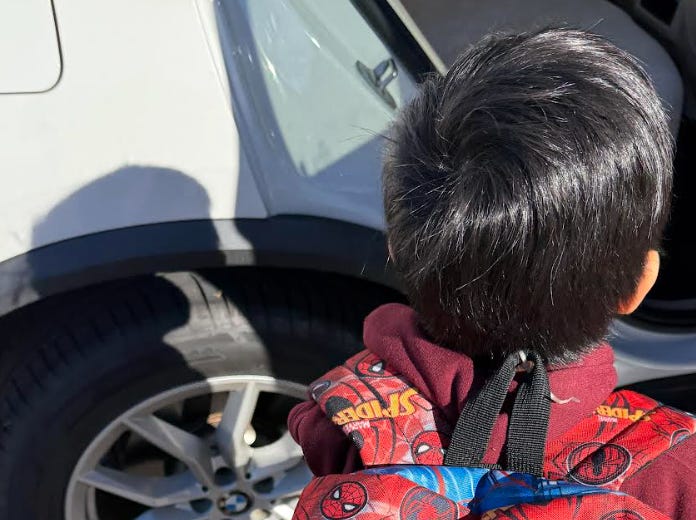
“I’m a friend of your mother’s, and I’m going to take you to her, okay?”
“Tell me about the sports you like to play.”
“What is your favorite thing to eat?”
“Are you into video games?”
These are the questions Paula Page-Merchant asked the four-year-old boy in Spanish, loudly enough to try to drown out the anguished, guttural sobs coming from the boy’s father at the thought of not seeing his only child or his wife for God knows how long. Page-Merchant had never heard such sounds from a grown man and did not want the boy to hear them. “It hurt me to my soul,” the decorated U.S. Army veteran, who completed three combat tours in Iraq, told The Mississippi Independent.
Page-Merchant is one of the founders of Adelante, an organization hastily but thoughtfully created by five women in early 2025 to respond to the crisis facing immigrants in the Jackson area. Born in Mexico, she came to the United States at age four with her mother and six older siblings. Her father, a Louisiana native, died when she was young, and the family was never able to prove his paternity. So, she went through the long and arduous process of becoming a naturalized U.S. citizen. When Page-Merchant was 20 years old, her mother died, after spending her adult life as a migrant farmworker in southern California. Page-Merchant and her siblings worked the fields, too, until labor laws changed and required children of immigrants to go to school.
“I still remember Mama being mad about that!” Page-Merchant says with a chuckle, explaining that over time her mother was grateful for the education her children obtained.
Asked why she commits herself to helping immigrants in dire need, Page-Merchant answers: “It’s the right thing to do. I want to be on the right side of history. I see my mother in all these folks right now. Her struggle. Being a good person, just trying to make it with her kids.”
Back at the detention facility, Page-Merchant took the boy, an American citizen, from where he had been detained with his father after they were picked up by ICE on the way to school one recent morning. She had connected with the boy’s mother and offered to retrieve the child so the mother would not have to risk detention herself by going to pick up her son.
By the time they were situated in Page-Merchant’s car, the boy’s deep, blank stare had not changed. The Kidz Bop playing on the radio did not help. Page-Merchant’s warm smile and kind words in her singsong Spanish did not help. The boy did not say a word. He hardly blinked. He did not ask any questions. He just stared. When they arrived at the family’s trailer, they knocked and knocked on the door. But the mother did not open it for fear that this too could be “la Migra.” Finally, she realized it was her son and opened the door. The boy jumped into her arms and uttered the first words Page-Merchant had heard from him the entire time: “The police took Daddy!”
Until recently, Adelante’s primary focus was on prevention and education. That included ensuring immigrants understood their rights in case they were confronted with ICE or Customs & Border Protection agents; educating them about all the paperwork they should be able to present at any time; and helping them put plans in place and compile proper documentation for their children and their vehicles in the event they were detained. In the last few weeks, Adelante’s work has shifted toward helping families when the worst happens—when a loved one is detained. For the family whose little boy Page-Merchant picked up from detention, that meant helping locate the family’s truck after it was impounded, providing financial support and food assistance because the family’s income is now cut in half, and figuring out childcare so the mother can continue to work. The mother and father worked opposite shifts at the same company, so someone was always available to care for their young child.
“It’s like you punch them in the face and then hit them again,” is how Page-Merchant describes what is happening to the families of immigrants who are detained. The initial punch comes with being detained, even in cases where the immigrant is in the process of having his immigration claim adjudicated and until now had been allowed to live his life while that claim is pending. He has a work permit. He works hard and pays taxes and does right by his family and neighbors. He has the hands of a man twice his age from the labor that most Americans would refuse to do. The conditions where he works and where he lives are unimaginable to many. The pay is too low and the rent too high. He has no criminal background. He shows up for his immigration court dates. He’s even told by the authorities that all is well and he has nothing to worry about. And the very next day, his world is turned upside down.
The second punch comes for his wife and son. On top of the obvious pain of not having their husband and father around and not knowing what will become for him, they face immense financial strain and the looming threat of the mother also being detained.
And the vehicle. Where is the father’s truck? It’s one of the family’s only financial assets, and it’s nowhere to be found. ICE is not permitted to impound vehicles after detaining the drivers. Calls to all the area tow companies turn up nothing. The sheriff’s office does not know anything. “Maybe try the U.S. marshals,” someone tells the Adelante team. But even if the vehicle is located, the cost to recover it can be insurmountable. A $400 tow fee, plus hundreds of dollars per day for storing the vehicle, may be more than the vehicle is even worth. And that’s money the family could be spending for groceries, or to hire an attorney, or to pay for childcare now that one parent is gone.
For another family, the vehicle is the least of their worries. The entire family – a mother, father and two young children—were picked up recently. Although the children are U.S. citizens, the mother wanted to keep them with her in detention, so they would not be separated. Now, the entire family has been split up, the mother to one state, the father to another. And no one knows where the children are, despite searches of multiple detention sites.
In south Mississippi, an immigrant family with grown children who are U.S. citizens lives in fear for the elderly parents and their neighbors and extended family. The father has spent his career in construction, the mother cleaning houses. They pay taxes with ITINs, or individual tax identification numbers, issued to them by the federal government. They own their own home and pay property taxes. They don’t receive any government benefits. One of the adult children is in the Army National Guard. Two are in college, with one planning on a career in social work.
The oldest of the three siblings has taken it upon herself to help those in her community who need it. She gives rides to those who fear being pulled over—helping get children to and from school and adults to and from work. She assists those who need help filling out documents. She translates for people. Folks in her community keep a lookout for ICE and CBP. And together, they endure the vitriol that has grown toward the Hispanic community since January.
The woman’s brother was recently subjected to racial profiling, accosted in a big box store by ICE agents who only let up after he screamed, “I’m an American soldier and you’re racially profiling me! I’m an American citizen!”
“There’s no need for so much hate,” the older sibling explains. “We’re the same people who’ve grown up in the same community, attended the same schools, played the same sports as everyone else,” she says. Of those who now spew hatred toward her and others in the immigrant community, she says, “I was sitting next to them in the same exact classrooms, with the same exact goals–to have a better life.”
“The hate and profiling has gotten ridiculous,” observes Kacie Marvin, a small business owner in Ocean Springs who also volunteers to help immigrants along the Gulf Coast by keeping watch for vehicles that may be ICE or CBP. She explains that a lot of people in her community complain about immigrants and Hispanics, even though very few immigrants actually live in her particular community. For her part, Marvin helps with food drives organized by Missisisppi Gulf Coast Mutual Aid Collective to help immigrant families in need. But she says they need more volunteers, because Gulf Coast communities are so spread out. “We need bodies and cars, people delivering groceries, taking pictures and videos, talking to neighbors to make sure they aren’t going without.”
As for why she does it, Marvin talks about the book One Long Night, a history of concentration camps around the world that tells the stories of more than 50 people who were detained without trial, tortured and separated from their families. “To see it being done here on our coast—I won’t be a part of it, and I don’t think anyone else should either.”
Yet many elected officials are a willing part of it. U.S. senators Cindy Hyde-Smith and Roger Wicker, and U.S. representatives Trent Kelly, Michael Guest and Mike Ezell all voted this summer in favor of more than $170 billion in federal funding for immigration enforcement. Without their votes, H.R. 1, also known as the One Big Beautiful Bill Act, would not have passed, and there would be no funding to hire so many ICE and CBP agents, to purchase their undercover vehicles, to construct detention facilities, to buy the thousands of drones used to surveil immigrant communities or to deport people to other countries often not even their own. Ironically, Hyde-Smith brags about her support of H.R. 1, touting on her Facebook page the “Peace on Earth and in our communities” owed to those parts of the law that fund immigrant detention, ICE agent training, and partnerships between ICE and state and local governments to detain immigrants.
Local protesters gather regularly outside Hyde-Smith’s office in Ridgeland, most recently to protest ICE and its cruel tactics that are causing so much trauma among so many families this holiday season.
In Part 3 of this series, we’ll look further at Mississippians’ efforts to help the immigrant community and to call out Mississippi’s officials who unconditionally support ICE.
Image: Unidentified boy whom Paula Page-Merchant removed from custody (courtesy Page-Merchant)
Thank you for documenting the wonton cruelty being perpetrated by the regime enabled by our Republican Congressional delegation. Morally reprehensible.
Vote for a clown, expect a circus. A disgrace. Nobody is illegal.