


On July 1, 2026, a Mississippi law will take effect that requires people to prove citizenship before their voter registration is accepted. Yet nine days before that deadline, a federal judge blocked access to the database the law depends on.
U.S. District Judge Sparkle Sooknanan ruled on June 22, 2026, that the Trump administration’s revamped version of the federal Systematic Alien Verification for Entitlements database, known as SAVE—which states had begun using to check their voter rolls—was unlawful and could no longer be used.
The judge found that the overhaul aggregated Americans’ personal data in violation of federal privacy law and relied on citizenship records the government “knew to be unreliable” in a way that “threatens the sacred right to vote.” The ruling did not eliminate SAVE itself, the decades-old benefits-verification program, but it blocked the expanded version that made mass voter-roll checks possible.
The injunction deprives Mississippi’s SHIELD Act—the Safeguard Honest Integrity in Elections for Lasting Democracy Act, signed by Gov. Tate Reeves in April—of its primary tool. What that means for implementation of the state law is unclear. Neither Reeves nor Secretary of State Michael Watson (whose office regulates elections) responded to requests for comment from The Mississippi Independent.
The SHIELD Act directs local registrars to verify an applicant’s citizenship against the federal database, and tasks the secretary of state with running the entire voter roll against it every year. If the database is unavailable, the state could require voters to produce documentary proof of citizenship, such as a birth certificate, a passport or naturalization papers.
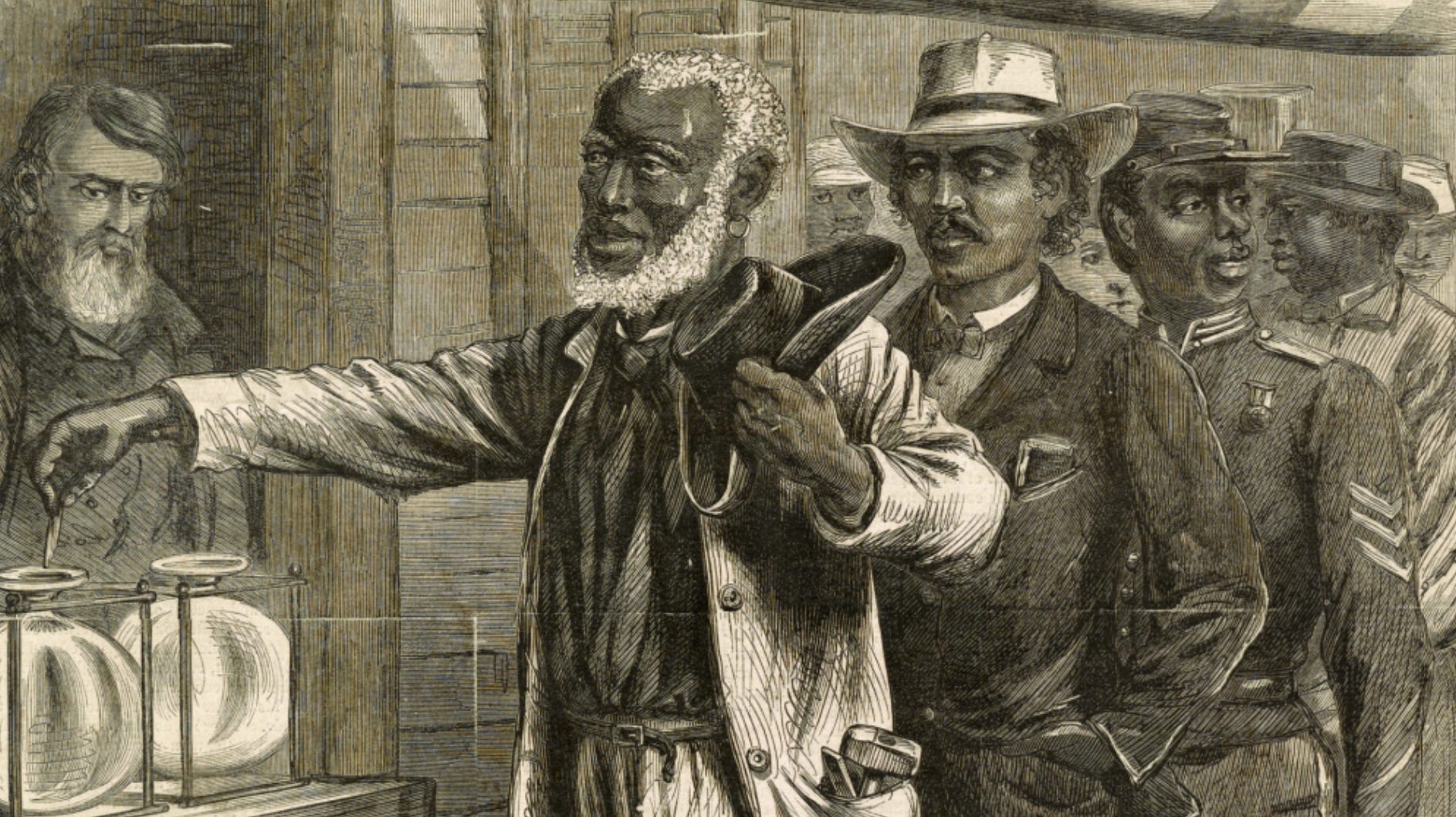
Whatever the state decides, the basic dynamic—placing the burden of proof on the voter—has a long history in Mississippi, stretching back to the Reconstruction era, when Black citizens gained the right to vote for the first time. From that point until the Voting Rights Passed in 1965, Mississippi officials used various mechanisms to deter Black voting, from poll taxes to requirements to interpret clauses of the state constitution. State Democrats argue that the SHIELD Act falls within this dynamic as “a poll tax dressed up in modern language.”
In the words of its own architects, the state’s 1890 constitutional convention was called to disenfranchise Black Mississippians by legal means, given that violent intimidation tactics used during the previous 15 years had prompted intermittent federal intervention. The resulting provisions did not mention race, though that was clearly their focus. The constitution included rules that the voter, not the state, had to satisfy, which were designed to exclude Black Mississippians who would be least able to comply.
Section 243 of the 1890 constitution established a poll tax of two dollars, payable to the county school fund by the first day of February in the year a man (only males had the right at the time) wished to vote. Beyond the expense, which was no small thing for a poor voter, the catch was proving that it had been paid. An official receipt was the only acceptable proof, and neither the registrar nor the tax collector kept a permanent record of who had paid. A man who paid in February and lost his receipt by November could not vote.
In 1896, the Mississippi Supreme Court, in Ratliff v. Beale, described the poll tax, the proceeds of which were to go to public schools, as designed “primarily as a clog upon the franchise.” Though the burden of proving the right to vote rested on the voter, the court ruled specifically on the use in liens for nonpayment of the tax. Defenders of the constitutional clause asked: “Can it be that the poll tax was imposed to exclude negroes from voting? The constitution says it was to aid common schools. Is that a lie? We copied from Massachusetts’ constitution. Was that to exclude negroes?”
In its ruling, the court noted: “It is evident therefore that the [constitutional] convention had before it for consideration two antagonistic propositions—one to levy a poll tax as a revenue measure and to make its payment compulsory; the other to impose the tax as one of many devices for excluding from the franchise a large number of a class of persons, which class it was impracticable wholly to exclude and not desirable wholly to admit. In our opinion, the clause was primarily intended by the framers of the constitution as a clog upon the franchise, and, secondarily and incidentally only, as a means of revenue.”
The constitution’s Section 241 set residency requirements of two years in the state and one year in the election district—the longest in the United States, and the only one-year district requirement in the nation. The requirement operated against the labor force that the cotton economy had produced. A sharecropper who moved from a plantation in one county to another in a different county, in pursuit of a better contract, was, by the next election, ineligible to vote in either place. The state did not have to prove that he had moved. He had to prove that he had stayed.
Section 244, the so-called understanding clause, was the third lock on the door. It required a would-be voter to read a section of the constitution or understand it when it was read to him and give a reasonable interpretation to the satisfaction of the registrar, who in most cases was white and could choose to be unsatisfied. The man who was reportedly behind this clause was James Z. George, who played a leading role in crafting the constitution’s language. George, a former slaveowner who had signed the state’s secession ordinance, served as a general in the Confederate army and was a state supreme court justice and later a U.S. senator.
The Section 244 provision sparked opposition even in the white press of the day, with more than 30 state newspapers editorializing against it. It passed anyway and handed the registrar a test that no applicant could be sure of passing while leaving the onus on the voter.
Together, the three sections had the same effect as the terrorism and violence of the previous Reconstruction era: rapidly diminished Black voting. Mississippi thus wrote the template, and every other Southern state copied it. Within a decade, Black voter registration across the South collapsed from hundreds of thousands to tens of thousands. This codified disenfranchisement architecture held for 75 years.
What broke the system of disenfranchisement was the removal of the registrar’s discretion. The Voting Rights Act of 1965 sent federal examiners into the counties where local officials had used tests like the understanding clause to keep the rolls uniformly white, and it required jurisdictions with the worst records—Mississippi among them—to clear any change in voting procedure with the federal government before it could take effect. The law took the burden of proof off the voter and put it on the state. Mississippi now had to prove a change was not discriminatory before it could impose it. Black registration in the state climbed from single digits in some counties to majorities within a few years.
That arrangement lasted until 2013. In Shelby County v. Holder, the U.S. Supreme Court struck down the formula that determined which jurisdictions had to clear their voting changes in advance, ending the preclearance requirement in practice. The discretion the Voting Rights Act had taken from the states was returned to them. Mississippi could again change the rules of registration without first proving to anyone that the change would not fall along racial lines.
The SHIELD Act makes use of that returned discretion. Like the 1890 poll tax and understanding clause, it does not name race, but it again puts the responsibility for proving the right to vote on citizens who are at the mercy of records over which they have no control. It requires proof of citizenship, checked against the federal database, a system built to confirm eligibility for public benefits, not to vet voter rolls. Even before the federal judge enjoined sharing the database, Utah’s Republican lieutenant governor called it “notoriously inaccurate”—a concern echoed in the June ruling. Where it cannot confirm a voter, the voter must produce other documents.
Roughly four in five Mississippians do not hold a passport. Hundreds of thousands of Mississippi women have married names that do not match the names on their birth certificates. The citizens least likely to be able to produce a birth certificate are older Black Mississippians, many of whom were born in segregated or under-resourced facilities where the births of Black infants were not consistently recorded. The Southern Poverty Law Center has estimated the law could affect more than a million Mississippians.
The voters that the SHIELD Act is most likely to turn away are the same cohort that the 1890 constitution turned away, and for the same structural reason: The state requires proof that in some cases the citizen might not be able to furnish. At stake is the linchpin of democracy, the right to vote.
In 1890, it was a poll-tax receipt, a copy of which the state did not keep. In 2026 it is a birth certificate checked against a database that is no longer accessible. Both provisions were written in race-neutral language, with the burden of proof on the voter and no state responsibility to ease the registration process.
Image: Harper’s Weekly drawing of newly enfranchised Black voters casting ballots for the first time (via Library of Congress)
