


Republished from Derrion Arrington’s Substack “America is Mississippi.”
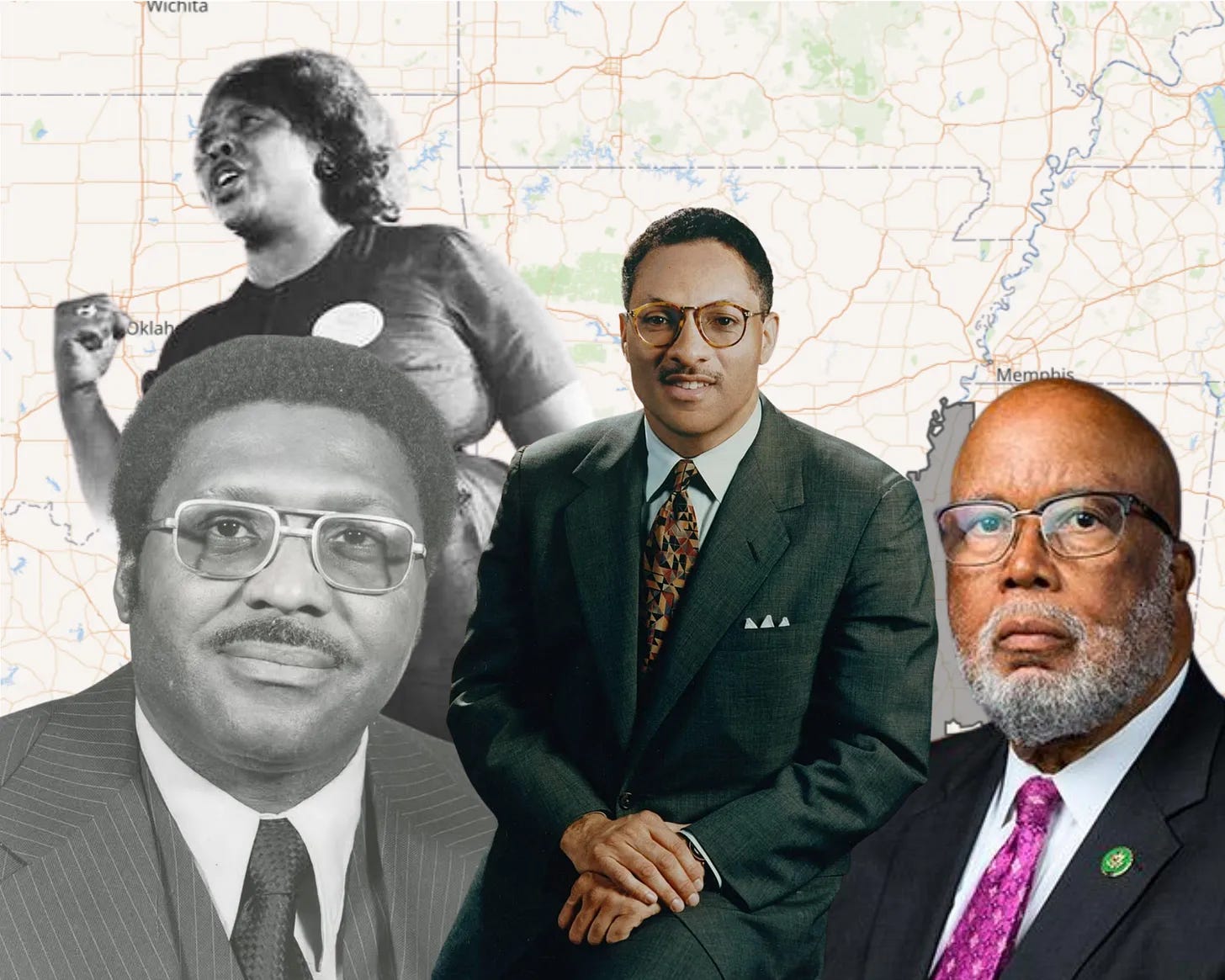
Mississippi’s Second Congressional District runs from the outskirts of Memphis through the Delta to south of Natchez and touches the suburbs of Jackson. It hugs the Mississippi River and its fertile floodplain for more than 200 miles, encompassing all or part of 24 rural counties where the contrast of wealth and poverty seems frozen in time from the days when local plantations were worked by enslaved people and cotton was king. It is one of the poorest congressional districts in the nation. For more than 60 years, it has also been the place where Mississippi has argued with itself about what democracy means and who it serves.
Every serious fight over political representation in the state has been waged inside its boundaries—or over the shape of those boundaries themselves. Fannie Lou Hamer tried to unseat Jamie Whitten from it. Robert Clark lost it twice, then handed his research to the man who won it. Mike Espy broke through and held it for six years. Bennie Thompson has represented it since 1993. And now the United States Supreme Court is considering a case that could eliminate it altogether.
The district is the ground.
In the spring of 1964, Fannie Lou Hamer went before Secretary of State Heber Ladner to qualify as a candidate for Congress from the Second Congressional District. She was 47 years old and had been a registered voter for barely a year. Two years earlier she had been fired from the plantation where she had worked for 18 years—the same day she attempted to register. Ten days after that, 16 bullets were fired into the house where she was staying. She found it easier to qualify as a congressional candidate than it had been to pass the literacy test.
The district she was running in was 68 percent Black. Only six to eight percent of Black residents were registered. Jamie Whitten, the incumbent, chaired the House Appropriations Subcommittee on Agriculture and had used that position to kill a bill that would have trained 2,400 tractor drivers—600 of them white. Hamer’s campaign directed itself at whites as well as Black people. Her thesis was that all Mississippians, white and Black alike, were victims of the all-white, one-party power structure, and that Whitten’s defense of that structure came at a cost even to the white people he claimed to represent. She told her audiences she was only saying what they had been thinking all along.
She gathered more than 300 signatures for her nominating petition, well above the legal requirement. County registrars refused to certify the names. She was blocked from the general election ballot and ran instead in the Freedom Election, where she received 33,009 votes to Whitten’s 49. The regular Mississippi Democratic Party went for Goldwater. The Freedom Democratic Party was the only organization in the state that supported Johnson and Humphrey.
A July 1964 radio report prepared weeks before the Atlantic City convention laid out the economics alongside the franchise numbers. Of 422,000 Black Mississippians of voting age, 28,000—6.6 percent—were registered, against 525,000 whites. Wages in Sunflower County ran $300 a year for a cropper and $150 for a laborer, lower than pre-revolutionary Cuba. Senator Eastland sat on the Judiciary Committee—the graveyard of civil rights bills—while Whitten killed nutrition and training programs from Appropriations. Cotton mechanization was transforming the Delta’s labor economy, and plantation owners like Eastland had no constructive response to the displacement it caused. The one-party system locked everyone into an arrangement that served the people at the top and failed everyone else. The Second District was a node in the national infrastructure of white supremacy, and that infrastructure impoverished white Mississippians alongside Black ones.
By 1972, the tactics had shifted but the logic remained. Hamer told a Chicago radio audience that she had been shuffled between the First and Second Congressional Districts depending on when Black voters achieved a registration majority. They moved her out when the numbers threatened white control and moved her back when the danger passed. The district was a weapon wielded against the people who lived in it.
On July 10, 1982, Robert Clark stood before 210 delegates at the Leflore County Civic Center in Greenwood and accepted the unanimous nomination of the Black political coalition to run for Congress in the Second District. He had entered the Mississippi Legislature 14 years earlier as the only Black representative in the body. He had chaired the House Education Committee, built the Mississippi Legislative Black Caucus, and authored the state’s landmark education reform legislation. David Jordan, president of the Greenwood Voters League and a viable candidate himself, stepped aside. Clark, Jordan said, was better known in the legislature and could draw more white votes.
Both men understood the math. The district’s total population was 52.8 percent Black, but only 44 percent of its voting-age population was Black, and whites still made up a majority of registered voters. The gap was the residue of decades of suppression. Victory required near-total Black mobilization and at least 12 percent of the white vote.
Clark framed his campaign in the language of coalition and shared economic interest. He proposed a regional council for rural development in the Mississippi Delta modeled on the Appalachian Regional Commission, pointing to the stark imbalance in federal investment between the Delta and neighboring regions. He committed himself to fighting for farmers—easing grain restrictions, extending federal emergency farm loans—while insisting the Delta could not survive on agriculture alone. He identified Reaganomics as the central threat to the district’s prospects, arguing that the administration’s policies were reversing years of incremental progress through rising unemployment, declining farm income, and cuts to social programs. These were issues that crossed racial lines.
Gov. William Winter endorsed Clark publicly, declaring that his election would lay to rest the claim that Mississippi still practiced racist politics. Sen. John Stennis endorsed him too. Ed Perry, Clark’s white colleague from Lafayette County, organized a fundraiser in Oxford and justified it plainly—white Democrats had been asking Black Democrats to vote for them for years, and now it was time for white folks to return the favor.
Webb Franklin, Clark’s Republican opponent, ran on a slogan that operated with layered precision. “He’s One of Us” signaled shared values on the surface. Underneath, the message was unmistakable. Franklin posed before a Confederate monument in television advertisements. His newspaper inserts paired his photograph as a district attorney with an image of Clark alongside references to George McGovern. On the courthouse steps in Vicksburg, a white roofer greeted Clark—”Hey boy, they been talkin’ bad about you hea”—then told a reporter he would never vote for a Black man.
Clark carried the district’s Black-majority counties as expected. White voters consolidated behind Franklin, and Black turnout fell short in roughly six counties. Franklin won by 2,914 votes. Clark had secured 12 percent of the white vote—the threshold that was supposed to guarantee victory—but Black participation had not met projections. The distance between possibility and power was 1.5 percentage points.
Two years later, Clark ran again. Every variable improved—better district lines, a stronger campaign, broader institutional endorsements. White crossover support dropped from 12 percent to seven. The margin widened to 4,358 votes. Clark had improved his operation and lost by more. The coalition required to win the Second District could not be assembled under the conditions Mississippi imposed on a Black candidate assembling it.
Ed Perry had crystallized the problem at a Washington fundraiser between the two races, praising Clark’s extraordinary qualifications—14 years in the legislature, chairmanship of a major committee, architect of education reform—and then adding a sober observation. “I think if Robert were white, there wouldn’t be a race.” Former Sen. James Eastland, still formidable in retirement, stated it without adornment. “It’s racial. Whites will vote for Franklin. Blacks will vote for Clark.”
In early 1985, Clark decided he would not run a third time. The personal cost had been enormous. He had nearly lost his family. The structural conclusion arrived alongside the personal one—white crossover had declined even as everything else got better—and he accepted both.
He stepped aside and stayed close. Clark passed his research to Mike Espy, a 32-year-old Yazoo City attorney who began organizing in November 1985. The research identified precincts where federal poll monitors had been absent during Clark’s races and mapped voting variations in locations with consistent patterns across election cycles. Espy studied Clark’s campaigns with the precision of an engineer reverse-engineering a failed prototype. Clark’s 1984 loss had come down to fewer than 10 votes per precinct across the district. That was the threshold Espy’s operation would have to clear.
Espy came from a family whose roots in the Delta’s institutional life ran deep. His grandfather, Thomas Jefferson Huddleston Sr., had founded the Afro-American Sons and Daughters—a fraternal organization with 35,000 members by the 1930s—and in 1928 established the Afro-American Hospital of Yazoo City, the first hospital for Black people in the state. The Espy family operated funeral homes across the Delta. Espy understood the district’s economy from the inside, and he ran on it.
His campaign stayed low-profile until mid-October—radio ads on Black stations, one organizer per precinct, no television exposure until a final debate less than a week before the election. He avoided a runoff because he knew his coalition could mobilize only once. The approach looked quiet from the outside. Underneath, it was intense. When Espy finally engaged Franklin on the issues, he went after him on farm policy, Social Security, and the congressman’s legislative record. Clark saw the agricultural argument as the blow that landed. White farmers had traveled to Washington to press Franklin on their concerns, and Franklin had dismissed them. That indifference, in a district where farming was survival, cost Franklin the margin he needed.
On Nov. 4, 1986, Espy defeated Franklin by 3,900 votes, carrying approximately 12 percent of the white vote—five points more than Clark had managed in 1984. Clark had endorsed Espy on radio two days before the election, invoking Medgar Evers and Martin Luther King and warning voters about Republican voter intimidation tactics. At his victory rally in Vicksburg, Espy said Mississippi had matured a little bit. He likened the Second Congressional District to a patchwork quilt, unified by shared values—faith, family and the aspiration for economic improvement.
In Congress, Espy reached out as much to the white landowners and agricultural businesses in the district as he did to the largely poor Black majority. He was accused at times of abandoning his core supporters, but others saw a coalition builder pursuing the nonracial politics needed to improve the state’s economy and unify Mississippi’s Democratic Party. He rarely got more than 20 percent of the white vote, but in a district defined by racial polarization, that alone represented ground that no one before him had held.
When Espy resigned in January 1993 to become Secretary of Agriculture, the special election to replace him drew eight candidates and compressed decades of political evolution into a single contest. Henry Espy ran on his brother’s coalition-building model. [Mayersville Mayor] Unita Blackwell represented the movement generation. James Meredith appeared as the lone-wolf integrationist. And Bennie Thompson—a Tougaloo graduate, former Bolton alderman and mayor, Hinds County supervisor since 1980, organizer of the state’s first association of Black mayors and its first association of Black county supervisors—represented the consolidation of institutional power built in the decades since the Voting Rights Act.
A white Delta newspaper columnist compared Thompson to David Duke and called his candidacy a dose of rat poison. A white businessman in Vicksburg hosted a fundraiser for Henry Espy in an antebellum mansion and described Thompson as “confrontational.” Thompson won the Democratic caucus in Greenwood with 87 percent of the delegate vote. In the April runoff, he defeated Republican Hayes Dent 71,701 to 58,544, powered by an 11,000-vote margin out of Hinds County—the mostly Black, urban section that had been added to the district two years earlier. Thompson told a crowd of about 600 that it was time for Democrats to unite. “We want to show Gov. [Kirk] Fordice and the Republicans that they are not the only folks in the 2nd Congressional District who can get together.”
He has held the seat for more than 30 years. The institutional infrastructure built in the years after the Voting Rights Act—the Black supervisors, the Black mayors, the network of county-level elected officials who turned organizing energy into governing authority—delivered the district to Thompson and kept it.
Now the Supreme Court may take it away.
Louisiana v. Callais, argued in October 2025, challenges the legal framework that has required states to draw majority-minority districts when voting is racially polarized and minority voters are sufficiently large and geographically compact to form a majority. The plaintiffs contend that states cannot intentionally draw voting districts to achieve a certain racial composition, even when done to remedy a demonstrated disadvantage. If the Court agrees, Section 2 of the Voting Rights Act—the provision that has undergirded decades of redistricting law—could be gutted.
In Mississippi, the consequences would be immediate and cascading. A federal judge found last year that the voting districts used to elect Mississippi Supreme Court justices illegally diminish Black voting power. The judge ordered the legislature to redraw one of the three districts. Powerful committee chairs in the statehouse are stalling, waiting to see whether Callais erases the legal obligation before they have to comply.
The fallout extends well beyond the state Supreme Court. Republicans could redraw the congressional map and eliminate the majority-Black Second District entirely—the district Hamer challenged Whitten in, Clark lost twice in, Espy broke through in, Thompson has represented for three decades. Mississippi, with a 35 percent Black population, could end up with all five of its House members white. A state whose poorest counties sit in the Delta—counties where Black and white residents share the same collapsing infrastructure, the same underfunded schools, the same hospital deserts—would lose the one congressional seat whose occupant has consistently made those conditions the center of the job.
Hamer understood in 1964 that Whitten’s grip on the Appropriations subcommittee hurt white farmers alongside Black sharecroppers. Clark ran on a Delta development commission that would have served every county in the district regardless of racial composition. Espy won because white farmers recognized that Franklin had failed them. The Second Congressional District has always been the place where the argument for shared democratic interest ran up against the fact of racial polarization—and where, over 60 years of organizing, litigation, defeat, and transfer, the argument sometimes won.
Fannie Lou Hamer told a Chicago audience in 1972 that she knew the ballot was powerful because they had done everything to keep her from getting it. The methods change and the logic holds. In 1964, it was literacy tests and registrars who refused to certify names. In 1982, it was “He’s One of Us” and a Confederate monument in a television ad. In 2026, it is a Supreme Court case with a bland procedural caption.
The Second Congressional District is the product of 60 years of organizing, litigation, defeat, transfer and victory. Every generation built on what the last one left. Hamer’s Freedom Elections proved the demand. Clark’s two losses built the infrastructure. Espy’s breakthrough proved the coalition. Thompson’s tenure proved the durability. The question before the Court is whether any of it was constitutionally required in the first place—whether the ground itself can be taken back.
Hamer answered that question in 1965, testifying under oath at the Stringer Grand Lodge on Lynch Street in Jackson. “For the first time in my 47 years,” she said, “I want to see if the Constitution means anything for Negroes or is it just a law for the white people.”
Sixty-one years later, the Delta is still waiting.
Image: Collage of Black political leaders in Mississippi (via “America is Mississippi”)

Wow, thank you for the history. I'm white and was born and raised in the MS Delta near Crowder. We were not taught about slavery in history in high school. I am glad that I get the newsletter even though I don't remember how I was signed up... But thank you ever so much for what you do reporting on my home state and it's politics. I do love reading the truth!