


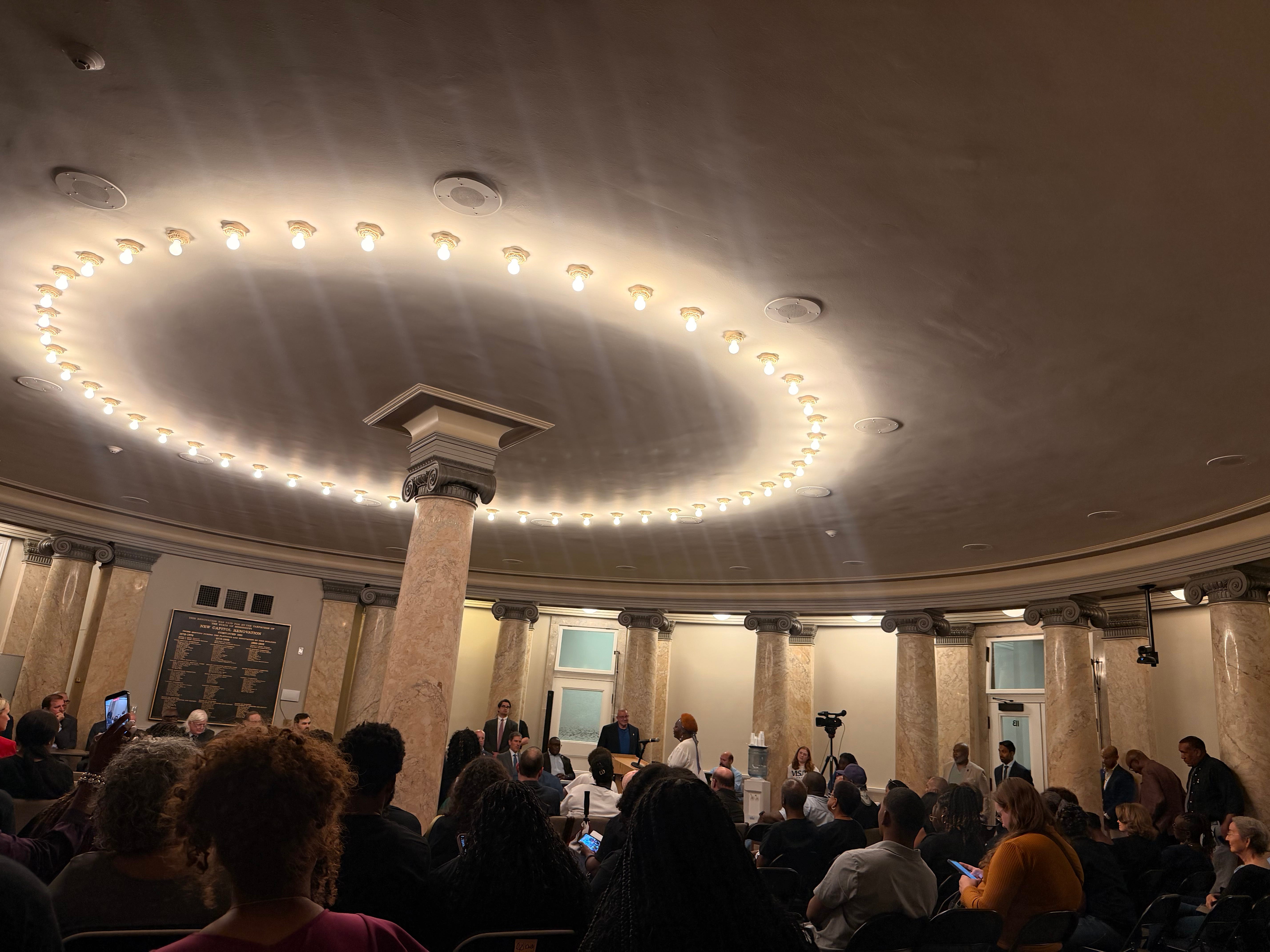
State Sen. Dean Kirby on Thursday night opened the eighth redistricting hearing on his committee’s schedule, the last one currently set, by telling the room what his committee does and does not do. The Joint Legislative Committee on Reapportionment and Redistricting draws state House and Senate districts. Congressional maps, Kirby said, move through Judiciary A in the Senate and Judiciary B in the House.
Twenty minutes later, the first member of the public to reach the microphone asked the committee to redraw a congressional district.
State Auditor Shad White told the committee members that he wanted them to take up congressional redistricting, whether in a special session or a regular one. His reason, he said: “The Delta has been at the bottom of far too many rankings for far too long, and the Delta deserves better leadership than Bennie Thompson. It just does.”
White’s remarks were an overt call to use redistricting to target a political candidate—specifically, the only statewide elected official who is Black.
Thompson has represented the Second Congressional District since 1993 and is the only Black member of Mississippi’s congressional delegation.
The room booed.
White kept talking.
“That’s fine, you can boo if you want, that’s totally fine,” White said. “But I’ll just tell you, not a lot of people want to stand up in a room like this and speak for a majority of people who want to see our congressional districts changed.”
White said there is “a silent majority of people who want better representation for the Mississippi Delta”—people, he added, who want “somebody who is not focused on running the January 6th committee.”
Kirby cut in to say that if the hearing got too disrespectful he would adjourn it and nobody else would speak.
White returned two weeks ago from a National Guard deployment to the Middle East and has said publicly that he is weighing a run for governor. He told the committee he worked as a Senate staffer during the 2011 redistricting.
More than 40 people spoke after him over the next three hours at the New Capitol, allotted two minutes each, with a bell sounding at 90 seconds.
Jesse Otto Smith went to the podium and said he had heard the auditor.
“My father was born in 1926. He couldn’t vote,” Smith, who is 76 and lives in Jackson, told the committee. “My grandfather was born in 1891. He couldn’t vote. My great-grandfather was born as an enslaved man, considered less than a human, in 1861. He couldn’t vote. He was a piece of property. That’s why I am here.”
Smith expressed gratitude to Thompson for road resurfacing and healthcare in the district and said he hoped the congressman would keep the seat as long as he wants it.
State Rep. Kabir Karriem of Columbus, who chairs the Mississippi Legislative Black Caucus, came wearing the caucus lapel pin, which carries the image of Robert G. Clark Jr., the first Black Mississippian elected to the Mississippi Legislature since Reconstruction. Karriem told the committee he sees echoes of 1876 and 1890 in 2026, and that after the last Black legislator of the Reconstruction era left office, 73 years passed before another was elected.
“On behalf of the 1.2 million people that we represent, we’re totally against this,” Karriem said.
A dozen speakers asked the committee to draw new maps. Most came from Madison, Rankin and Simpson counties, several identified themselves with the Mississippi Federation of Republican Women, and their arguments ran along the same line: Draw to traditional criteria, compactness and contiguity and county boundaries, and treat voters as individuals and not by race. Karen Mosley of Simpson County put it this way. “A good candidate is a good candidate. They will get elected regardless of race or gender.”
Kyari Davis, a sophomore political science major at Jackson State University, asked when in the history of this United States that had ever been true.
A rally billed as Rally for Fair Maps had gathered on the Mississippi Supreme Court lawn two hours earlier, and its flyer told people to wear black and bring signs. Several speakers said they had come from the rally. Malik Ross of the Mississippi Votes Action Fund gestured at the room and pointed out “all these black and white shirts here out in the crowd.”
The students were the largest group that signed up. They came from Tougaloo College, Jackson State and the University of Southern Mississippi, and several said they had stood outside in the heat for hours before the doors opened, one of them wearing a suit in “feels-like” temps bumping 100 degrees. Several focused their two minutes on people who had organized in Mississippi before them, including Bob Moses and the citizenship schools, Stokely Carmichael, the Tougaloo Nine, Medgar Evers and James Meredith.
Aznii Welchlin, the 94th student government president at Tougaloo, spent the end of her two minutes repeating one sentence eight times. “Leave our maps alone.”
Arianna Brumfield of Tougaloo used her time to ask what the hearings are for.
“Public participation cannot end with just giving us two minutes here at a mic,” Brumfield said. “Are Mississippians being consulted or are they exercising political agency? How will testimony affect maps?” A mapmaker knows what a census population looks like, she said, and residents know where their children go to school and where their churches are. “If this here is democratic participation, show us where the people answered the decision.”
The committee has not released any draft maps. Members took no questions Thursday, as they have not at any of the eight hearings.
Robert James, president of the Mississippi State Conference NAACP, asked the committee directly whether it is weighing changes to Senate District 45, Senate District 2 and House District 22, three districts redrawn in 2025 under a federal court order. He got no answer, which is how the hearings have been run.
State Rep. Zakiya Summers of Hinds County had the last word of the night, and spent it on the vote counts from that 2025 session. The House adopted the Senate plan with 62 Republicans, five Democrats and three independents in favor. The Senate approved the plans 41 to 8 and 45 to 7.
“That’s bipartisanship,” Summers said. “Let us just go forward with the work that we have done in a bipartisan manner and let us not do anything with these districts.”
The committee took no questions and adjourned before 9 p.m. Written comments may be sent to the committee’s counsel, Ted Booth, at ted.booth@peer.ms.gov.
Image: Hearing in the state Capitol (credit Derrion Arrington)
