


This article has been updated with further details, including a map of the spray area.
People living in the vicinity of Arkabutla Lake are worried about a government plan to spray herbicides across 5,500 acres of the basin starting in August. Among their concerns are that aerial spraying of the chemicals will endanger public health, damage fish and wildlife and kill important native plants.
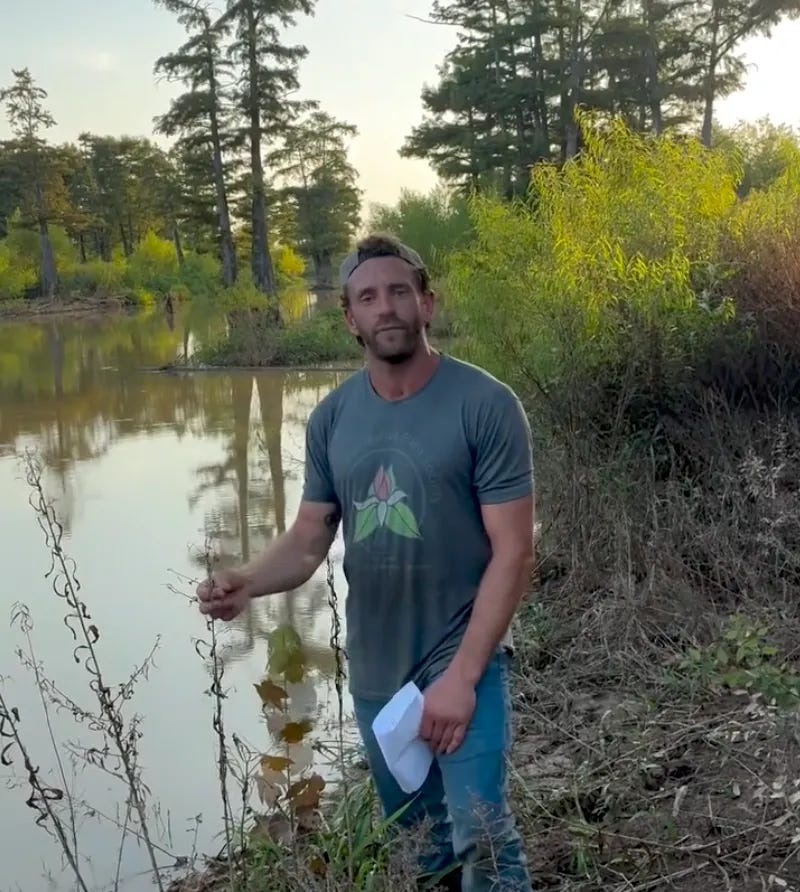
The U.S. Army Corps of Engineers Vicksburg District, which operates Arkabutla and three other flood control reservoirs in north Mississippi, insists that there is no cause for concern. But many residents, including Harry Babb, a local naturalist and content creator who maintains the social media sites Habitat Harry, remain wary.
“It’s about our natural heritage,” Babb, the most visible objector to the herbicide spraying plan, told The Mississippi Independent. “I’m advocating for a better approach.”
Babb has been pushing for a different method to reduce intrusive vegetation in sections of lakebed exposed by a drawdown of water levels beginning in 2023. He said he has called elected officials from his county supervisor to his congressional representatives asking them to support reevaluating the plan but that, “Their response is, this is for flood mitigation and whatever we have to do, we have to do.”
Arkabutla Lake, completed in 1943 as part of a massive series of flood control projects in the Mississippi River basin, required damming the Coldwater River to retain floodwaters above the low-lying Delta and moving the entire town of Coldwater from within the impoundment area. The Corps of Engineers says the herbicide spraying is necessary to eradicate woody plant growth that followed a major drawdown of the lake’s water levels to repair its failing dam.
In the spring of 2023, a sinkhole and seepage were discovered in the dam and engineers concluded emergency repairs were needed at the outflow channel, the Corps reported. The agency’s warning to area residents that the dam was compromised by “potential breach conditions” prompted the Memphis office of the National Weather Service to issue a standing flash flood watch for parts of seven northwest Mississippi counties located downstream.
Work has since begun to stabilize the dam, though major construction, including of a new discharge outlet, is not expected to begin until 2030. The projected date for refilling the shrunken reservoir is 2035.
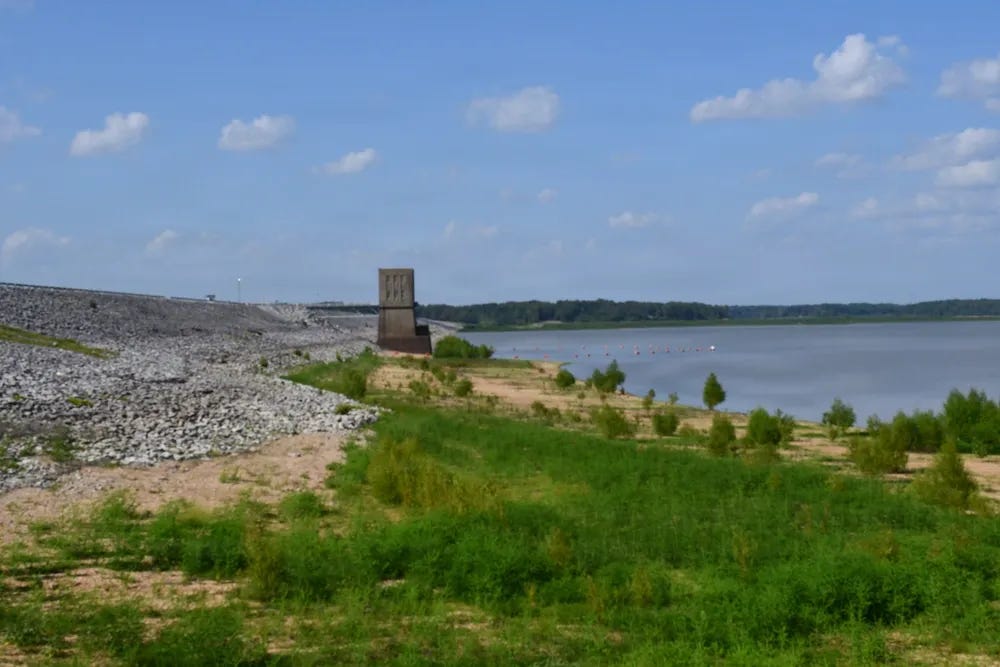
During ongoing repairs, water levels in the lake have been significantly lowered, exposing mud flats on which woody plants including black willow, water elm and button bush have taken root. The plants would not survive inundation once the lake refills, but the Corps says leaving them to die following a decade of growth would cause problems, including the potential for debris within the lake. The $340,000 spraying contract has been awarded to Provine Helicopter Service of Greenwood, Mississippi, with a start date around Aug. 1.
Following the announcement of the spraying project, local residents launched an online petition asking for revisions to the plan that has so far garnered almost 2,500 signatures, with the numbers growing significantly with each passing day. On July 21, a group calling itself Arkabutla Concerned Citizens posted an announcement on social media urging people to meet at the lake’s main entrance at 11 a.m. on Saturday, July 25, for a peaceful protest. The date coincides with the closing of public comments on the Corps’ draft environmental assessment of the dam repair project.
Babb said a more reasonable approach than the planned broadcast herbicide spraying would include mechanical removal of young trees or targeted applications of a less dangerous herbicide. “It’s hard to be careful with aerial application by helicopter,” he said. More targeted spraying or the establishment of a buffer zone would also reduce the potential for damaging or killing existing mature stands and seedlings of bald cypress trees around the lake’s perimeter, he said.
The Corps says it investigated alternatives including prescribed burning, mechanical removal and simply leaving the vegetation, but concluded that none of those options was viable. No further explanation was given for the rejection of less intrusive measures.
The selected plan calls for broadcasting the herbicides glyphosate (brand name Roundup) and imazapyr (Arsenal), which will kill all vegetation sprayed in the lake bed, not only target species. Glyphosate is a controversial pesticide with potential risks for humans and wildlife. Imazapyr can damage or kill mature trees and persist in soil for long periods. Both are approved by the EPA for aquatic application and both kill any plant they come into contact with.
According to this site, the greatest risk of aerial herbicide application is the potential for drift, which can carry pesticides miles from target areas. Drift is also sometimes a problem in farming areas like those that Arkabutla is designed to protect. The U.S. Environmental Protection Agency’s ecological assessment of glyphosate notes that it poses a “potential risk to terrestrial and aquatic plants, mammals, and birds, and low toxicity to honeybees for most uses.”
Under the Trump administration, the EPA has cast doubt upon the World Health Organization’s warning that glyphosate may cause cancer in humans, and last month, the Supreme Court sided with the manufacturer of Roundup in a ruling expected to block thousands of lawsuits alleging the company failed to warn people the product is potentially carcinogenic.
As for imazapyr, the EPA warns that it should not be applied to water “except as specified” on the label. Among the EPA’s warnings for the herbicide are that it should not be used on food crops, Christmas trees or within one-half mile upstream of an active potable water intake in flowing water, including a lake, pond or reservoir.
Most area residents are concerned about the impact of the herbicides on water quality and the potential for drift, Babb said.
Babb said he has enjoyed seeing the river basin return to a more natural ecosystem since the lake’s drawdown and would be pleased to see the Coldwater “rewilded,” though he concedes that is unlikely to happen. “I’m not advocating against a refill [of the lake] and I’m not opposed to using herbicides,” he said. What he is against is the indiscriminate poisoning of native species like buttonbush, hibiscus and, potentially, mature cypresses and overcup oaks. He suggested there should be a buffer zone to protect sensitive natural areas from the herbicide spraying.
Asked if there will be a buffer zone, Vicksburg District spokesperson Christi Kilroy said in an email that the spraying “will focus solely on areas of the lakebed between elevations of 206’ and 212’.” For comparison, the Corps reports that the lake’s pool elevations range from 189.3 feet near the bottom to 209.3 feet in what is called the conservation storage area, with additional areas inundated as needed that range up to an elevation of 256.3 feet. Those figures do not make clear whether the spray area would include the established forests that Babb has expressed concern about, though in one of his videos he reports that he is standing amid mature cypress trees at an elevation of 212 feet, which would place it within the spray zone.
Kilroy said the treatments will be limited to the exposed lakebed and, following publication of this article, sent a map of the targeted area:
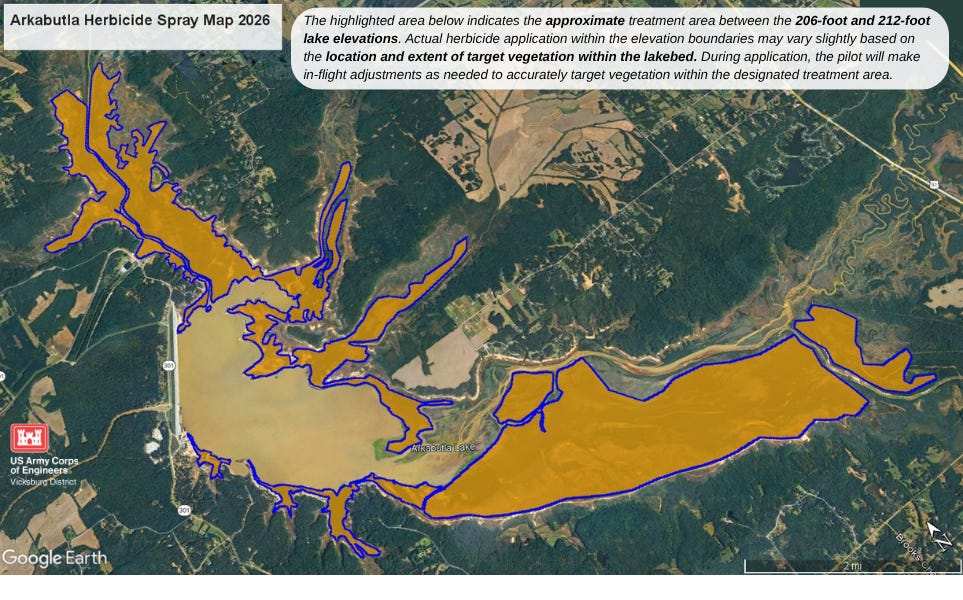
Currently, the Corps maintains a target pool of 204 feet, though preliminary repairs including grouting in the foundation of the discharge outlet were recently paused to release water because the pool reached 220 feet, Kilroy said.
The exact timeline for the spraying will depend on weather and pool elevations, Kilroy said. Numerous posters on Habitat Harry social media pages have pointed out that regrowth is inevitable during such an extended period. Asked if the project will involve multiple sprayings, as plants regrow during the decade-long drawdown, Kilroy said only that the current contract is for one application. She was unable to cite other examples of water bodies in which the Corps has used such broadcast herbicide applications.
According to the Arkabutla project fact sheet, killing the vegetation is “a critical component of preparing the reservoir for future operations. If allowed to mature and remain in place as normal pool levels are eventually restored, the vegetation could interfere with the operation, storage, and long-term maintenance of the dam and reservoir.”
Though it was built primarily for flood control, Arkabutla, like the other three Corps lakes, has become popular for recreation. Some public sites have been closed due to the drawdown or the risk of a breach, but the Corps fact sheet notes that in conjunction with the spraying, “No widespread closures are anticipated. Campgrounds and recreation areas are expected to remain open, though visitors will likely see aircraft operating in the area.”
The fact sheet does not say how the agency or the aircraft operators will ensure that no one enters the spray zones during aerial herbicide applications.
Image: Harry Babb stands along part of the Arkabutla lake backwater (via Habitat Harry Instagram page); Arkabutla reservoir, July 22, 2025 (credit Erin Hern, U.S. Army Corps of Engineers Vicksburg District)