

by Margaret McMullan
The Republicans are running late.
It’s 6:30 a.m. on primary election day 2026 and the Democratic pollworkers and I are at the Randolph Center in Pass Christian, Mississippi, setting up booths, tables, chairs and VOTE HERE signs—a choreography I’ve learned from 10 years of working elections.
Before long, three Republican poll workers arrive. There’s a mix of cordiality and underlying tension—a subtle wariness, like neighbors who know their fences are meant to divide.
In these moments, party lines should blur—everyone just wants to get the polls open at 7:00 a.m., but the remaining Republican still hasn’t arrived with the laptops, ballots and supplies. When he finally shows up at 7:10, wearing a cowboy hat, we scramble to assign roles and recalibrate machines that have sat idle for months.
There’s no reason to identify these people by name, as their behavior is not altogether flattering. The man I call S. lays claim to the big sturdy table that I’ve set up as his Republican table and scooches it forward. I move it back because the laptop needs to be closer to the power source. I unwind the cord and plug it in so I can check IDs. In Mississippi, photo IDs are mandatory to vote.
“This is our table, and you can’t be anywhere near here,” S. says, glaring at me with thinly veiled hostility.
“She’s with us,” S.’s wife says, and, poof, just like that, he’s all smiles, nice. He apparently doesn’t recognize me from last year, when I worked the Democratic side.
This year, politically, I’m positioned on the opposing side. The election commissioner had called me months ago to ask if I’d work the polls for the Republicans because they needed more experienced workers. I agreed, thinking maybe I could be a spy behind enemy lines.
Although the office of election commissioner says they are nonpartisan, they lean heavily Republican.
I am an older white woman, so I blend in with Republicans. But I am not, nor have I ever been, one of them. I am curious to find out if any have changed their minds as a result of the obvious horrors of this administration.
As I have done for years, I’m wearing my grandmother’s pin and my mother’s pearls for luck. My grandmother fought for Civil Rights in Mississippi back in the 1960s. My mother escaped Nazi-occupied Austria in 1939.
Working on the wrong side can be excruciating.
Today, I’m sitting with J., a 49-year-old, divorced white man with a Confederate flag as his Facebook page profile, who recently posted his doubts about the Holocaust.
Mississippi’s political climate is notoriously charged and Pass Christian, a small coastal town of approximately 6,000 residents, is no exception. Voters arrive with strong opinions and sometimes stronger suspicions. Several voters come in bad-mouthing Cindy Hyde-Smith, the incumbent U.S. senator, who said that if people can’t afford beef, they should choose another protein. Some voters refuse to speak to Democrats, waving them away like they’re flies, while others seem relieved to see familiar faces regardless of affiliation. It’s hard not to notice how party allegiance seems to shape everything from body language to small talk.
Throughout the day, our chairs squeak, making us sound like old dot matrix printers.
There are a few mistakes.
S. is playing a game on his phone while a voter signs in without registering. So, our numbers are off. Last year, during the presidential election, he made the same mistake but in reverse: Three voters registered but did not sign in.
We are not supposed to pre-initial ballots, yet J. pre-initials several as he talks on his cell phone while pacing the stage in his cowboy boots. The Randolph Center also serves as a community theater center.
Throughout the day, my counterparts consume muffins, pizza and protein shakes. I want to turn to S.’s wife and ask: Do you still support Trump and his new forever war in Iran, the failed economy, crime, fraud, child abuse, corruption and endless lying? But I don’t.
We’re not supposed to talk politics, so when she complains about the long TSA lines at airports, I can’t explain that Democrats are pushing to fund TSA, FEMA and cyber security and fighting to rein in ICE and Border Patrol. Republicans, on the other hand, are forcing TSA, FEMA and U.S. cyber defenses to do without funding as political leverage.
I sit, swinging between frustration, hope and boredom.
“Democracy is not a state, it is an act,” congressman John Lewis wrote.
Years of working elections have given me a front-row seat to Mississippi politics—a theater where the stakes are high and the actors are often at odds. But each polling day reminds me of democracy’s resilience. And its hope.
“Hope is not a lottery ticket you can sit on the sofa and clutch, feeling lucky,” writer and activist Rebecca Solnit has written. “Hope is an ax you break the door down with in an emergency.”
At the polls, I find hope in my own persistence to welcome every voter who walks in, even when the voting process is flawed and Trump and the Republican party seem to want to make it even harder to vote.
After all, democracy isn’t forged with talk or grand gestures, but in ordinary acts—setting up chairs, checking IDs, offering facts when misinformation reigns.
At 7:00 p.m., we close the poll and check the machine totals, which line up with the rest of the state: (R) Sen. Cindy Hyde-Smith and (D) District Attorney Scott Colom will compete in the 2026 midterm election.
Of 2,079 registered voters in our district, 254 voted—a low turnout.
Many Mississippi voters appear to have given up. Rigid voter ID laws, no early voting, limited absentee voting, and some of the harshest felony disenfranchisement policies in the nation make the state one of the most difficult places to vote. Recently, election commissioners purged approximately 50,000 Mississippi voters using unverified credit data from Experian.
As we pack up the booths and ballots, I will myself to be grateful.
We are polarized. But maybe polarization is not so bad. I know the difference between right and wrong. Nazis are bad and they murdered most of my mother’s family in a Holocaust that did, in fact, occur.
Clarity brings a certain amount of happiness and hope.
The next day, I will take a long walk, and check the banana and fig trees coming back to life after the freeze. I’ll schedule an annual checkup, too.
My plan is to survive and keep showing up.
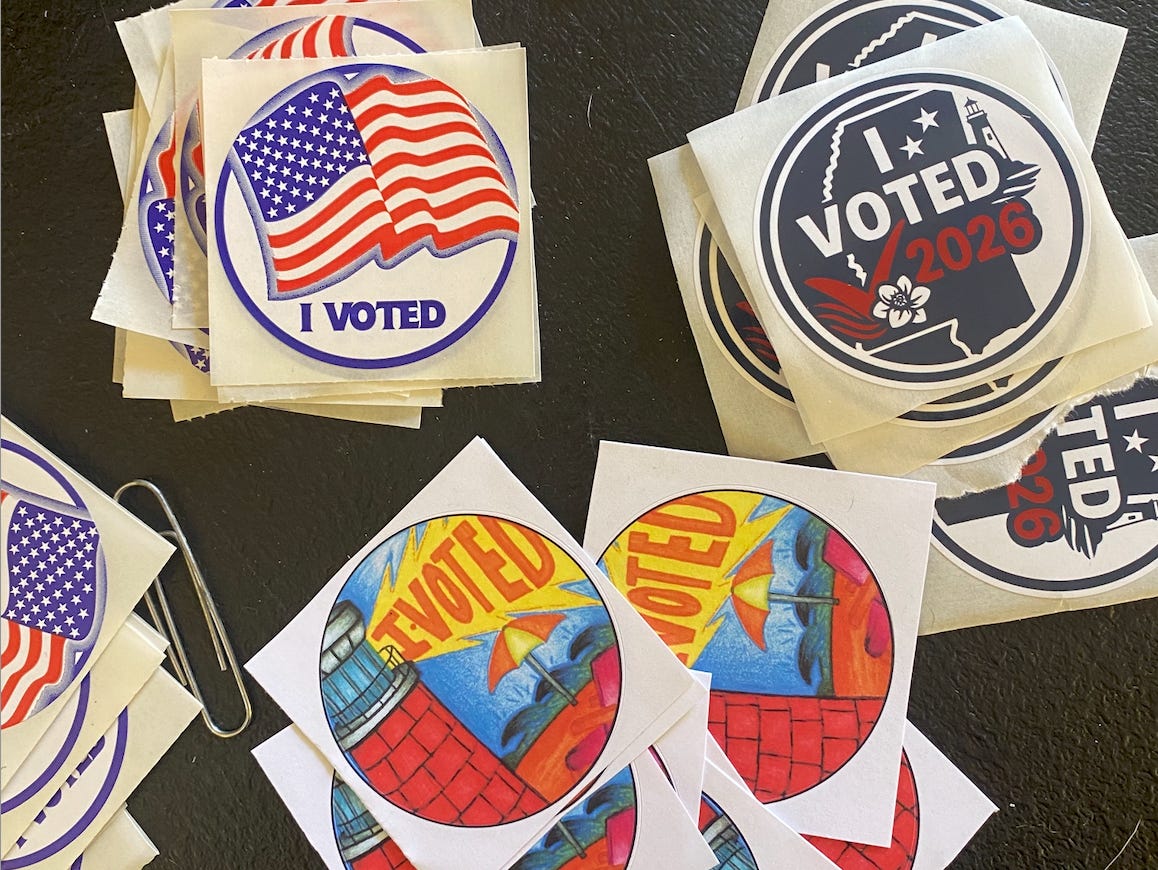
Image: Voter stickers, Pass Christian (courtesy Margaret McMullan)
Thank you Margaret. I was on the "resolution board" in 11/2024 and can so relate! Painful time.
Wow, big thanks to the TMI for publishing this piece! I enjoyed the evergreen story and the gorgeous writing.