


Three candidates—Cindy Hyde-Smith, Scott Colom and Ty Pinkins—are on the ballot for the U.S. Senate on Nov. 3, and whoever finishes first takes the seat. No majority vote and no runoff are required. A candidate can hold the seat for six years on less than half the vote.
State legislatures chose U.S. senators until 1913. The men who wrote Mississippi’s constitution in 1890 had no popular Senate election in front of them. Hiram Revels and Blanche Bruce, the only Black Mississippians who have so far served in the U.S. Senate, were both elected by the Mississippi Legislature during Reconstruction. The Seventeenth Amendment, which required senators to be elected by the people, was completed on April 8, 1913. Mississippi is not among the states listed as ratifying it.
For the offices on the state ballot, the convention wrote a two-part test. Section 140 of the constitution required a candidate for governor or any other statewide office to carry a majority of the popular vote and a majority of electoral votes apportioned among the state House districts. Section 141 sent the choice to the Mississippi House of Representatives, on a recorded vote, when no candidate cleared both. Section 142 barred House members from accepting appointments from an officer the House had elected.
That test decided the 1999 governor’s race. Neither Ronnie Musgrove nor Mike Parker took a majority of the popular vote or of the electoral vote, and Musgrove finished about 8,300 votes ahead. Under Section 141, the choice went to the House, which elected Musgrove 86 to 36 on Jan. 4, 2000.
Nothing in the constitution required members to vote the way their districts had, and many did not. Twenty-seven of Musgrove’s votes came from members whose districts had gone for Parker, according to an Associated Press account published in The Mississippi Press (may require subscription) two days after the vote. Rep. Bobby Moak of Bogue Chitto described the calculation before the vote. “Should I follow the district and vote for someone who’s not going to win and be on the outside and not get anything for my district?” he asked. “My district will benefit.”
One member went the other way. Rep. Valeria Robertson of Olive Branch voted for Parker in a district Musgrove had carried, saying she had to vote her conscience. “I have not gotten any response whatsoever,” she said the following day.
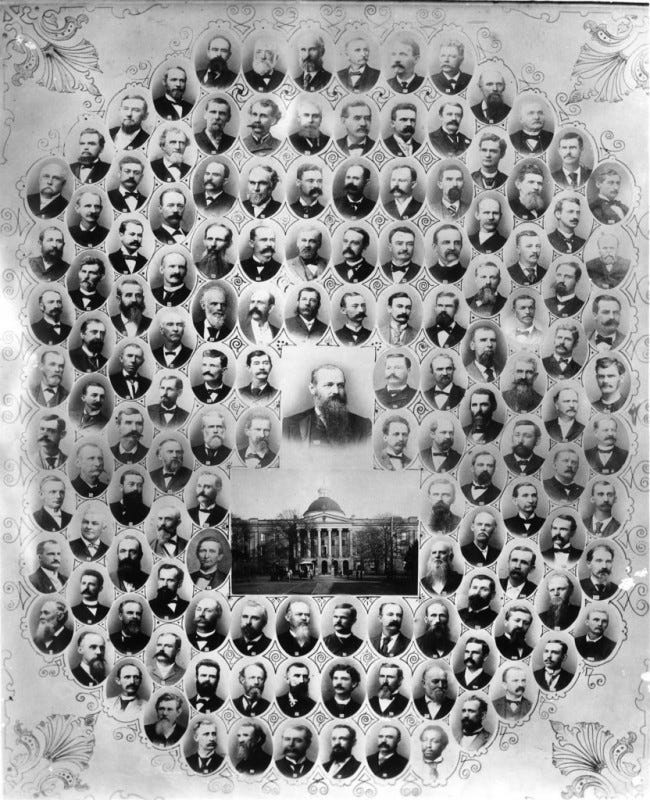
The Mississippi Supreme Court had characterized the convention that built the test in 1896 in Ratliff v. Beale, and the U.S. Supreme Court quoted that language two years later in Williams v. Mississippi. Within the limits the federal constitution allowed, the state court wrote that “the convention swept the field of expedients, to obstruct the exercise of suffrage by the negro race.” It added that, “Restrained by the Federal Constitution from discriminating against the negro race, the convention discriminates against its characteristics.”
The poll tax and the understanding clause adopted at that convention governed who could register. Sections 140 through 143 governed how statewide votes were counted once cast. Black Mississippians comprised a majority of the state’s population in 1890 and were concentrated in Delta counties, a distribution that a count apportioned according to House district divides and that a straight popular count does not.
The sections stood until 2020. A group of voters sued in federal court in Jackson in 2019 in McLemore v. Hosemann, arguing the electoral-vote scheme violated the doctrine of one person, one vote, but the case was still pending when the legislature acted.
State Rep. Charles Beckett filed House Concurrent Resolution 47 under the title “Constitution; remove the electoral vote requirement for the Governor” and the House adopted it 114 to 2 on March 10, 2020. The Senate adopted it 51 to 0 on June 11, 2020. After the House declined to concur in the Senate’s amendment, a conference report passed the House 109 to 6 on June 28 and the Senate 49 to 2 on June 29. Voters approved it that November.
The resolution amended Section 140 and repealed Sections 141, 142 and 143. The governor and other statewide officials are now elected by the people, a majority wins, and “if no person receives a majority of the votes, then a runoff election shall be held” under procedures set by the legislature. The resolution does not mention federal offices.
Colom would be the first Black Mississippian in the U.S. Senate since Blanche Bruce left it in 1881. If he wins on Nov. 3 without a majority, he will have done it under the only rule on the ballot the 1890 convention never addressed.
Image: Members of the 1890 constitutional convention (via Wikipedia Public Domain)
