

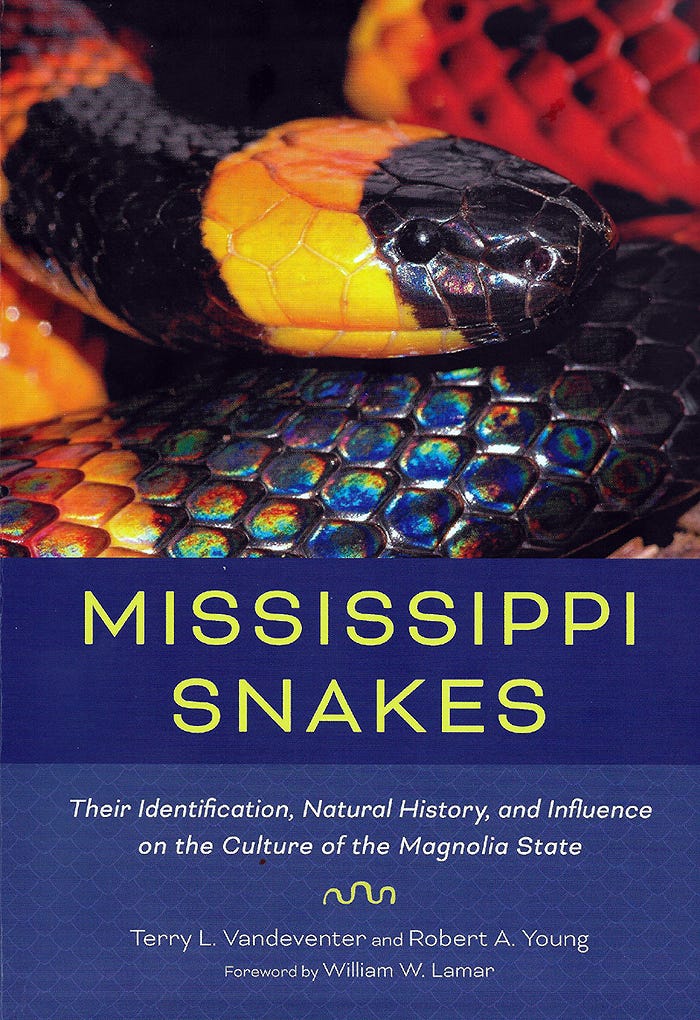
“Few people have a take ’em or leave ’em attitude when it comes to their feelings regarding snakes.”
With that statement, in the introduction to the new book Mississippi Snakes: Their Identification, Natural History, and Influence on the Culture of the Magnolia State (University Press of Mississippi), the authors set out to unravel perhaps the most complex relationship between humans and animals: us and the snakes.
“Whatever feelings one may harbor about snakes, these emotions are often deep-rooted and intense,” the authors note in what some might consider that an understatement. This dynamic underscores the challenge authors Terry Vandeventer and Robert Young undertook in writing a book for “the masses” that opens a door to greater understanding and more humane treatment of these complex, fascinating creatures.
Mississippi Snakes is 400 pages of detailed, informed observation and analysis set out in a fluent, familiar style and laced with wry humor and play. It is also superbly illustrated with photographs, drawings and maps, providing readers with authoritative, up-to-date information about more than 50 different kinds of snakes who make their home in the Magnolia State.
What’s more—much more, in fact—Mississippi Snakes offers a fascinating, kaleidoscopic perspective on the people and culture of Mississippi from a snake’s-eye view, as it were.
During more than 30 years of fieldwork, Vandeventer, a herpetologist, and Young, a toxicologist who considers herpetology an avocation, met Mississippians of all stripes: “anglers, hunters, amateur and professional naturalists, farmers, country-store owners, foresters and old bluesmen sitting on Delta porches,” who added their own beliefs and stories to the cultural narrative of snakes. This narrative is further enriched by snakes in story, song and notions derived from both the Old World and the New.
A primary emphasis of Mississippi Snakes is on the identification and natural history of Mississippi snakes. Each profile of the more than 50 species and subspecies of snakes in the state provides distinguishing characteristics (as well as common variants), a natural history that includes common names and their origins, habitat, distribution (with detailed state maps for each species), temperament, behavior, reproduction and whether the species is venomous.
The identification of venomous snakes and the rare instances of snakebites are treated in separate sections, both of which implore the casual naturalist, hunter or fisherman to leave snakes alone and point out that many snakebites are due to someone trying to kill or capture a snake, venomous or not. Though full of information, the species descriptions are shorn of the technical language and nuances of scholarly/scientific publications to make identifying snakes in the field fast and effortless.
This reader-friendly style permeates the book. Mississippi Snakes, far from being just a field guide—a role it fills superbly—is a joy to read. As biologist William Lamar observes in his eloquent preface, Mississippi is “nothing if not a land of stories” and, “The authors share with us the incomparable folklore surrounding its snakes, some of it partly based on fact or misunderstanding, with a tranche—like so much gossip—lodged firmly in the realm of fantasy.”
Vandeventer and Young offer up such nuggets of information as in the Choctaw language, “sinti means ‘snake,’ while sintollo is the word for ‘beloved snake’ and refers to all rattlesnakes,” a drastic illustration of the differing perspective Native Americans had on the natural world. A cottonmouth figures prominently in True Evil, a novel by Mississippi author Greg Iles, and Faulkner describes his protagonist stepping on two “moccasins” while rescuing people from rooftops during the Great Mississippi Flood of 1927. Snakes often find their way into Mississippi blues, “literally or metaphorically,” among lyrics that “reflect love lost, rejection, unfaithfulness, and as is typical of most blues songs, a touch of risqué innuendo.” The authors offer lyrical samples from blues songs “Crawling King Snake,” “Cottonmouth” and “Black Snake Moan.”
Snakes appear in place names throughout the state such as the two Rattlesnake Creeks, one in Lauderdale County and another in Carroll County. The practice of snake handling receives a thorough, enlightening examination, and the Lake Washington “Snake Grabbin’ Rodeo,” during which harmless water snakes are caught and released, receives a (somewhat indulgent) nod.
Mississippi Snakes reveals the authors’ diligence in every sentence. The scholarship behind this work is impeccable and the research comprehensive, thorough, leaving no relevant stone unturned, often quite literally, of course, when speaking of fieldwork. Mississippi Snakes provides professionals as well as the casual outdoorsman or backyard naturalist a concise, accurate field guide, and we have every reason to believe that the authors’ hopes of the book finding its way “into the college classroom as a definitive reference on Mississippi snakes” will be realized in short order.
As for the authors’ other “grand dream”—that the book will “perhaps strike a spark in the curious mind of some youngster who will hopefully, someday, grow up to write an even better book,” that certainly might happen, but a better book than Mississippi Snakes will be a long time coming.
Image: Cover of Mississippi Snakes (via University Press of Mississippi)