


PORT GIBSON, Miss.—A decade ago, Rev. William Coleman made his living mowing lawns and selling secondhand items out of a truck. The idea of heading up Port Gibson’s all-white preservation group was not a remote consideration.
Yet, as Coleman recently put it, “Al dangled this hook in front of me and I bit, and I haven’t been able to spit it out.”
“Al” was the remarkable Clarence Alton Hollingsworth Jr., who died at his Church Street home a few weeks ago, just shy of his 94th birthday, and who is remembered as a dogged historic preservationist with a penchant for inspiring others to act.
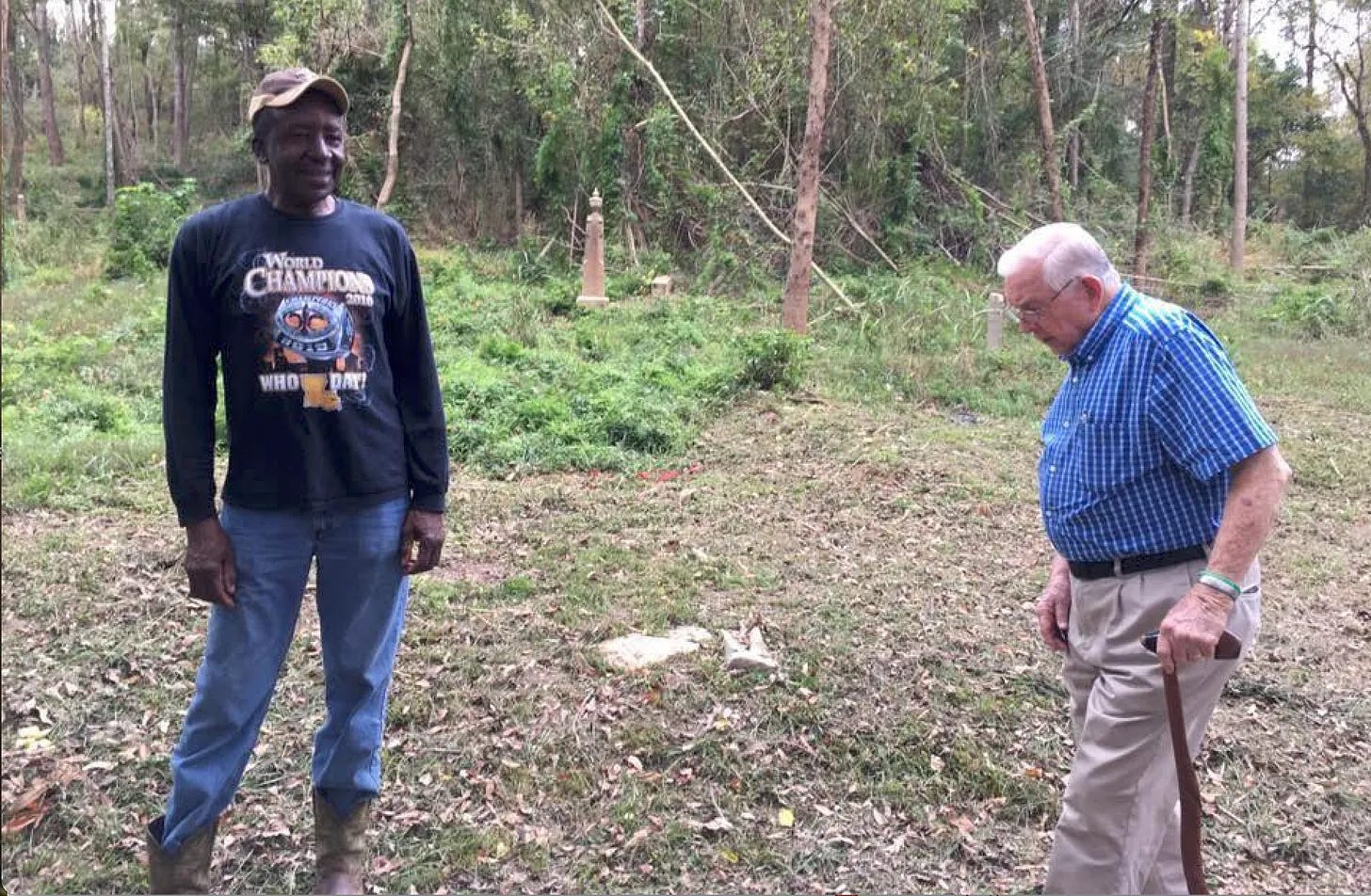
For Coleman, the initial hook was the abandoned African American cemetery known as Golden West, on the outskirts of town, which had been lost in a bramble of briars, weeds and young trees. Hollingsworth valued historical sites of all kinds and wanted to see the burial ground restored. In his mind, it made sense for Coleman to take it on given his landscaping expertise. Golden West proved to be an arduous project, with hundreds of graves, many unmarked, spread across densely overgrown, steep terrain.
“When I went out there, I couldn’t even find it,” Coleman recently recalled. “But Al was determined. He said Wintergreen cemetery, and the Catholic cemetery, and the Jewish cemetery, were all well maintained, and Golden West should be, too.”
Port Gibson is a scenic yet economically depressed town founded in the early 19th century on the banks of Little Bayou Pierre, between the better-known historic cities of Vicksburg and Natchez. Despite its stagnant economy, the town’s showplaces are generally well maintained. Wintergreen, the main cemetery, where Hollingsworth is now buried, is among the more beautiful and carefully maintained in the state. The town proclaims itself “too beautiful to burn”—a reference to a dubious quote by Union Gen. U.S. Grant. Though the comment is almost certainly a myth, given that invading generals do not typically stop to consider the aesthetics of contested terrain, it has fostered local pride.
Port Gibson is 90 percent Black, and it bothered Hollingsworth that the African American cemetery was singularly neglected. Once alerted to the situation, Coleman shared that concern. Midway into the project, Coleman suffered a major setback when he lost one of his legs in an accident, but with Hollingsworth’s support and encouragement he forged ahead.
Coleman had met Hollingsworth through his wife, the late Libby Hollingsworth, who had hired him to maintain the lawn of the couple’s home. The relationship soon blossomed into friendship and an unexpected professional alliance. Hollingsworth later saw to Coleman’s installment as head of the Port Gibson Heritage Trust, a preservation group that the couple had helped found. As Coleman put it, “One of his things was, we’ve got to change the image of the Port Gibson Heritage Trust. It can’t be all white. We need a mixture of people.” Most preservation groups focus on the more conspicuous examples of historic architecture, which, in Port Gibson, means columned antebellum homes and other outcroppings of white plantation culture. Hollingsworth wanted to see a more diverse array of projects, including slave dwellings and Civil Rights Era sites. It was typical of his worldview.
“Al is one of a kind,” Coleman said, still speaking of Hollingsworth in the present tense a few days after his funeral on April 2, 2026, in the town’s historic First Presbyterian Church, which is famous for its steeple topped by a golden hand with the index finger pointing heavenward. “Al is an original,” Coleman said. “There is no other Al Hollingsworth. It’s just the nature of the guy. No pretension. What you see is what you get. He’s real in every way.”
A beloved figure in Port Gibson and beyond, Hollingsworth was a longtime champion of historic buildings, records and artifacts, and everyone who is anyone in Mississippi’s preservation community showed up for his funeral. State Sen. Albert Butler read a proclamation by Lt. Gov. Delbert Hosemann singing Hollingsworth’s praises. He was also known for his progressive views during the Civil Rights Era, his quick wit, his sense of fairness and his unwavering love of life. His wife Libby, who died in 2016 and whose family roots in Claiborne County date back to the territorial era, shared those traits.
Al Hollingsworth was born in Greenville, Mississippi on April 7, 1932, and died at home on March 21, 2026, surrounded by loved ones. Those who knew him recall that he was even tempered and driven, someone who remained resolute after being partially disabled by a stroke in 2011, followed by his wife’s death and a subsequent fall in which he was blinded in one eye. His longtime friend Bobby Lowe said Libby Hollingsworth drove him to overcome such obstacles, which influenced his perseverance after she was gone.
“He kept going because he didn’t want to let Libby down,” Lowe said.
After Libby’s death, Hollingsworth continued with the preservation work they loved. He occupied their home until the end with the aid of local caregivers and a monitoring system that enabled distant family members to keep watch on him remotely.
Though he lived a comparatively privileged life, Hollingsworth was notably egalitarian, particularly for someone of his generation. He respected and valued everyone’s insights, whatever their station in life. Lowe said that following two contentious boycotts of white businesses in Port Gibson during the 1960s, the reverberations of which continued for many years, Hollingsworth worked to unify the community. “Al brought Blacks and whites together in Port Gibson more than anybody else,” Lowe said. “He was probably one of the most brilliant, gentle human beings I’ve ever known. He had a deep-seated intelligence, and he knew right from wrong.”
Hollingsworth recognized that history is multifaceted and encompasses more than the fine homes lining Church Street, which was one reason he pushed Coleman to take on Golden West. As Coleman recalled, “He said, ‘It’s the other side of the story. We need to tell that. The others are taken care of.’”
Even on his deathbed, Hollingsworth’s mind remained sharp and inquisitive. He conversed with visitors about preservation projects, politics and an array of random topics, always asking questions and offering thoughtful observations. Despite the pain he experienced toward the end, he was, as Lowe described him, “Kind, kind, kind.” When a thoughtful neighbor brought him a peach cobbler, he ate it even though it was difficult for him to chew and swallow, just to make her happy.
He was meanwhile still trying to get a historical marker installed at Golden West and pushing others to document and help preserve Port Gibson’s historic African American buildings, of which the town has an abundance, though they are not fully appreciated. Coleman assured Hollingsworth that the Port Gibson Heritage Trust would do just that. It was not simply a deathbed promise; Coleman is now a true believer.
The Heritage Trust’s board is today roughly half Black and half white as a direct result of Hollingsworth’s efforts. In ensuring the organization was more representative of the city’s demographics and history, Coleman observed, “One of the things you have to maneuver is the old mindset.” Fortunately, this was a realm in which Hollingsworth had considerable personal experience. His efforts also ensured that historic preservation would continue as the town’s demographics changed, given that in the past, it was largely the domain of whites, and seen that way by many Black residents.
Growing up in the Delta, Hollingsworth developed an early love of history and of youthful adventure that prompted one of his fondest personal memories. In 1949, when he was 17, he, a cousin and a friend built a small-scale replica steamboat, with a working steam engine and paddlewheel made from a combine thresher, named it the Huck Finn and, the following summer, sailed it from Greenville to New Orleans, a distance of more than 400 river miles, sleeping on sandbars along the way. Hollingsworth was the pilot. (The story of their trip was recounted in the Aug. 21, 2025, edition of the Port Gibson Southern Reveille.) After their return, all three joined the military. Hollingsworth went on to graduate from Mississippi State University.
In 1956, he married Port Gibson native Elizabeth “Libby” Shaifer, after which he took a job managing the Armstrong Tire plant in nearby Natchez. During his career as an Armstrong executive, he and Libby relocated with their three children to California, then Connecticut. After he retired, the couple returned to her family home in Port Gibson to care for her aging parents.
As manager of the Armstrong plant during the Civil Rights era, Hollingsworth oversaw the controversial integration of employee facilities. As his friend Jessica Crawford noted in her eulogy at his funeral, “Al was on the right side of history—so much so that the FBI had to show him how to check his car for bombs that might have been planted by the Klan. He told me the story of when he desegregated the water fountains, bathrooms and dressing rooms at the Armstrong plant. He called the maintenance man and told him to come to the plant on a Saturday and said this is what we’re going to do, and I don’t want to hear anything back about it. He had him remove the ‘whites’ and ‘colored’ only signs and move one of the water fountains. He had him take out the wall that divided the white and Black bathrooms and dressing rooms. I asked him what happened on Monday when everyone came back and Al kind of laughed and said, ‘Well, there were a lot of dirty, thirsty white people for several weeks.’” The story illustrates both his dry wit and his open mind.
The Hollingsworths’ progressive views prompted occasional blowback, as when some locals objected to their paying housekeepers more than the customary low wages. Hollingsworth’s response was that everyone else should simply pay more.
After returning to Port Gibson from Guilford, Connecticut, the Hollingsworths threw themselves into community service projects, with an emphasis on preservation. In Guilford they had restored a historic home, helped establish a historic district and gotten involved in the National Trust for Historic Preservation. Crawford recalled seeing in their Port Gibson home office “dozens of lanyards with name tags from preservation-oriented meetings and conferences Al and Libby had attended all over the country. Al was especially a cheerleader for women preservationists, and he told me someone once asked him why he surrounded himself with so many women. He said, ‘My response was that I surround myself with the people who get things done!’”
The Hollingsworths were founding members of the Mississippi Heritage Trust, which bestows the annual Libby and Al Hollingsworth Award for lifetime achievement and leadership in both state and national historic preservation. They also worked with The Guilford Preservation Alliance, the Port Gibson Heritage Trust (as founding members), the Mississippi Historical Society and the Archaeological Conservancy, for which Crawford is Southeast regional director, and were longtime supporters of the Mississippi Department of Archives and History.
The couple’s historic preservation efforts were not limited to making donations. They got involved in planning, organizing, lobbying, hosting and advocating for key causes. Hollingsworth spent 14 years managing the Port Gibson Main Street Association, a program of the National Trust to promote local businesses and historic streetscapes, and with his wife helped lead a successful fight against widening tree-lined Church Street. They donated money to save Prospect Hill, a dilapidated plantation house outside town from which more than 250 enslaved people were freed before the Civil War to immigrate to a colony known as Mississippi in Africa, in what is now the West African nation of Liberia. Those donations bought time and enabled strategic repairs; the Archaeological Conservancy, which then owned Prospect Hill, recently sold it to two Natchez residents who have begun a complete restoration. Due to its history, the house has attracted interest among an array of people, Black and white.
After Libby’s death, Hollingsworth established a Mississippi Heritage Trust endowment in her memory and lobbied for the preservation of her family’s historic Shaifer house and the Port Gibson Civil War battlefield on which it stands.
As Crawford observed, “It was not just historic places he valued; it was the stories they carried. Al believed everyone’s heritage was important, whether it was a historic house, a local church with bullet holes from the Civil Rights era, the vanishing houses where enslaved people lived, a portrait, a family album, or a collection of quilts.”
Due to his wife’s connection, the Shaifer house—the lone surviving structure on the Port Gibson battlefield—was especially important to him, and he was disheartened by the state’s poor maintenance after the family donated it and it was restored. The house, which has since been transferred to the National Park Service, is still in a state of advanced disrepair. Hollingsworth remained hopeful that it would once again be restored and better maintained but saw the neglect as a cautionary tale. It made him more circumspect about choosing where to donate important historical artifacts.
The original owners of the Shaifer house were slave holders who cultivated market vegetables and cotton on their plantation southwest of town. Al and Libby abhorred slavery and racism, but they embraced the stories embodied by the house and the lessons learned. Their interest was in preserving the physical evidence of a pivotal piece of history, which was important both personally and as part of a larger historical narrative. Hollingsworth meticulously researched the house using both historical documents and the family’s oral traditions. Among its uses, it had served as a field hospital during and after the Battle of Port Gibson.
Crawford recorded Hollingsworth telling the Shaifer house story, during which he said that he and Libby had donated one of its blood-stained benches to the Grand Gulf state military park and were chagrined to find that it was later painted over, obscuring the evidence of its use in the field hospital. “So much for history,” he said. They also placed on loan to the park museum a commemorative chair made by a Union veteran and given to Confederate veteran (and then Shaifer house owner) Kell Shaifer, on which was painted a rendering of the battlefield and the larger Vicksburg Campaign. The Hollingsworths later transferred the chair to the state’s Two Museums for safekeeping. “Libby got the chair back and got it where she wanted it in Jackson,” Hollingsworth said.
In recounting the house’s history, Hollingsworth pointed to relics that were close at hand. At one point in Crawford’s recording, he tells her, “You’re sitting in a Shaifer house chair. That was their new dining room furniture.”
He recounted how female Shaifer family members, an enslaved housekeeper and their children fled the house after fighting broke out around midnight between Union and Confederate armies on May 1, 1863. The women and children escaped in a small wagon that they had to push and pull about a mile to the Confederate lines, where they were able to acquire a horse and continue to a safer area. Among the evacuees was Elizabeth Humphreys Shaifer, the family’s elderly matriarch, who had difficulty walking and had to be carefully but hurriedly loaded into the wagon along with the children of both the Shaifers and enslaved “Mammy Mary,” the latter of whom is remembered for her skills as a quilter, and whose image appears alongside family members in a treasured photo album. Pointing across the room, Hollingsworth told Crawford that Elizabeth Humphreys Shaifer was “that lady in the portrait there.” He added, “I sleep under Mammy Mary’s quilt every night.” The Hollingsworths had a large collection of her and others’ quilts that he eventually donated to the Abby Aldrich Rockefeller Folk Art Museum at Colonial Williamsburg. His large cache of historical documents and artifacts remain in his family’s hands.
After the war’s end, Hollingsworth said, Kell Shaifer walked home from a distant post, fell sick along the way and ended up prostrate by a roadside, where a Union officer stopped to give him food and water. Hollingsworth, a devout Christian, saw in this episode a classic Good Samaritan act. When Shaifer got home, he found that his wife had given birth but that the baby had died. His wife, who had discovered a half-buried corpse in the yard after the battle, and cleaned up the blood inside, died soon after. So, Hollingsworth said, “Kell comes home. Mammy Mary is the only adult left. She has the house put back together. When Kell Shaifer came back, that’s what he found, his former slave housekeeper taking care of his house and children.” The story illustrates the intimately entwined local histories and reinforced Hollingsworth’s desire to preserve the evidence—all of it.
“You’re always going to have the Black and white thing,” Hollingsworth once said. The point was to find a way through the sometimes profoundly disparate yet shared histories. In his view, that was why it was crucial to preserve illuminating evidence. He noted that Kell Shaifer never reconciled himself to the freeing of his slaves, and added, “The tragedy in my mind [is], today, the Black community, at least in this town, they’re ashamed of their ancestors’ experiences.” Slave dwellings have disappeared because no one wanted to save them. Yet, how better to visualize the experiences of the enslaved? “Most everything in this town was basically built by slave labor,” he said. The battlefield itself was pivotal in its longer history. “That’s a battle that happened and when it started the Black people in this town were enslaved and when it ended, they were free,” he observed.
Lowe said Hollingsworth recognized the challenges of sparking continued interest in local history given the longstanding residential flight from Port Gibson and the greater focus of young people on social media and other contemporary concerns. Yet one of Hollingsworth’s younger caregivers, who had little previous interest in history, was ultimately drawn in by his stories and frequently posted about local historical sites, including the Shaifer house.
Coleman said he did not expect to get swept up in the Hollingsworths’ efforts to preserve the evidence of those entwined yet often conflicting local stories. He said he met Libby Hollingsworth only one time, after she saw him working on the grounds of the Catholic Church across the street from their home and walked over to ask him about maintaining their yard. As the two strolled the grounds discussing plants—both the Hollingsworths were master gardeners—she was impressed that he could identify them all. She then took him inside and introduced him to Al. When Coleman came back a few days later to do the work, Libby Hollingsworth had gone to the hospital, and she never came back. Coleman said, “Mr. Al, right before he passed, told me, ‘William, you were her last hire. That was the last official thing she did before she went to the hospital.’ That meant something to him. We grew from there. There was almost never, like, an employee relationship. He’d say, ‘That’s William, he cuts the grass, but we’re friends. He gave me access to his office for any meeting I needed to have.”
After Hollingsworth’s death, Crawford wrote in a Facebook post, “It’s still hard to find the words to describe what a wonderful man he was and what he meant to me. I learned so much from him about history, preservation, business, and just about life. There’s so much to say about him and his kindness, generosity, his fabulous sense of humor, the character and courage he showed during the Civil Rights era, and how he lived his entire life. He had a gift for bringing the right people together to get things done.”
She added: “I’m so sad, but I keep remembering that I could have gone my entire life without knowing Al Hollingsworth, but I got lucky and I did know him. I loved him and I told him so every time I saw him. I treasure every minute I spent with him, and I am certainly not the only one.”
Among the others who feel that way is Josephine Moore. During the decade or so that Moore worked for Hollingsworth, first as a housekeeper and later a caregiver, she saw him as a “fair minded, strong-will hearted man.”
After initially helping Hollingsworth at Christmas parties, she said, “I became just one of the family. Sit at the table with them to dine. Color didn’t matter to him. Color mattered with a flower or clothes but not the color of your skin. Once you learned of him and he got to know you he was just straight-up with you. He was into teaching people how to advance in this world.”
Moore said she knew little about history before meeting Hollingsworth but that the two would talk about such things all day long. “We would talk about what our foreparents told us,” she said. “He would tell me about how Port Gibson got started. I learned a lot about his life, too. He always had that ‘go’ mentality, even at the end. He never forgot anything.”
This article is reposted from Alan Huffman’s What Happened Substack. A version also appears today in the print edition of the Port Gibson Southern Reveille (the newspaper’s Facebook page is here.)
Image: William Coleman and Al Hollingsworth at Golden West cemetery (courtesy Jessica Crawford)
Thank you for this moving, inspiring post.