


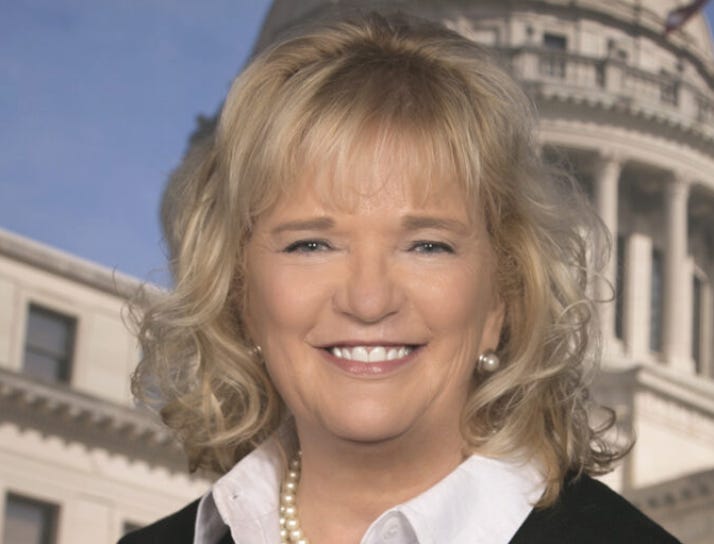
In the first week of March 2026, as the Mississippi Legislature approached one of its final procedural deadlines, Rep. Becky Currie (R-Brookhaven) stood on the House floor and offered a number she could not fully explain.
Approximately eight people incarcerated in state prisons had died during the preceding week, she told her colleagues, all of them between the ages of 20 and 30. She did not have their names. She did not have confirmed causes of death. She did not say whether the Mississippi Department of Corrections had provided any of that information to her as chair of the House Corrections Committee. What she had was a count—partial, unverified and, by her own account, incomplete—and a set of reform bills that the Senate was preparing to kill.
The deaths Currie referenced are part of a pattern that has drawn sustained national attention. A multipart, collaborative investigation published earlier this year found that prison understaffing and gang violence likely led to the killings of nearly 50 incarcerated people since 2015, with only eight cases resulting in criminal convictions. Family members of those who died behind bars said they had received little or no communication from prison officials, learning details instead through a whisper network of incarcerated people, advocates and, in some cases, journalists.
The federal government has confirmed what the reporting revealed. In 2020, the U.S. Department of Justice announced an investigation into conditions at four Mississippi prisons. In 2022, the department issued findings that conditions at the Mississippi State Penitentiary at Parchman violated the Eighth and Fourteenth Amendments to the Constitution. In 2024, it issued similar findings for three additional facilities—South Mississippi Correctional Institution, Central Mississippi Correctional Facility, and the Wilkinson County Correctional Facility—concluding that the state had failed to protect incarcerated people from violence; to provide adequate medical and mental health care; and to maintain safe conditions of confinement. Every major state prison in Mississippi now operates under federal findings of unconstitutional conditions.
It is against this record that Currie, a former nurse, has spent two legislative sessions attempting to force the state to confront what is happening inside its own facilities. Her 2025 omnibus reform bill passed the House 118–0 but died during late-session negotiations between the chambers, in part due to opposition from the office of Gov. Tate Reeves, who favored awarding monitoring authority to a private firm rather than the Mississippi State Department of Health. This year, Currie returned with a package of individual bills targeting healthcare, oversight, and accountability.
Several of those bills cleared the House with unanimous bipartisan support in February. H.B. 1744 mandated the creation of hepatitis C and HIV treatment programs in state prisons and required the state to obtain medications at federal discount prices through the 340B program—a response to reporting that the state’s medical contractor, Kansas-based VitalCore Health Strategies, was treating only about 50 of more than 5,000 inmates diagnosed with hepatitis C each year. H.B. 1692 would have transferred authority to award the prison healthcare contract from MDOC to the Department of Finance and Administration, a structural change designed to prevent the agency from resorting to another round of emergency, no-bid contracts when VitalCore’s current three-year, $357 million agreement expires in 2027. H.B. 1739 would have overhauled the Corrections and Criminal Justice Oversight Task Force to require investigation of all unexpected deaths in state custody and the publication of findings.
Other bills in the package died at the February 3 House committee deadline or were double-referred—a procedural move that often signals that a bill lacks leadership support. Among them was H.B. 1745, which would have redirected $690,000 from a contract MDOC awarded to the politically connected law firm Butler Snow to the legislature’s own watchdog agency, PEER, for an independent audit of the VitalCore contract. Currie, who chairs the committee with jurisdiction over corrections, was not informed of the Butler Snow arrangement until late December 2025. H.B. 1748, which would have removed a requirement that legislators give advance notice before visiting state prisons, also failed to advance.
The bills that survived the House arrived in the Senate Corrections Committee, chaired by Sen. Juan Barnett (D-Heidelberg), who told reporters he supported the principle of stronger oversight and planned to meet with Currie. But Barnett fell ill before the March 3 deadline for Senate committees to act on House bills and authority over the committee passed to vice chair Lydia Chassaniol (R-Winona).
On Feb. 26, Chassaniol convened the committee and advanced only two measures—a bill requiring MDOC to develop policies for protective equipment when incarcerated people handle industrial chemicals, and the prison deaths oversight bill. She said she was unlikely to call another meeting before the deadline and that she was honoring Barnett’s wishes by limiting the agenda. A spokesperson for Lt. Gov. Delbert Hosemann did not respond to questions about whether Hosemann supported the prison reform measures. The remaining Currie bills—the hepatitis C treatment mandate, the healthcare contract transfer, and the Inmate Welfare Fund oversight—were set to die without a vote.
Hours before the March 3 deadline, Currie moved to save them. On the House floor, she introduced strike-all amendments to two Senate bills—S.B. 2041, which, in its original form, dealt with researching dyslexia in the prison population, and S.B. 2778, a repealer bill—and replaced their contents entirely with the language from her killed reform measures. The amended bills now carry the hepatitis C and HIV treatment mandates, the transfer of healthcare contract authority to the Department of Finance and Administration, provisions allowing hospitals to bid on the prison healthcare contract, Inmate Welfare Fund oversight requiring MDOC to provide a consolidated accounting to legislators, and a provision granting parolees who participate in religious services credit toward their supervision terms. S.B. 2778 includes a reverse repealer, functioning as a backup vehicle for the same provisions. Both bills passed the House and were sent back to the Senate.
The existing oversight mechanism for Mississippi’s prisons has been, by the assessment of its own members, largely symbolic. The Corrections and Criminal Justice Oversight Task Force, established by statute in 2014, is authorized to make policy recommendations but has no enforcement power. Its staff is drawn from MDOC employees. State Public Defender André de Gruy, who serves on the task force, has described the arrangement as “MDOC reviewing themselves.” The task force’s January 2025 annual report made no mention of investigating prisoner deaths.
In October 2025, following published reporting on prison killings, Corrections Commissioner Burl Cain said the department would review unprosecuted homicides and deaths ruled to be of undetermined causes. Nearly five months later, there have been no additional indictments or convictions in open homicide cases. Cain, who was appointed by Reeves, has not publicly addressed the status of that review.
The amended S.B. 2041 and S.B. 2778 now sit in the Senate, where their fate depends on whether leadership allows them to reach the floor or routes them back through committee—and on whether Barnett, upon his return, supports or resists the provisions Chassaniol declined to advance. Reeves, who opposed Currie’s 2025 reforms, has given no public indication that his position has changed. He leaves office in January 2028.
Currie has framed the stakes in terms that are at once fiscal and moral. Mississippi incarcerates approximately 19,500 people in state facilities at an annual cost to taxpayers of roughly $459 million. VitalCore has received nearly $700 million in state contracts since 2020. The Department of Justice has found unconstitutional conditions at every major state prison. And people are dying at a rate that the chair of the committee charged with corrections oversight cannot fully document—because the department she oversees is not providing her the information.
“They’re a ward of the state and we pay a lot of money to take care of them, and we’re not getting our money’s worth,” Currie told the House on March 4. The question now before the Senate is whether it agrees that the deaths warrant investigations—or whether, for the second consecutive year, it will decide that they do not.
Currie did not respond to requests for comment from The Mississippi Independent.
Bonus: If you’ve been following the Hidden Mirrors podcast, about the prison book club at Mississippi’s Wilkinson County Correctional Facility, a new episode is now live. This week, club members switch from talking about reading to talking about writing their own stories, including a planned group book where each man authors a chapter. This is the penultimate of a total of 12 episodes.
Header Image: Becky Currie (via sengov.com)
