

by Christopher Harress
In the same two-week stretch that Mississippi’s $10 billion Compass data center project was crowned both the worst and the best economic development deal of 2025, Gov. Tate Reeves announced that Elon Musk’s artificial intelligence company, xAI, would build a $20 billion data center campus in Southaven, outside Memphis.
It was the kind of whiplash-inducing moment that captures the unsettled politics of data centers in America right now, when such projects are hailed as engines of the future one week, derided as fiscal sinkholes the next.
“There’s a lot of bad, dumb data center deals out there, and Mississippi became pretty clearly a standout,” said John Mozena, president of the Center for Economic Accountability, a Michigan-based nonprofit that advocates for transparency and free-market reform in economic development. Mozena’s group awarded Mississippi the less flattering of the two honors. “I’m not aware of any state in the country that offers data centers what’s essentially a decade-long holiday from most major state taxes, corporate income, franchise and sales, plus up to a 66 percent property tax break for 30 years.”
Mississippi’s incentive structure is unusually generous, allowing the state to layer multiple subsidies onto a single project.
Under the Mississippi Major Economic Impact Act, companies that invest at least $300 million and create 30 jobs can receive up to 10 years of state income-tax rebates, sales- and use-tax exemptions on construction materials and equipment, and property-tax exemptions that often wipe out the full local tax bill, frequently extended through 20-to 30-year PILOT agreements.
Those benefits are often paired with cash grants, workforce training subsidies, and publicly financed roads, water, sewer, and electric infrastructure. For power-hungry data centers, utilities may also build new substations and transmission lines, with costs ultimately spread across ratepayers. In the case of xAI, The Associated Press reported that the state agreed to waive sales, corporate income and franchise taxes, while local governments reduced property taxes—a package that can drive a project’s effective tax burden close to zero for decades.
Although not specific to data centers, the state’s Advantage Jobs Incentive Program also refunds up to 90 percent of payroll taxes, depending on the number of jobs created, wages, and location. The eligibility criteria are exceptionally generous. For data centers, companies must create at least 100 jobs paying the average state or county wage, whichever is lower, to qualify for a 70 percent payroll cash rebate, including bonuses and overtime. If salaries exceed 175 percent of the average, the rebate rises to 90 percent. In more developed counties, the threshold increases to 200 jobs.
So far, Mississippi has secured five major data center projects, totaling roughly $49 billion in headline investment. They range from Amazon’s $3 billion facility near the Port of Vicksburg in Warren County to its far larger $10 billion campus in Madison County, and include Compass Datacenters’ apparently good and bad $10 billion hyperscale complex in Lauderdale County, near Meridian; AVAIO’s $6 billion project in Rankin County; and, most recently, Musk’s $20 billion xAI campus planned for Southaven in DeSoto County. Together, they span nearly the length of the state and have been promoted as symbols of Mississippi’s arrival in the global tech economy.
State leaders have framed the boom in sweeping terms. Announcing the AVAIO deal last summer, Gov. Reeves said it would “not only transform Rankin County and the Metro Jackson region” but would “transform our economic landscape and lead to even more high-tech leaders choosing Mississippi.”
Similar language has been used in the other projects. Amazon has touted hundreds, and in some cases more than a thousand, direct jobs; Compass has promised thousands of direct and indirect positions; AVAIO has projected slightly more than 60 high-tech roles alongside hundreds of construction jobs; and estimates for xAI range from about 100 jobs, according to Southaven’s mayor, to several hundred, according to the governor.
What has been far less visible than the dollar figures and job claims are the underlying details.
“There’s a really egregious lack of transparency on these deals,” Mozena said. “There’s no actual good number out there for what this is going to cost in evaded tax revenues. That’s a legitimate question any other business owner in the state could ask: ‘How much in taxes are these guys not paying that I have to pay? Why are they special?”
“And job creation,” he added, “well, data centers suck at job creation. They’re terrible job creators.”
Amid mounting concerns, a nationwide backlash has intensified as electricity bills rise and unease about artificial intelligence grows. As Sam Altman, the chief executive of OpenAI, once put it, “AI will probably most likely lead to the end of the world, but in the meantime, they’ll be great companies.”
For many communities, the “great companies” part is increasingly in question.
Data center projects are frequently sold as major employment boons, though in practice, many of the positions used to justify subsidies are low-skilled, temporary or indirect, according to Good Jobs First, a Washington, D.C.-based watchdog.
That pattern has played out across the country. In Tucson, Ariz., a project known as Project Blue pledged 180 jobs, but city officials later concluded that most would be temporary construction work, with few permanent roles—a mismatch, they said, for a community facing acute water and energy constraints.
“The jobs that data centers do create locally are typically low-wage, term-limited, non-technical positions such as security, maintenance and janitorial work,” according to research from the University of Michigan.
In Ohio, Google announced a $1.7 billion expansion of three data center sites, with talk of “thousands” of jobs. Subsequent reporting showed that while roughly 1,200 workers were needed during construction at each facility, permanent staffing was expected to total around 200. In Indiana, residents have complained that an xAI data center delivered only “tens” of long-term jobs while receiving generous tax abatements, even as nearby communities raised concerns about air quality and health.
“A lot of folks are working in good faith, but this job creation falsehood is at the heart of so many of these economic development deals,” Mozena argued. “The real purpose isn’t to create jobs but to make voters believe that politicians are responsible for creating jobs.” Most jobs are construction related.
Data centers require large expanses of land, massive electrical capacity and upgraded roads capable of handling years of heavy construction traffic and trucks carrying oversized transformers, diesel generators, steel, concrete and cooling equipment.
In Mississippi, where highways and local roads already suffer from chronic underinvestment and are among the worst in the country, counties are often left scrambling to reinforce infrastructure without clear guarantees of what’s in it for them. (The Mississippi Department of Transportation did not respond to questions regarding infrastructure plans to support data centers.)
Lauderdale County Supervisor Josh Todd said during a Council of Governments meeting on Nov. 10, 2025, that all of Mississippi’s 82 counties, along with MDOT, have an abundance of infrastructure needs and must prioritize which projects to tackle first and which will have to wait for funding.
“We’ve all heard numbers,” Todd said. “I’ve heard city numbers, county numbers, school numbers. I want to know for sure.”
Todd said he also wants to know how much the county is set to receive and to have a plan in place to allocate the funds before they arrive, addressing the most dire needs.
The same challenge applies to electrical power. Utilities must build new transmission lines, substations, and, in some cases, entirely new generation infrastructure to serve round-the-clock demand. Those upgrades take years, cost hundreds of millions of dollars, and frequently require land acquisition and environmental permitting—processes that have historically been contentious in the state. While companies promise to pay their share, the line between project-specific costs and system-wide investments often blurs.
A single large data center can draw as much electricity as an entire city, resulting in a demand surge that utilities across the South are now racing to meet. In some states, including Mississippi, that has meant extending the life of aging fossil-fuel plants or reviving coal units once slated for retirement. Elsewhere, utilities are advancing plans for new gas-fired generation to keep pace with round-the-clock load.
The environmental footprint is also stark. Construction and air-permit documents reviewed by The Mississippi Independent show that hundreds of emergency diesel generators will surround at least one planned facility, a backup system capable of burning millions of gallons of fuel during a prolonged blackout. Those generators, typically tested regularly and designed to run continuously during grid failures, would sit near residential areas rather than at distant power plants.
Water adds another layer of strain. Modern data centers rely heavily on liquid cooling, and a single large facility can consume millions of gallons per day, rivaling the daily needs of a town of tens of thousands of people. Nationally, data centers already account for roughly 4 percent of U.S. electricity demand, a share expected to triple over the next few years as artificial intelligence workloads expand.
In Mississippi, where outages occur more frequently and last more than twice as long as the national average, that combination of heavy power demand, diesel backup systems and water-intensive cooling raises the stakes for both the grid and the communities living alongside it.
Musk’s announcement, the largest single investment in state history, made Mississippi the latest stop in a nationwide race to host the physical backbone of the AI economy. It has also turned the state into a case study in a widening national divide over how much public money should be spent to attract facilities that consume enormous amounts of power, water, and land while creating relatively few permanent jobs.
The dueling awards underscore the paradox in states like Mississippi, which are rolling out the red carpet, offering lavish tax incentives and confidentiality protections. Elsewhere, lawmakers and residents are pushing back.
In Virginia, Arizona, Missouri, Indiana and Oregon, local opposition has blocked or delayed an estimated $18 billion in proposed data center construction. Warrenton, Va. voters ousted every town council member who supported an Amazon-backed project. A similar revolt unfolded in Cascade, Ore. This month, Birmingham, Ala., temporarily paused its own data center discussions for six months, citing uncertainty over costs and benefits.
Mississippi officials and utilities have insisted that data centers will be a boon and will stabilize, or even lower, residential electricity rates.
“Electric grids operate on economies of scale,” an Entergy spokesperson told The Mississippi Independent. “When large customers establish service to power a major new project, they help spread the utility’s fixed costs… driving down electricity prices for everyone.”
Yet the utility’s own filings suggest a more complicated reality. Entergy offers discounted electricity to large industrial users through incentive credits, discounts that it can legally recover by adjusting rates for other customers.
In practice, that means when a data center pays less, someone else often pays more.
An Earthjustice analysis of other states found electricity rates for large users fell by more than 80 percent in some cases, while residential rates rose. In Mississippi, where residents already face some of the nation’s highest monthly power bills, and where poverty rates are high, the risk is acute.
To critics, the data center boom fits a familiar Southern pattern: capital-intensive industries extracting public resources with limited long-term benefit.
Across the United States, lawmakers are reconsidering these AI behemoths. Georgia has imposed a moratorium on new data center tax incentives. Connecticut is reassessing laws passed just a few years ago. Virginia, once the unquestioned capital of data centers, is facing mounting resistance.
Even as officials describe the projects as transformational, skeptics ask whether Mississippi is repeating old mistakes, trading secrecy and subsidies for promises that may never fully materialize.
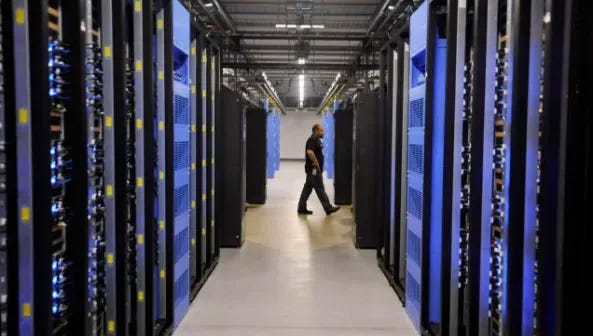
Image: Interior of unidentified data center (via Transmedia Newswire)