


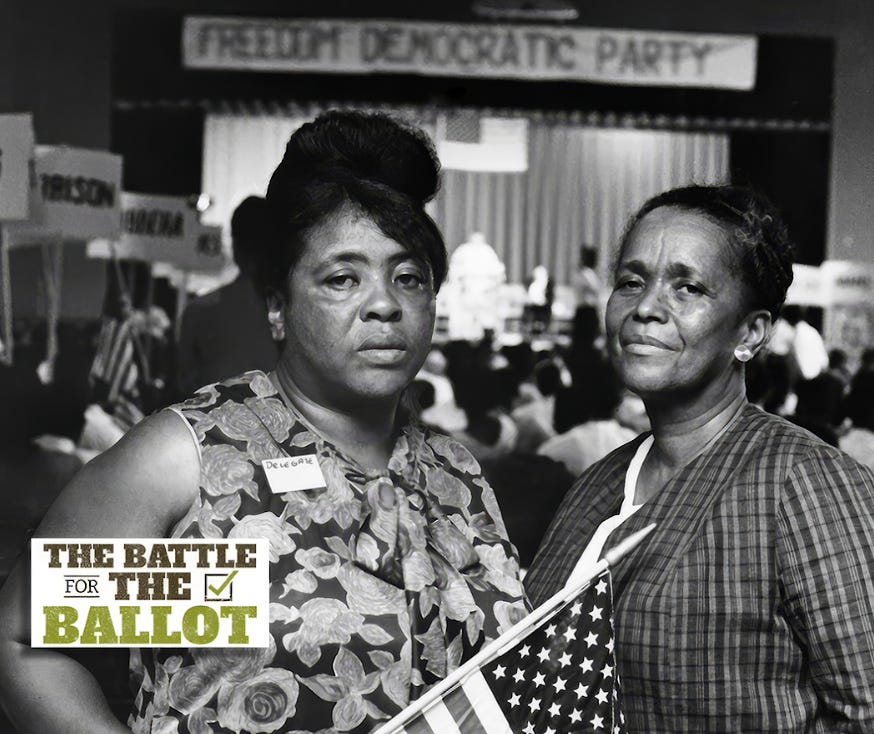
On Jan. 5, 1966, state Rep. Kenneth O. Williams of Clarksdale, chair of the Mississippi House Census and Apportionment Committee, introduced a bill to redraw the state’s congressional districts. The bill became House Bill 911 three days into the regular session of the legislature. The Voting Rights Act had been federal law for five months.
In 1964, three Black women—Fannie Lou Hamer of Ruleville, Annie Devine of Canton and Victoria Gray of Hattiesburg—had run for Congress under the banner of the Mississippi Freedom Democratic Party, formed in response to the state’s regular Democratic Party having shut out Black voters. Registrars refused to certify the petitions of Hamer, Devine and Gray, so they never reached the official ballot. They ran instead in a parallel “Freedom Vote” open to anyone, which they won in a landslide.
Hamer drew roughly 33,000 Freedom Votes against Rep. Jamie Whitten’s 49. On the strength of those results, the Mississippi Freedom Democratic Party asked the U.S. House to refuse to seat Mississippi’s five white congressmen, arguing that their elections were invalid because half the state’s population had been barred from voting. The challenge ran through most of 1965, including depositions, sworn testimony and a September hearing in which the three women spoke. The U.S. House dismissed the challenge on a vote of 228-143 on Sept. 17, 1965. Whitten and the others kept their seats.
The bill that Williams put on lawmakers’ desks was not new. The legislature had drafted it during the 1964 general session and held it without passage before the Voting Rights Act existed—before Hamer had filed at the Indianola courthouse, at which time Sunflower County’s registrar in Indianola had been processing voter applications under the new federal procedures for 153 days, and before the voter registration drive—and attendant white violence—of Freedom Summer.
The plan Williams introduced was the plan the legislature had been holding for two years against the day the federal apparatus would inevitably force the question. Williams’s bill proposed five congressional districts—the same number the state had under the 1962 plan, but with the lines redrawn specifically to dilute Black voting strength.
The 1962 Second District had run east from the central Delta into the hill counties of north Mississippi. It contained Sunflower County, where Hamer had filed; Leflore County, where the Greenwood chapter of the office of the Student Nonviolent Coordinating Committee, known as SNNC, had been operating since 1962; Humphreys County, where George Lee had been shot in his car in 1955 and Gus Courts had been shot in his store the same fall; Washington County, the Greenville port county on the Mississippi River; and Holmes County, where Robert G. Clark Jr., would file for the state House the following year.
The Williams plan moved Sunflower, Leflore, Humphreys, Washington and Holmes out of the Second District and into the First. It packed the central Delta counties with the eastern Black Belt counties of Lowndes, Noxubee, Lee, Monroe, Oktibbeha and Clay to produce a First District that combined the heaviest concentration of Black Mississippians in the state into a district they could not carry. The redrawn Second District contained the hill counties of north Mississippi and the northern Delta counties of Bolivar, Coahoma, Quitman, Tallahatchie and Tunica.
The Mississippi Senate moved to resist. The Williams plan would be overturned in federal court before the next election, a number of senators said, and there was no point in the Senate’s passing a plan the court would have to redraw. The Senate Rules Committee considered the Williams plan in early February and rejected it. The committee approved instead a competing plan drafted by state Sen. W.B. Alexander of Cleveland, the Bolivar County senator whose district lay inside the 1962 Second District. The Alexander plan would extend the east-central Fourth District west across the state to absorb a number of Delta counties with high Black populations, leaving the Second District with a Black population majority and the Delta intact as a single congressional unit.
The Senate took up the Alexander plan on Feb. 15 and passed it after beating down amendments to make it conform with the House plan. When Sen. William Burgin of Columbus rose on the Senate floor the next day to oppose an amendment Walter Moore of Oakland had offered against the Alexander plan, Burgin named the purpose of the Moore amendment for the record. The amendment, Burgin said, was drafted “to distribute the Negro population of the Delta so that they will not be in a majority in the First or Second Congressional Districts.” If the plan was adopted, Burgin warned, “that same party will take the same contest back to the House of Representatives, and this time they will have a constitutional basis for the contest.”
State Sen. George Yarbrough of Red Banks, the floor manager who had brought the Alexander plan to the floor and was running the debate, closed the discussion before it could spread. “Let’s don’t start a lot of discussion,” Yarbrough said, “that might give somebody in Washington or the liberal press in the North a chance to take a dig at Mississippi.” The Moore amendment was defeated 21 to 26.
The legislative action was running against a federal clock. On Oct. 19, 1965, Peggy J. Connor of Hattiesburg and other plaintiffs including the Mississippi Freedom Democratic Party had filed Connor v. Johnson in the U.S. District Court for the Southern District of Mississippi, challenging the existing districting on racial and population grounds. The three-judge federal panel hearing the case had warned the legislature that if the state did not act, the court would. The conference committee deadlocked through March.
On April 5, 1965, Lt. Gov. Carroll Gartin announced a reconstituted conference, with George Payne Cossar of Tallahatchie, Charles Allen of Monroe, and Jimmie Morrow of Rankin for the House and Gartin himself with Yarbrough, E.K. Collins of Laurel and A.J. Foster of Amory for the Senate. With April 8 standing as the deadline for candidate qualifications under Mississippi law, the conferees had three days to produce a compromise.
The compromise plan kept Sunflower, Leflore, Humphreys and Washington counties out of the new Second District but moved Tunica, Bolivar, Coahoma, Quitman and Tallahatchie counties into a redrawn Second District alongside the hill counties stretching from DeSoto to Alcorn. The Mississippi Freedom Democratic Party counted the result on April 19, 1965, at 440,023 in total population, with 301,660 Black residents and 138,365 white residents. The new Second District was 68 percent Black by population. Gov. Paul Johnson signed House Bill 911 into law before the qualifying deadline closed.
The structural argument the Williams plan made depended on the difference between population and the electorate. Six counties in the new Second District had Black voting-age majorities. Only one had achieved a Black majority of registered voters by April 1966. Coahoma County, the home of NAACP leader Aaron Henry and the only county in the new district where federal examiners had been sent under the Voting Rights Act, recorded 7,061 Black voters registered against 6,380 white voters. The remaining five counties had white-majority registration despite Black voting-age majorities. DeSoto County had registered 1,470 of its 6,246 Black voters of voting age. Tunica had registered 468 of its 5,822. Quitman had registered 2,060 of its 7,250. The Williams plan operated on those numbers.
The Mississippi Freedom Democratic Party filed a motion with the federal three-judge panel hearing Connor v. Johnson charging that the new plan was racially geared and a successful effort to gerrymander the Black vote in Mississippi. The presiding judge of the panel was J.P. Coleman of the U.S. Court of Appeals for the Fifth Circuit—the former Mississippi governor who had served as Whitten’s counsel in the Hamer-Devine-Gray contest, elevated to the Fifth Circuit by President Lyndon Johnson on July 27, 1965, between the contest’s arguments before the House and the House’s Sept. 17 floor vote.
The Mississippi Delta had constituted a single congressional district from 1882 forward, through the redistricting plans of 1932, 1952, and 1962. The Williams plan was the first to carve it up.
On June 14, 1966, the Meredith Mississippi March Against Fear followed Highway 51 into Grenada, the hinge county the Williams plan had kept in the redrawn Second District. Grenada County contained 18,400 people, about half of them Black. Of the 4,300 Black residents of voting age, 135 were registered.
That afternoon, Martin Luther King, Jr., addressed a mass meeting at Bellflower Baptist Church, and more than two hundred people marched from the church to the town square to register. One hundred sixty Black Mississippians registered to vote in Grenada that day. The Williams plan had moved the lines. The work of registering the voters within those lines—specifically designed to dilute their numbers—went on.
Image: Fannie Lou Hamer and Ella Baker, 1964 (via SNCCDigital.org)
