


Every judicial race on Mississippi’s Nov. 3 ballot is for a lower court. Court of appeals, chancery, circuit and county judges are all up.
The state Supreme Court is not, in any of the three districts. The Secretary of State’s 2026 elections calendar accounts for the absence in one line on its first page: “The regularly scheduled election for Mississippi Supreme Court is currently enjoined due to a federal court order.”
The calendar does not name the order or the case. It also does not say what happens to the seats that would have been filled.
The order came from Senior U.S. District Judge Sharion Aycock, who ruled on Aug. 19, 2025, that the map “illegally dilutes the votes of Black Mississippians in District 1 in violation of Section 2 of the Voting Rights Act” and barred further elections on those lines. Judicial qualifying ran from Jan. 2 to Feb. 2 of this year, all under Aycock’s bar. Among the judge’s findings: “No Black candidate has ever been elected to the Mississippi Supreme Court without first being appointed to the position by a sitting Governor and thereby possessing the incumbency advantage.”
The districts were drawn in 1987, the same year a federal court first applied Section 2 to the election of judges in Mississippi. That case, Martin v. Allain, filed in 1985, struck down eight trial court districts. The Supreme Court districts were not in it.
Carroll Rhodes was one of the lawyers who brought the case. Judge William Barbour found that it was “difficult for us to draw a Black majority Supreme Court district without splitting counties,” Rhodes told The Mississippi Independent, and the state argued that counties should not be split. The Magnolia Bar Association brought a challenge and lost it in 1992.
The three districts do more than elect judges. They set the lines for the Public Service Commission and the Transportation Commission, three seats each. A ruling against the map would redraw six more statewide offices. Those commissioners are elected alongside the governor, next in 2027.
The Fifth Circuit threw out Aycock’s ruling on May 11, 2026, and sent the Supreme Court districts case back to her court after the U.S. Supreme Court decided Louisiana v. Callais in April. Aycock reopened it for new evidence in July. Briefs are due Nov. 2 and she will hear it on Nov. 16.
Callais requires a plaintiff to show that a state drew its lines because of race. “It’s a steep hill to climb,” Rhodes said of the proof requirement. “Now the plaintiff has to prove that when the legislature draws the districts, the districts are drawn with the intent to discriminate against Black voters. And that’s almost impossible to prove.”
According to Rhodes, officials once expressed such racial motivations out loud, through the 1890 constitutional convention and afterward. That stopped after courts began ruling against them. Now, he said, they give other reasons.
Martin v. Allain first applied Section 2 to the election of judges and produced the districts that put Black judges on Mississippi trial benches. The plaintiffs were private citizens. The U.S. Department of Justice was not involved.
Rhodes noted that the team included Jackson attorney Rob McDuff and lawyers from the Lawyers’ Committee for Civil Rights Under Law, and that they built their case on a line of Supreme Court decisions beginning with Allen v. State Board of Elections in 1969.
“The U.S. Supreme Court said that these voters who were private individuals, private plaintiffs, were really private attorneys general and had standing to challenge it,” Rhodes said. He added that the court said the same thing in Perkins v. Matthews in 1971 and in later cases. “But now that was a different U.S. Supreme Court,” he said. “That was a Supreme Court different in its makeup from the Supreme Court now.”
The state of Mississippi is asking the federal courts to rule that no private citizen can sue to enforce the Voting Rights Act. If the state is right, no Black voter, no local NAACP branch and no civil rights organization could bring a case over a Mississippi map. The U.S. attorney general would alone have the power to bring such a lawsuit, which the state claims the law has always required.
That argument is before a three-judge federal court in Jackson, which has had the case since June. The State of Mississippi has asked the judges to set it aside until the legislature draws new maps. Briefing closed Oct. 2, 2026. The panel has not ruled.
After a federal panel in 2024 found that parts of the 2022 House and Senate plans diluted Black voting strength, the legislature redrew the affected districts and three seats changed hands in special elections in November 2025. Since May 2026, the state has treated those 2025 maps as having no force, and a state Senate seat in District 34 will be filled on Dec. 22 under lines drawn in 2022.
The state has already taken the question to the nation’s capital, arguing that the plaintiffs—the Mississippi NAACP and the 14 voters—had no business bringing the lawsuit. The state’s appeal, filed Aug. 26, 2025, presented one question: “Whether private parties may sue to enforce section 2 of the Voting Rights Act, 52 U.S.C. § 10301.” It did not raise the issue of the fairness of the maps or whether Black voters in the challenged districts could elect candidates of their choice.
The U.S. Department of Justice has not brought a Section 2 districting case in Mississippi. On Sept. 24, 2025, it went the other direction. Solicitor General D. John Sauer filed a brief for the United States in Callais asking the Supreme Court to narrow the test that courts use to decide Section 2 claims. “This Court should modify that judge-made framework,” the brief says.
“Private parties may not sue to enforce section 2,” the state told the U.S. Supreme Court in a brief filed Oct. 21, 2025. “Congress authorized only the Attorney General to enforce section 2.” Solicitor General Scott G. Stewart signed the brief as counsel of record, with Attorney General Lynn Fitch and Deputy Solicitors General Justin L. Matheny and Anthony M. Shults.
On May 18, the Court declined to answer. It threw out the legislative-maps case ruling and sent the case back to Jackson “for further consideration in light of Louisiana v. Callais.”
Justice Ketanji Brown Jackson was the lone dissenter. “This case presents only the question of Section 2’s private enforceability, which our decision in Louisiana v. Callais did not address,” she wrote.
Two federal appeals courts have ruled on the question. The Eighth Circuit held in November 2023 that private plaintiffs cannot sue under Section 2. “The Voting Rights Act lists only one plaintiff who can enforce § 2, the Attorney General,” the panel wrote in Arkansas State Conference NAACP v. Arkansas Board of Apportionment. In May 2025, the same court closed the other route, ruling in Turtle Mountain that private citizens also cannot reach Section 2 through the general civil rights statute. Both votes were 2 to 1.
The Fifth Circuit ruled the opposite way 10 days before the Arkansas decision. In Robinson v. Ardoin, which was decided on Nov. 10, 2023, it held that the voters who sued “are aggrieved persons” and that “there is a right for these Plaintiffs to bring these claims.” Judge Leslie Southwick wrote that decision.
Mississippi is in the Fifth Circuit, and Southwick sits on the three-judge panel that the case went back to.
Rhodes said the lawyers in Martin argued that appointment was the reason only three Black trial judges had ever served in the state. Reuben Anderson was appointed a municipal judge, then to the Hinds County Court, then to the circuit court, then to the Mississippi Supreme Court. Fred Banks replaced him by appointment as he moved up.
“All of the Black judges who were elected before ’89 had first been appointed,” Rhodes said. “And we argued that that appointment would send a signal to white voters and white lawyers that this Black is okay. Because it was white officials who were doing the appointment.” Black voters, he said, “didn’t get a chance to choose people until we were successful in the lawsuit.”
Asked what happens if the U.S. Supreme Court rules that private parties cannot sue to enforce Section 2, Rhodes said the districts he won would probably hold for a time, but that new litigation would be stopped. Civil rights organizations and activists, he said, “would not be able to bring” those cases.
The panel in Jackson has not ruled on the state’s motion.
The judicial deliberations over the state Supreme Court districts and who can sue over the Voting Rights Act could both have profound, longterm impacts on Mississippi voters.
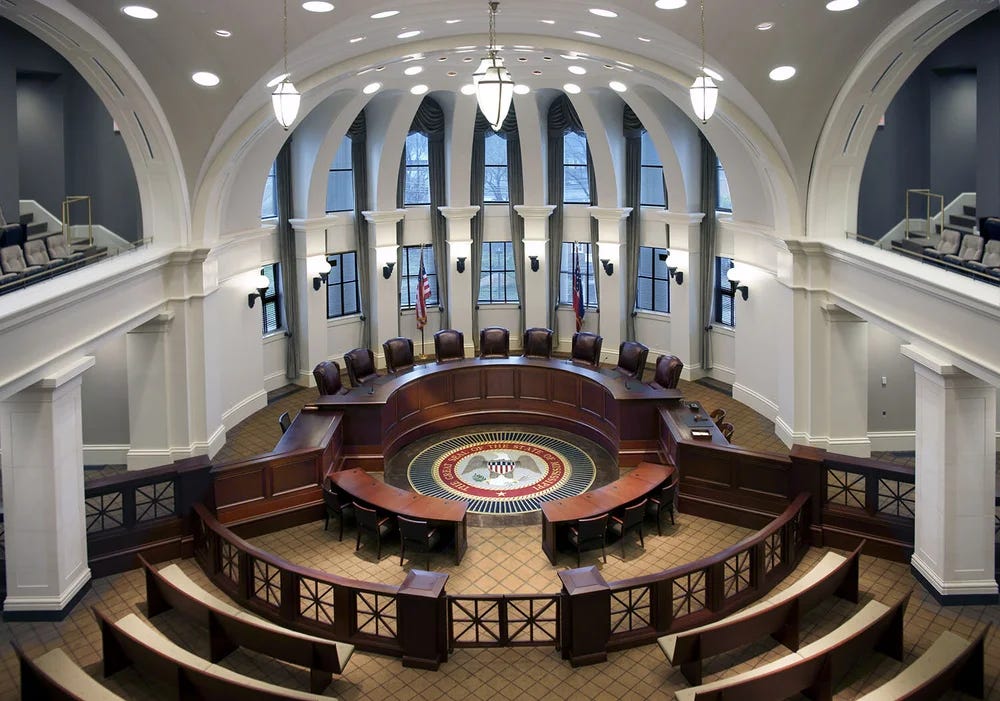
Image: Mississippi Supreme Court chambers (courtesy Dale Partners Architects)

This subtrifuge is exactly what I expect from Mississippi. Racist.