

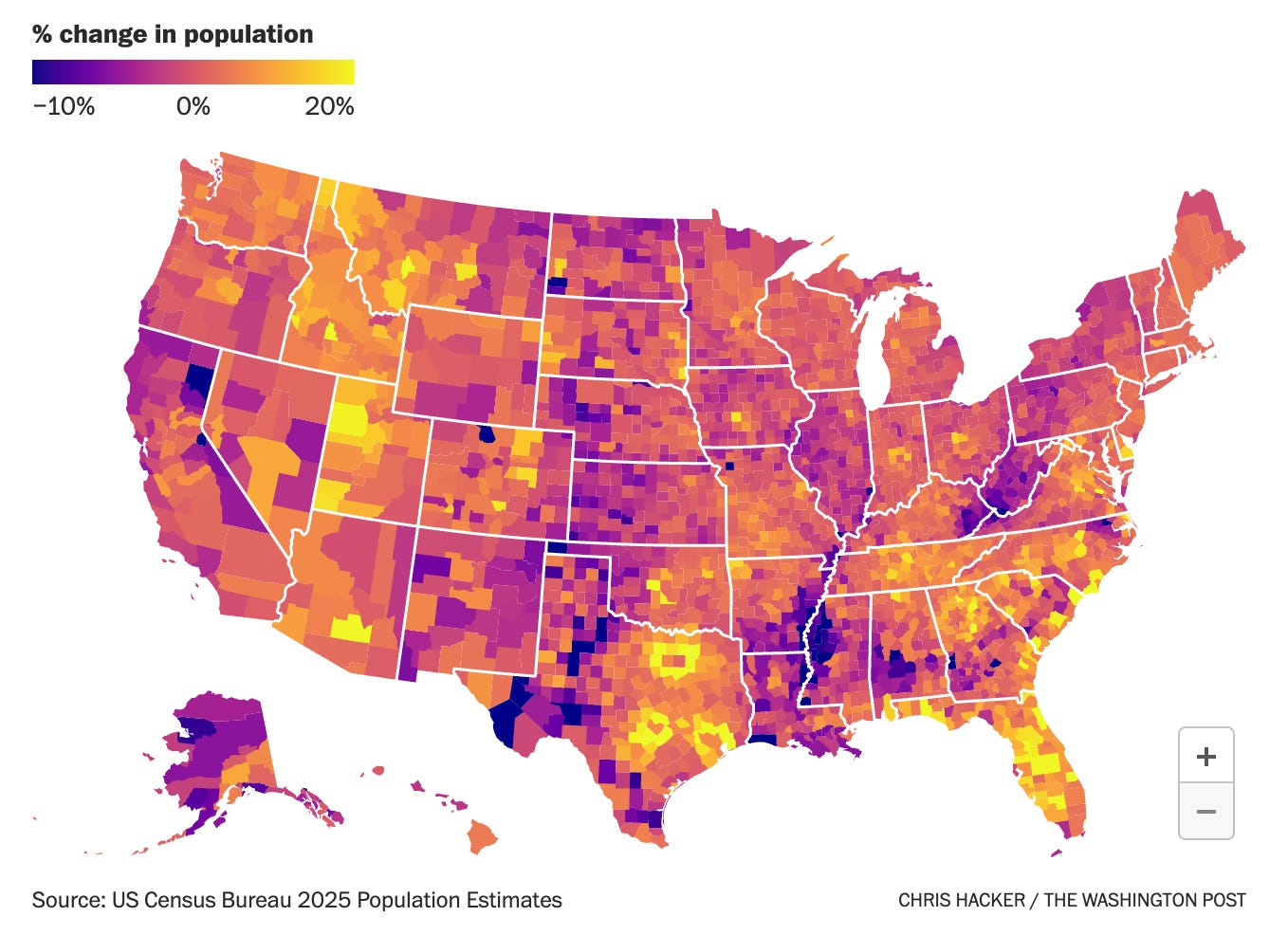
U.S. Census data shows that between April 2020 and July 2025, the population of the southern United States led the nation in growth, yet Mississippi lost population, with numerous counties showing dramatic declines.
Based on Census Bureau population trends, a Washington Post analysis published on Tuesday reported that across every age group, the Southeast grew faster than any other region between April 1, 2020, and July 1, 2025—by 6 percent, nearly double the national average.
Yet, Mississippi stands out in the Post’s data map for its departure from the trend. Overall, the state’s population continued to decline, most dramatically in the Delta and in rural counties along the Mississippi River in the southwestern part of the state. Isolated parts of Alabama, Arkansas, Louisiana and Texas also showed notable declines, though all those states aside from Louisiana also showed pockets of significant growth and greater overall population stability.
As the Post also recently reported, census numbers help determine how the federal government allocates billions in funding to states and municipalities, as well as how leaders draw up legislative districts and how much representation each state gets in Congress. Census data also influences where businesses choose to locate.
Mississippi lost a congressional seat following the 2000 Census due to population decline. As a result of shifting demographics and continuing population decline, the state could lose another seat when data is compiled from the 2030 Census, which would leave it with only three seats in the U.S. House of Representatives, a University of Mississippi population researcher has warned.
According to a previous analysis of census data by Mississippi Today, ReThink Mississippi and the University of Mississippi’s Center for Population Studies, the state’s 2024 population stood at 2,943,045—down nearly 45,000 from its peak in 2014. The state ranked 49th in population change during the preceding decade, with only West Virginia showing a greater loss.
Image: Population trend data map (via the Washington Post)
Loosing a population of 45000 out of 2.9 million from 2014 to 2024 is about 4500 per year for this 10 year span. That is not a dramatic decline. In 2003 when Mississippi attained its 4th District the population was 2,877,000. On average a population of 747,000 people get congressional representation. Information I looked up says the population in 2026 is 2,958,000. Despite the variances in the data I believe it is unlikely that the 2030 census will take away a district.