


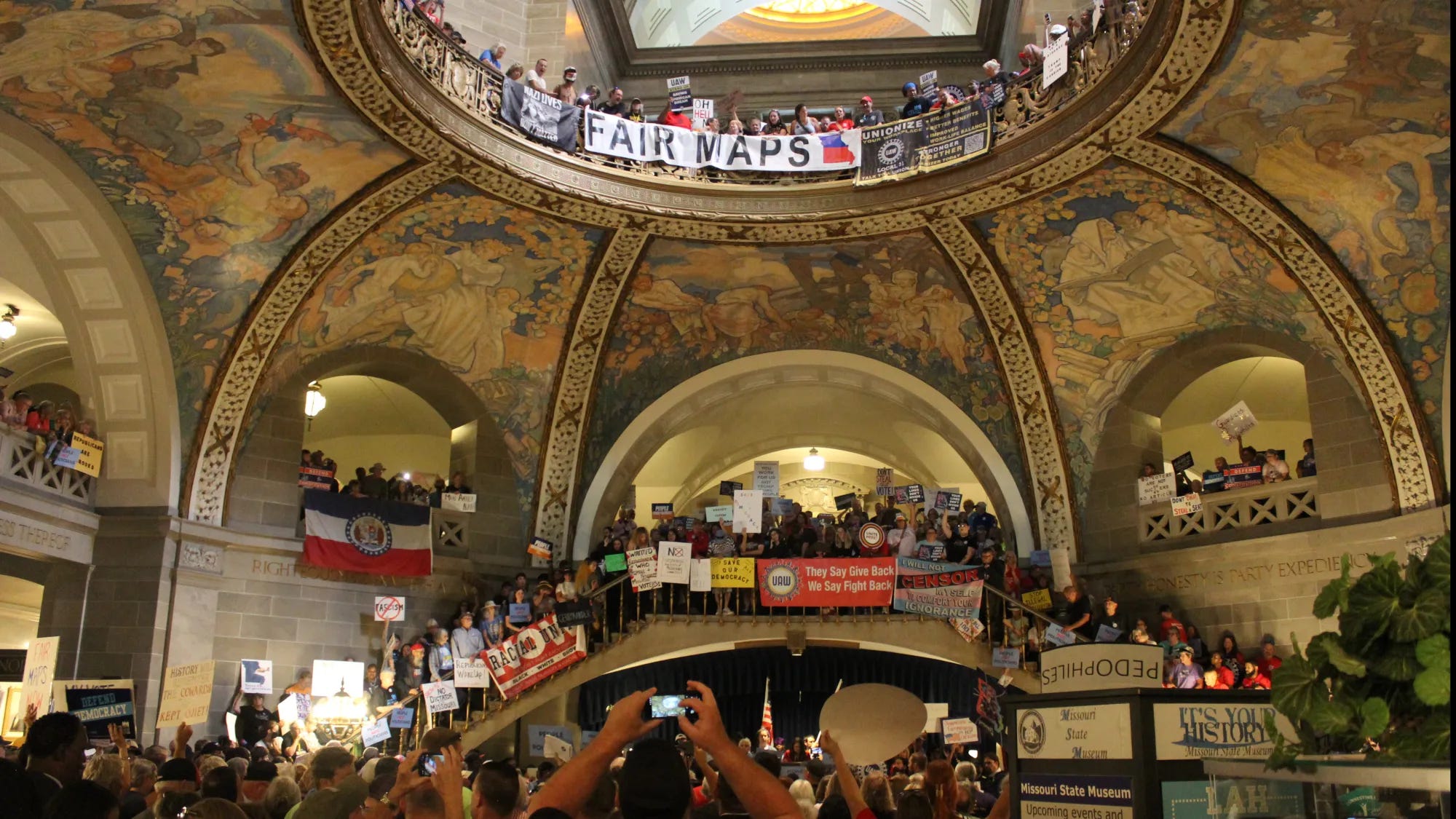
When the U.S. Supreme Court ruled on Sept. 25, 2026, that the state of Missouri must run its November congressional elections on the map the state drew in 2022, it blocked for the third time a replacement map the state’s legislature passed in 2025 that would have made incumbent U.S. Rep. Emanuel Cleaver’s Kansas City district more Republican.
The order in People Not Politicians v. Onder was unsigned, and no justice noted a dissent. The ruling did not decide whether Missouri’s new map was legal. The justices cited the principle that courts should not change election rules once voting has begun, noting that ballots had already been printed and mailed under the old lines.
U.S. Rep. Robert Onder, the sitting Republican congressman in Missouri’s Third District, and another Republican candidate, Richard Brattin, had sued in federal court saying they would be harmed by having to campaign in districts different from the ones where they won their August primaries. They won at that stage. The state court had ruled for the 2022 map, but a federal judge then said the opposite and ordered Missouri to use the 2025 map.
What kept the new map off the ballot and got the U.S. Supreme Court involved was a provision of the Missouri Constitution that Mississippi voters no longer have—the right to put a referendum to statewide voters, which in Mississippi’s case was struck down by its state supreme court in 2021.
Under Missouri law, citizens who gather enough signatures can suspend a statute until voters approve it at the next election. Opponents of the state’s new congressional map did just that. On Sept. 3, 2026, the Missouri Supreme Court placed the referendum on the November ballot and held that the 2022 map governs until Missourians vote on it. The referendum group went to the U.S. Supreme Court to attempt to block the federal order to use the 2025 map, and the court ruled in their favor.
Mississippi had a comparable referendum mechanism for 29 years. The state supreme court struck it down in 2021, ruling that the signature requirement written into the 1992 amendment could no longer be met because Mississippi’s congressional representation had dropped from the five designated in the measure to four.
Lawmakers have not restored the ballot provision. State Sen. Jeremy England filed a measure during the 2026 session that would have required referendum signatures from 10 percent of active registered voters, or roughly 189,000 people, with no more than a third from any one congressional district. The bill died in the state Senate on Feb. 13, 2026, without a House companion bill. Senate Republicans who opposed earlier versions cited the risk of out-of-state money driving petition campaigns.
Mississippi’s ballot initiative history has come up at redistricting hearings that the legislature has been holding across the state. State Rep. Jeffrey Hulum III, who represents state House District 119 and is the Democratic nominee in the Fourth Congressional District race, was the first speaker at the Sept. 22, 2026, hearing on the Gulf Coast.
“Legislators should not choose their electors. The electors should choose their legislators,” Hulum told the joint committee. “If we want to do this, let’s go back to the ballot initiative. Put it on the ballot. Let the people of Mississippi decide if they want to redistrict in the state of Mississippi.”
Jim Smith spoke later the same night. “Mississippi state Republicans have refused to restore the people’s constitutional right to petition our government through the ballot initiative for three years,” Smith said. “They certainly do not trust the people who elected someone else to represent them, but now they want us to trust them to conduct a redistricting that is not even necessary until the year 2030.”
In Mississippi, legislative districts are adopted by a joint resolution that never reaches the governor’s desk. Congressional districts pass as a conventional statute that the governor can veto and the legislature can override with two-thirds of both chambers. If lawmakers deadlock on congressional lines, the courts step in, as federal judges did in 2002 and again in 2011. None of those paths includes a vote by state residents.
The legislature’s Joint Committee on Reapportionment and Redistricting holds the last of its eight public hearings on Thursday, Oct. 1, 2026, at the New Capitol in Jackson. It has released no proposed maps and published no criteria. England has not said whether he will sponsor another referendum bill in the upcoming session.
Written comments about the legislature’s redistricting may be sent to the committee’s counsel, Ted Booth, at ted.booth@peer.ms.gov.
Image: Redistricting protesters in the Missouri Capitol on Sept. 10, 2026 (Creative Commons credit Ceilidh Kern/The Beacon)
