


The annual holiday to commemorate the nation’s war dead is today most often observed as the start of summer and perhaps an opportunity to make the first beach trip of the year.
In Mississippi, which claims to have started the commemoration, today’s national holiday invokes both egalitarian sympathies and, almost invariably, racial undercurrents.
Memorial Day is about deciding who and what to remember from past armed conflicts. Mississippi’s Gulf Coast is today working out a narrower version of the same question, one permit at a time, revolving around Black Spring Break.
Mississippi’s claim on Memorial Day is older than the federal holiday. On April 25, 1866, a group of women in Columbus walked into Friendship Cemetery to lay flowers on the graves of Confederate soldiers who had died at Shiloh. Union soldiers were buried nearby, their graves untended. The women decorated those too. A northern newspaper reported the gesture, and the poet Francis Miles Finch turned it into “The Blue and the Gray,” published in the Atlantic Monthly in 1867. Columbus has claimed ever since to have held the first Memorial Day.
The claim is contested, and that is part of what Memorial Day is. At least a dozen towns say they held the first observance in the years after the Civil War. Columbus, Georgia dates its Ladies Memorial Association appeal to March 1866. Waterloo, New York won congressional recognition as the holiday’s birthplace and a 1966 presidential proclamation to match, on the strength of an annual observance it traces to 1866. Boalsburg, Pennsylvania claims an observance going back to 1864. The competing dates reflect how the holiday began: not by an act of Congress but as scattered local rituals involving the decorating graves, most of them in the South, where most of the war dead were buried.
The national holiday came later. Gen. John A. Logan, the Union commander of a veterans’ organization, issued an order in 1868 annually setting aside May 30 to decorate the graves of the war dead, and the observance spread under the name Decoration Day. It became Memorial Day in common usage by the turn of the 20th century, was expanded after World War I to honor the dead of all American wars, and was fixed by Congress in 1971 on the last Monday in May. Mississippi keeps a separate observance. Confederate Memorial Day falls on the last Monday in April; a Columbus legislator, Rep. Kabir Karriem, has filed a bill every session since 2016 to end that.
What the holiday honors and who gets to honor it on which ground are old questions in Mississippi, and they run through a stretch of the Gulf Coast that took a federal court to desegregate. For most of the state’s history, the manmade sand beach from Gulfport to Biloxi was closed to Black residents. In 1959, a Biloxi physician, Dr. Gilbert Mason, led the first of the Biloxi wade-ins, in which Black residents walked into the waters of the Mississippi Sound (part of the Gulf of Mexico bordered on the south by barrier islands) in defiance of the line that kept them off the sand. The wade-ins continued for years and were met with arrests and violence. On April 24, 1960, a wade-in ended in a beating that the local press came to call Bloody Sunday. In June 1963, days after the assassination of Mason’s friend Medgar Evers, Mason and others went to the beach again. A federal court ruling in 1968 finally opened the Mississippi beaches to everyone.
That history is the reason Black Spring Break exists. For 15 years, the gathering has brought Black visitors and college students to the same Gulfport and Biloxi beaches each April, drawing thousands in its peak years to Beach Boulevard and Highway 90. Organizers tie the event directly to the wade-ins and the 1968 ruling.
“We want to reflect and commemorate what our ancestors went through for us to be able to enjoy the Mississippi Gulf Coast beach,” the organizers said in a release this spring.
A highway marker on Biloxi Beach commemorates the wade-ins, but few people outside the city know it is there.
The gathering is now disappearing from the public beach. In 2026, attendance has continued to dwindle. Large crowds no longer gather on Beach Boulevard and promoters have moved nearly all events to private clubs in Gulfport. The shift followed a series of decisions by the coast’s governments. After a 2023 shooting on the last day of spring break left a Biloxi police officer and four other people wounded, the city adopted new special-events ordinances requiring greater security and financial guarantees from event sponsors, and its events committee denied the beach permit. In 2024, Harrison County announced it would not approve any commercial-use or amplified-sound permits on the beach during the weekend. Officials described the changes as matters of public safety and crowd control. A Biloxi councilman who represents the beach area called the first weekend under the new rules “so much better” and estimated the crowd at about a third of past years.
The result is a celebration of a beach’s opening that is being held, increasingly, off the beach. The sand that Black Mississippians were arrested for entering in 1960, and that a federal court opened to them in 1968, draws smaller crowds each April as the event that commemorates that opening moves indoors.
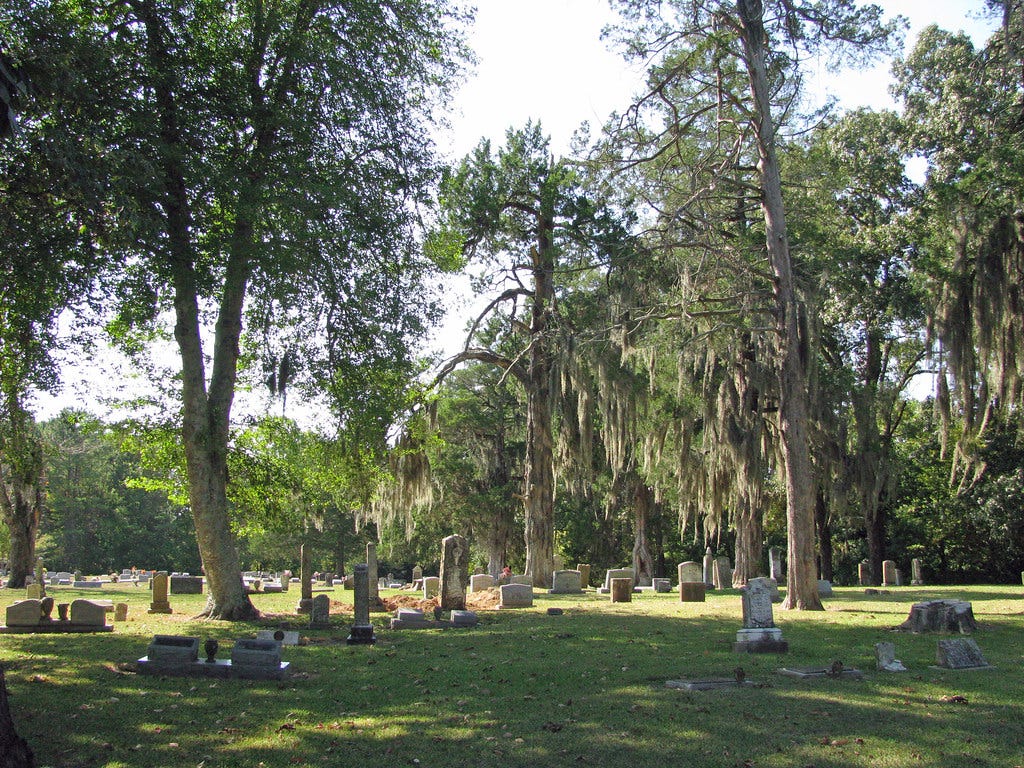
Image: Yazoo County cemetery (via Natalie Maynor/Flickr)

In answer to someone's question, the picture of the cemetery, as noted at the end of the article, is in Yazoo County.