


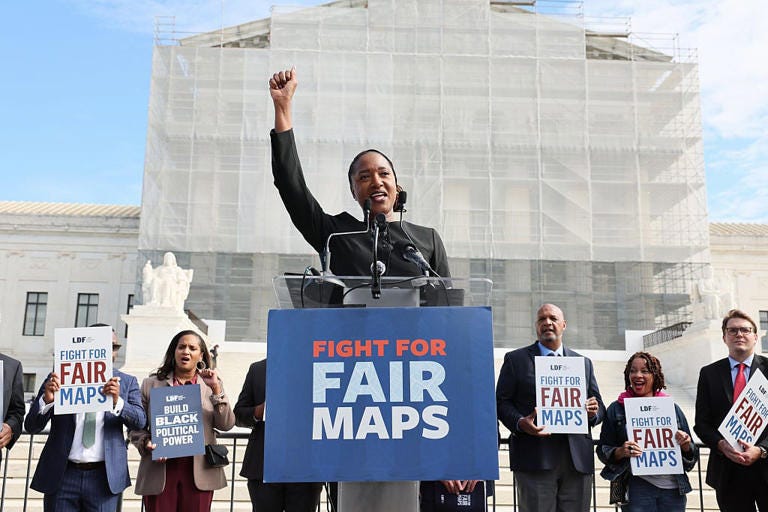
The most significant Black political gains Mississippi has made in a generation were won under a law the U.S. Supreme Court may soon gut.
In November 2025, Democrats flipped two Mississippi state Senate seats in court-ordered special elections, breaking the legislature’s Republican supermajority. Former Hattiesburg Mayor Johnny DuPree won a newly drawn district in the Pine Belt. In the north, a Democrat captured a seat stretching from DeSoto County into the Delta. Both victories were made possible by redistricting ordered under Section 2 of the Voting Rights Act—the last major federal tool for challenging discriminatory maps.
Now, that tool is on trial. The U.S. Supreme Court justices heard reargument in October 2025 in Louisiana v. Callais, a case that began as a dispute over Louisiana’s congressional map but has evolved into something far larger: a direct challenge to whether states can create majority-minority districts to remedy vote dilution at all. A ruling is expected by June.
A decision against Section 2 would reverse the most significant Black political gains Mississippi has made since 1965. It would not merely alter the state’s political landscape—it would dismantle the legal architecture that built it.
A state shaped by the VRA
Mississippi’s relationship with the Voting Rights Act is foundational to understanding what’s at stake. Before the law’s passage in August 1965, fewer than 7 percent of eligible Black Mississippians were registered to vote. The state’s 1890 constitution had been explicitly designed to disenfranchise Black citizens through poll taxes, literacy tests and “understanding clauses” that gave white registrars arbitrary power to reject applicants.
The transformation was swift once federal enforcement arrived. By 1968, Black voter registration had risen to nearly 60 percent. By the mid-1990s, Mississippi had more Black elected officials than any other state in the nation—a direct result of VRA enforcement and Section 2 litigation that dismantled at-large voting systems designed to dilute Black political power.
That progress required constant vigilance. Section 5 of the VRA once required Mississippi and other states with histories of discrimination to obtain federal approval before changing their election laws. When the Supreme Court struck down that preclearance requirement in 2013’s Shelby County v. Holder, Mississippi moved immediately to implement a strict voter ID law that had been awaiting federal review.
Since then, roughly 5 percent of the state’s polling places have been closed, and voter roll purges have accelerated—changes that civil rights groups say disproportionately affect Black communities. Without Section 5’s prophylactic protections, Section 2 became the last meaningful federal tool for challenging discriminatory voting practices.
What the court is considering
The Callais case arrived at the Supreme Court through a winding path. After a federal court found that Louisiana’s 2022 congressional map likely diluted Black voting strength—Black residents make up about one-third of the state’s population but were packed into a single majority-Black district out of six—the legislature drew a new map with two such districts.
A group of white plaintiffs then challenged the remedial map as an unconstitutional racial gerrymander. When the justices first heard the case in March 2025, it appeared to be a relatively narrow dispute about whether Louisiana had properly balanced competing legal requirements. Rather than issue a ruling, the court took the unusual step of ordering reargument on a broader question: whether the intentional creation of a majority-minority district violates the Fourteenth and Fifteenth Amendments.
That reframing matters. The court didn’t ask whether Louisiana drew its lines sloppily. It asked whether the remedy itself—creating districts where Black voters can elect candidates of their choice—is constitutionally permissible. That’s not a technical question. It’s a frontal challenge to the VRA’s core function.
Louisiana’s position has shifted accordingly. The state initially defended its remedial map but now argues in supplemental briefs that “all race-based redistricting is unconstitutional.” The Black voters who intervened to defend the map warn that such a ruling would gut civil rights protections nationwide. In their brief, they call Section 2 “the crown jewel of civil rights legislation” and argue that it falls squarely within Congress’s constitutional authority to enforce voting rights.
Direct consequences for Mississippi
The November special elections in Mississippi offer a preview of what functional VRA enforcement can produce. The three-judge federal panel that ordered the state to redraw legislative districts found that the 2022 maps diluted Black voting strength in several regions, including DeSoto County and the Hattiesburg area. The remedial maps created opportunities for Black voters in those communities to elect candidates of their choice—opportunities they seized.
That lawsuit—Mississippi NAACP v. State Board of Election Commissioners—relied entirely on Section 2. If Callais curtails or eliminates the ability to bring such claims, future challenges would become nearly impossible to win. While Mississippi’s Black population stands at roughly 38 percent, the legislature has consistently drawn district lines that pack Black voters into a limited number of seats, heavily restricting their representation.
The impact would extend well beyond the statehouse. According to the Brennan Center for Justice, nearly half of all Section 2 cases since 1982 have challenged at-large elections at the local level—cities, counties, and school boards that used voting systems designed to prevent minority representation. Mississippi saw hundreds of such systems dismantled through Section 2 litigation over the past four decades. Without that tool, jurisdictions could return to discriminatory structures with no federal remedy available.
The longer arc
The current legal challenge fits a pattern that stretches back through Mississippi history. The methods of voter suppression have evolved—from literacy tests and poll taxes to voter ID requirements and polling place closures—but the underlying political dynamics remain remarkably consistent: When Black political power advances, legal mechanisms emerge to curtail it.
The Callais case is not unfolding in isolation. This month, the Trump administration and Louisiana officials successfully petitioned a federal judge to dismiss a 1967 school desegregation order in DeSoto Parish. It was the second such dismissal since the Justice Department began working to overturn desegregation cases it once championed, framing decades-old civil rights orders as “outdated” federal overreach. In Concordia Parish, a judge rejected a similar motion, ruling that the district must first demonstrate it has fully ended segregation. Louisiana and the Justice Department are appealing. The pattern is clear: The same administration arguing in Callais that race-conscious redistricting is unconstitutional is simultaneously dismantling federal civil rights enforcement in schools.
Expert testimony in the Mississippi redistricting case found that voting in the state remains sharply polarized by race. Analysis showed that Black candidates won state legislative elections only in majority-minority districts, with roughly 83 percent of Black voters supporting Black candidates while only about 18 percent of white voters did the same. That polarization is precisely what Section 2 was designed to address—and precisely why majority-minority districts remain necessary for Black voters to elect candidates of their choice.
The Supreme Court reaffirmed Section 2’s validity as recently as 2023 in Allen v. Milligan, an Alabama case with facts nearly identical to the Louisiana dispute. That ruling ordered Alabama to create a second majority-Black congressional district. The Court’s decision to revisit the issue so quickly in Callais—and to frame the question around whether such districts are themselves unconstitutional—signals that at least some justices are prepared to reverse course.
Watching and waiting
A decision in Callais is expected by June, though Louisiana officials have asked the Court to rule earlier given the state’s April 2026 primary schedule. Whatever the timing, the ruling will arrive as Mississippi heads into another election cycle under maps that exist only because Section 2 remained enforceable.
Civil rights advocates are preparing for multiple scenarios. A ruling that upholds Section 2 while narrowing its application could still make future litigation more difficult. A broader ruling declaring majority-minority districts unconstitutional would effectively overturn decades of precedent and invite states to redraw maps that would effectively eliminate minority representation at every level of government.
For Mississippi, where Black voter registration went from under 7 percent to more than 60 percent because of the Voting Rights Act, and where Section 2 lawsuits transformed local governments across the Delta and beyond, the stakes are not abstract. They are measured in school board seats and county supervisor races, in state legislative districts and congressional maps—in the difference between representation and exclusion.
In 1890, Mississippi’s constitutional convention set out to devise measures that would, in the words of its delegates, “enable us to maintain a home government under the control of the white people of the state.” It took 75 years and an act of Congress to undo that work. The question now before the Supreme Court is whether the law that made that undoing possible will survive to protect what it built.
Image: Pro-VRA rally before U.S. Supreme Court building under renovation (via MSN.com)
