


The Entergy utility company, which provides electricity to customers in Mississippi, Louisiana, Arkansas and Texas, has consistently maintained that Mississippi’s data center boom will help keep electricity rates down for its residential customers.
Yet across the state line in Louisiana, an executive with the company acknowledged under oath last month that customers are not guaranteed to save a penny—and in fact, could be compelled to shoulder part of the financial burden—under a secret data center power deal that will be similar to one in Mississippi.
The admission raises a troubling question for Mississippi households: As the permits for new powerplants and pipelines gain final approval, will the multibillion-dollar data center expansion actually raise electric costs for people in America’s poorest state, who had no say in the expansion?
“The facts remain the same,” Entergy’s communications team told The Mississippi Independent in a statement. “Data centers are helping keep Entergy Mississippi’s rates lower than they otherwise would have been without data center growth.”
Different story in Louisiana
Entergy Louisiana’s director of regulatory affairs provided testimony under cross-examination at a Louisiana Public Service Commission administrative hearing Oct. 7. Ryan Jones contradicted previous assurances from both Meta and Entergy that the Mark Zuckerberg-owned company would be responsible for the $13 billion in new gas-fired power plants, and around $7 billion for hundreds of miles of new transmission lines, solar batteries and switching stations.
The deal Entergy Louisiana struck with Meta is similar to Amazon’s in Mississippi. It’s secret. Entergy won’t provide details of the agreement, such as how much it charges Amazon for power, but the company promised customers they would not be on the hook for subsidizing the multibillion-dollar energy infrastructure buildout and enormous power use.
“Through our Fair Share Plus pledge, data centers pay their full and fair share—and then some—ensuring existing customers do not subsidize data centers’ energy needs,” the Entergy emailed statement noted, referring to a March 2026 White House initiative that called on major tech companies and utilities to ensure “the rapid growth of AI data centers” without raising electricity costs for families and communities.
As part of the sweeping 2024 law that enabled the Amazon deal, lawmakers included a legal provision intended to protect ordinary electricity customers from the costs of major data center developments. However, it does not explicitly guarantee that residential customers will not pay any of those costs.
In fact, Mississippi’s 2024 data-center legislation contains provisions that could allow utilities to recover billions of dollars in infrastructure expenses through electricity rates, while limiting regulators’ ability to review the agreements beforehand.
The Mississippi Public Service Commission acknowledged receipt of The Mississippi Independent’s questions about whether it was aware of the Entergy admission in Louisiana and whether the regulatory body planned to conduct a similar hearing, but did not respond to those questions.
Beyond the Amazon deal, Entergy has entered into a series of confidential electricity-supply agreements with other major data center developers, enabling companies to negotiate electricity rates and infrastructure arrangements without publicly disclosing their financial terms.
Entergy claimed in its email to The Mississippi Independent that its ratepayers are already seeing savings. “In July 2026, customers began seeing those benefits when revenue from Amazon data centers helped eliminate a nearly $5 monthly bill increase,” the company noted.
A May 2026 report by Massachusetts-based environmental consultancy Synapse Energy Economics made a different claim, saying ratepayers have already paid $38 million extra because of the data centers, which is projected to rise to $74 million by the end of 2026. Synapse says the cost has pushed bills up by $10.60 on average, while also undermining the PSC’s role.
“By limiting the role of the PSC, Mississippi legislators transferred significant risk to residential consumers, who as a class of ratepayers, have now lost a key transparency and fairness check on Entergy Mississippi,” the report notes.
Entergy said that data center revenues will enable the company to cut outages in half by 2030 “at no additional cost to customers” and deliver more than $2 billion in customer savings uring the next 20 years, alongside a series of protections and benefits. “Protections include prepayment requirements, multi-year contracts, credit and collateral requirements, and early termination provisions,” Entergy Mississippi noted. “Mississippi legislation passed in 2024 also requires data centers to cover their full cost of service and provide additional customer benefits.”
Costly pipelines
To feed the energy-hungry data centers, Entergy Mississippi is building three new natural gas-fired power plants, while the Tennessee Valley Authority is constructing a fourth. Elon Musk’s xAI is building a fifth near its sprawling data center operations in Southaven.
Construction on the xAI plant is moving ahead despite a federal lawsuit and a challenge to its state air permit, which is up for a hearing this week before the Mississippi Department of Environmental Quality. The other four plants are expected to open between 2028 and 2029.
To produce all that electricity, the plants will need a steady supply of natural gas. An enormous construction effort is taking shape across the Southeast to deliver just that.
Houston-based Kinder Morgan is behind two interconnected pipeline projects that will stretch across Mississippi and into neighboring states, adding roughly 500 miles of new pipeline construction at an estimated cost of $5.2 billion. Work on the projects is expected to begin in late 2026 and 2027, with gas deliveries anticipated in 2028 and 2029.
But there is a question hanging over this multibillion-dollar undertaking: Does the Southeast actually need that much more natural gas?
Whenever a company wants to build an interstate pipeline, developers must convince the federal government that there is a public need for it. That approval, known as a certificate of public convenience and necessity, allows companies to move ahead with construction and can even give them the power to acquire rights to private land through eminent domain.
In its applications, Kinder Morgan argued that natural gas demand across Mississippi, Alabama, Georgia and South Carolina had been growing over the past decade and would continue to rise. But the company presented two strikingly different predictions about how much additional gas the region would need by 2035.
In its worst-case scenario, based on a severe 2025 winter storm, the Southeast could face a shortfall of 2.45 billion cubic feet of natural gas a day during winter, according to a Federal Energy Commission Report. Under its more likely forecast, the shortfall would reach just 460 million cubic feet per day—less than 15% of the two pipelines’ capacity.
The Institute for Energy Economics and Financial Analysis (IEEFA), an Ohio-based international nonprofit research organization, challenged Kinder Morgan’s projections in a June 2026 report.
Energy consultant Cathy Kunkel and attorney Suzanne Mattei, who authored the analysis, acknowledged that regions need to prepare for occasional extreme weather. But they questioned whether building enormous new pipelines to accommodate infrequent demand is “very likely not the most cost-effective approach to energy management.”
Their analysis also found natural gas demand had actually been flat or declining over the previous decade, rather than rising.
Another problem with the company’s projections was data centers.
IEEFA argued that Kinder Morgan had substantially overstated how much additional electricity the region’s proposed data centers would require, while assuming that much of that demand would be satisfied by natural gas power plants.
The company’s predictions exceeded those of the North American Electric Reliability Corporation, which monitors the reliability of the nation’s electrical grid, as well as some regional utilities, including Georgia Power—a company that has itself faced criticism for overestimating data center demand.
That matters because it has become increasingly possible that some of the projects driving these natural gas consumption forecasts and the subsequent pipelines may never be built, while others could consume considerably less electricity than developers anticipate. There is also no guarantee that natural gas will remain the preferred electricity source for data centers over the decades these pipelines are expected to operate.
Kinder Morgan, meanwhile, points to agreements with major utilities as evidence that the additional pipeline capacity is needed. But IEEFA’s concern goes beyond whether the gas will be needed. It is also about who gets stuck with the bill if it isn’t.
Several major energy companies have already committed to paying for space on the pipelines, including the Tennessee Valley Authority and Mississippi Power’s parent company Southern Power.
Here’s the big catch: Utilities don’t just pay for the gas they use. They reserve pipeline capacity over decades, whether they use the gas or not.
For regulated utilities like the ones in Mississippi, those expenses are often passed along to electricity or gas customers. In other words, the companies that sign the contracts may not be the ones ultimately shouldering the financial burden.
One report found that Mississippi Power did not require additional pipeline capacity and said that customers could end up paying for gas that won’t be used. IEEFA argues that this creates an incentive for utilities to commit to more infrastructure than may be necessary, knowing that much of the financial risk can be transferred to customers. In its report, the organization characterized the pipeline projects as an attempt to “force their customers into subsidizing data centers.”
Here’s the other catch: If the anticipated boom ends in bankruptcies, canceled projects or declining investment, the report’s authors wrote, utilities could be left with commitments to expensive long-term infrastructure that is no longer needed.
There is another financial risk that has nothing to do with whether the AI data center boom lives up to its promise: Natural gas prices are notoriously unpredictable.
In a separate April 2026 report, IEEFA examined the nationwide rush to construct new gas-fired power plants, warning that utilities were committing customers to decades of exposure to a fuel whose price can swing dramatically.
Extreme weather, international conflicts and growing U.S. exports of liquefied natural gas can all drive up prices. Those increases can pass directly to electricity customers, regardless of whether the power plants operate as intended.
The report pointed to the consequences of Russia’s invasion of Ukraine in 2022, when soaring natural gas prices drove up electricity costs.
IEEFA described the combination as “a double whammy for consumers.”
For Mississippi, where four conventional utility-scale gas plants are scheduled to begin operating over the next three years, the consequences could extend well beyond the cost of constructing the facilities.
The state is preparing for a future in which data centers consume extraordinary amounts of electricity, while utilities and pipeline developers commit billions of dollars to supplying it.
If those forecasts prove accurate, the new infrastructure could help meet that demand. If they don’t, the companies building it may still have ways to recover their investments.
The unresolved question is how much of that risk will ultimately fall on regular ratepayers.
That’s part of the secret.
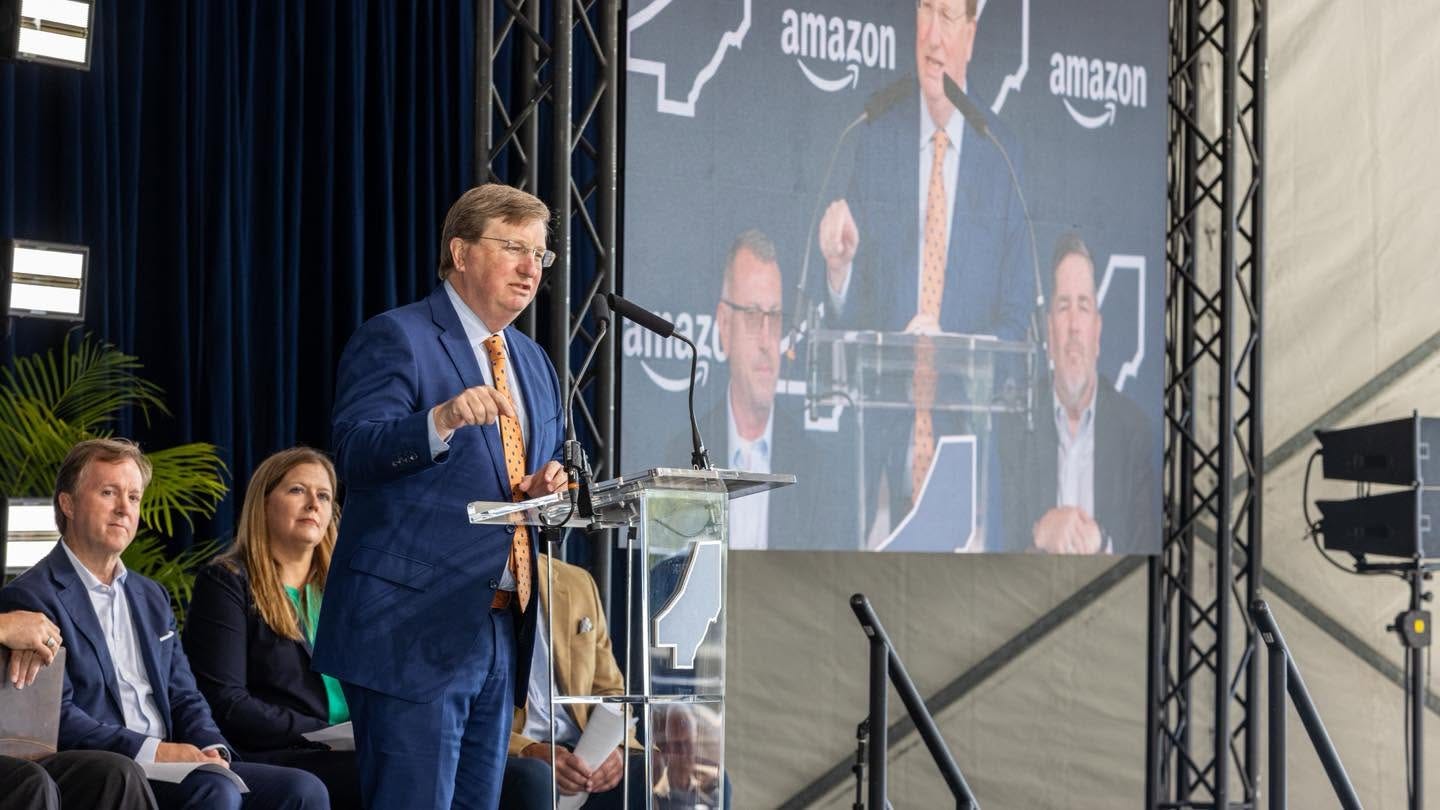
Image: Gov. Tate Reeves at an Amazon data center announcement (via the governor’s official Facebook page)
