


In Gov. Tate Reeves’s announcement of a planned xAI development in Southaven, Mississippi, he proclaimed: “This record-shattering $20 billion investment is an amazing start to what is sure to be another incredible year for economic development in Mississippi. Today, Elon Musk is bringing xAI to DeSoto County, a project that will transform the region and bring amazing opportunities to its residents for generations.”
The governor’s endorsement of the project, on Jan. 8, 2026, was predictably upbeat. As his office noted in the news release, “This is the largest economic development project in Mississippi’s history. It sets the pace for continued high-tech investments across our state and strengthens Mississippi’s position as a leader in this exciting tech revolution. There is truly no better time to invest in Mississippi.”
Left unsaid were the well documented downsides of the state’s ongoing, rapid escalation of data center construction, and what critics decry as xAI’s cavalier approach to government regulation. Concerns about negative environmental and financial impacts echo through many of the affected communities, including Boxtown in South Memphis, site of another Elon Musk facility devoted to xAI’s artificial intelligence product known as Grok, which is already in operation.
Due to Mississippi’s data center tax incentive, xAI will be exempt from sales, use, corporate income and franchise taxes in the construction and operation of the Southaven facility—a key factor in the company’s decision to locate there. Founded in Silicon Valley by Musk in 2023, xAI.corp. is an American artificial intelligence company with a stated mission to “understand the universe.” To tackle this broad challenge, the company’s recent investment in Southaven is portrayed as part of a plan to build the world’s largest supercomputer in the Memphis/north Mississippi region.
Musk’s first investment in the area, in 2024, was what’s known as Colossus I, built in Boxtown, on the banks of the Mississippi River in south Memphis. This past summer, Colossus II also set up operations in the nearby Whitehaven area. With construction of the Southaven data center, to be named MACROHARDRR, xAI will boast production of more than two gigawatts of computing power in the region.
In a press release following xAI’s investment in Southaven, Musk said, “xAI is scaling at an immeasurable pace—we are building our third massive data center in the greater Memphis area. MACROHARDRR pushes our Colossus training compute to ~2GW – by far the most powerful AI system on Earth.”
Everything that xAI does is powered by these three data centers. As an open-source platform, anyone can access Grok to answer user queries, generate images and complete other brain-saving tasks (though Musk recently announced that some of the image capabilities will be scaled back to comply with local laws, in response to a backlash about the program generating sexualized images of children). Organizations are also taking advantage of xAI’s offerings with their applications’ programming interface. The need for this kind of power is reflected in data showing 9.5 million daily active users and 38 million monthly active users.
Though xAI’s products help people and organizations tackle everyday tasks with increased efficiency, the impact of the facilities on the communities in which they are located is something that even Grok might have difficulty quantifying.
Southaven residents have recently demanded that xAI’s project there be shut down until independent, third-party health environmental studies are done. With 10 schools within a 10-mile radius of the xAI power plant on Stanton Road and concerns over public health, air quality, noise and lack of transparency from both the city and xAI, Southaven residents formed the Safe and Sound Coalition to make their voices heard. So far, their petition calling for the shutdown of the facility has garnered more than 1,200 signatures. Safe and Sound Coalition did not return a request for comment from The Mississippi Independent.
In response to those concerns, Southaven mayor, Darren Musselwhite stated in a press release: “Cultivating quality economic development should always go hand-in-hand with keeping clear view of the ultimate goal of public benefit. Never would I advocate for any development that didn’t share these goals in Southaven.” Musselwhite tried to assure residents that xAI had met all the necessary requirements in constructing and operating their facility.
“xAI has proven their commitment to being an outstanding corporate citizen in this regard in every possible way,” Musselwhite said. “Environmental sensitivity is at the forefront of this commitment as they go above and beyond required emission control requirements. The Solar SMT-130 natural gas turbines they use which are necessary to generate electricity for backup purposes are equipped with SoLoNOx dry low emissions (DLE) technology and selective catalytic reduction (SCR) systems that lower nitrogen oxide emissions to 2 ppm, which is the Lowest Achievable Emission Rate, making xAI’s facilities the lowest emitting facilities in the United States.”
The mayor’s technical language, which was no doubt cryptic for many residents, did not assuage concerns among those who say they mistrust studies paid for and controlled by the company itself without independent, third-party testing.
In an attempt to gain more insight into xAI’s testing and compliance with the facilities, The Mississippi Independent reached out to xAI for comment about their Mid-South operations.
The response was brief—yet telling: “Liberal media lies.”
With that, I decided to look elsewhere, hoping to find out firsthand how these facilities have impacted the communities. As a native and current Memphian, I thought there was no better place to see the impacts than where Musk and xAI decided to place their first facility: south Memphis’s Boxtown.
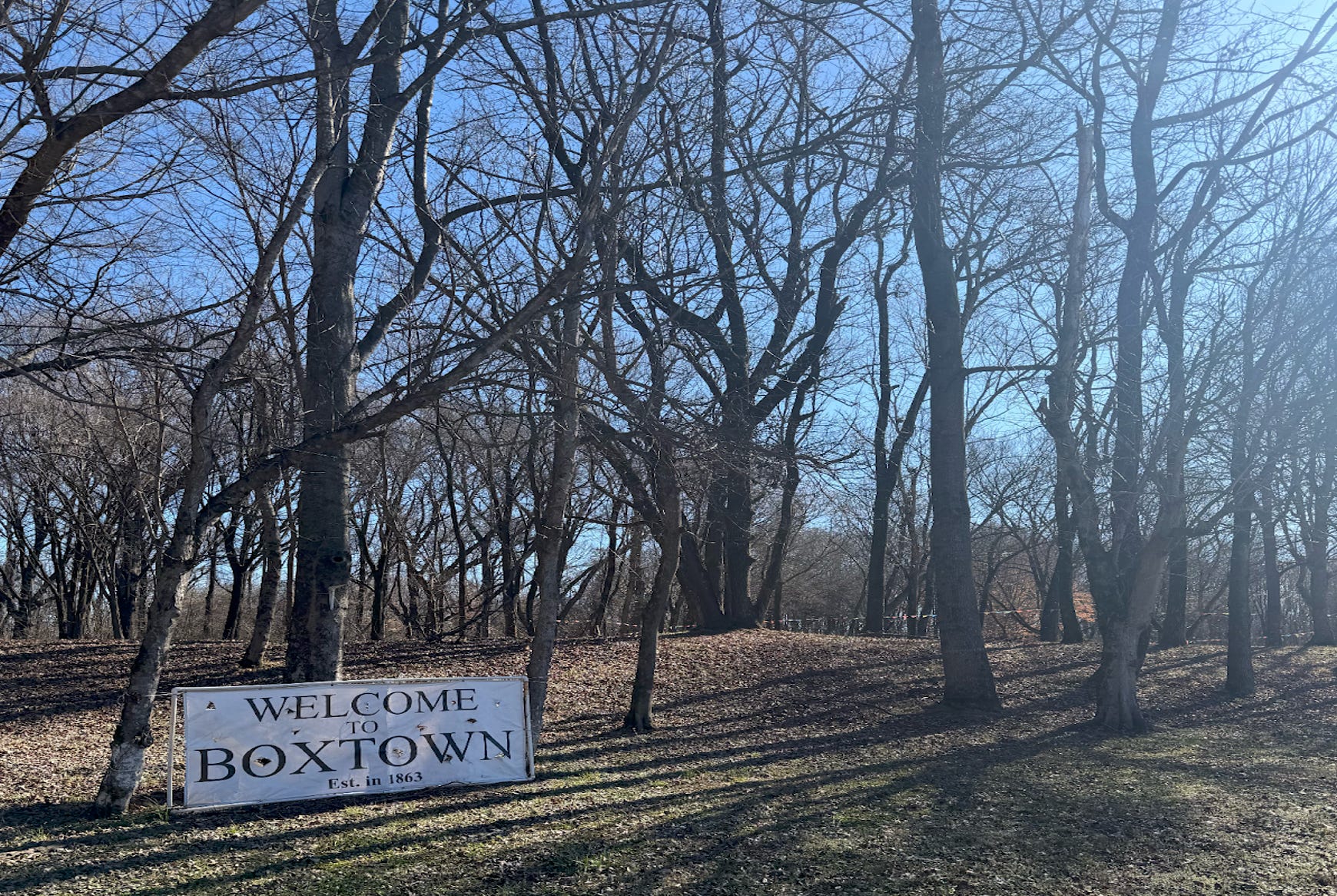
Visitors to Boxtown are greeted with a sign that proudly proclaims its founding in 1863, the same year that President Abraham Lincoln signed the Emancipation Proclamation. That dates are not coincidental: Boxtown was founded by newly-emancipated slaves and freedmen and began as an unincorporated, self-sufficient and tightly knit community. The name harks back to these origins, as, according to local lore, early residents built their homes from discarded railroad boxcars and scrap wood and other packing supplies.
From these humble beginnings, the community for years served as a time-capsule of postwar Black poverty, its homes lacking indoor plumbing, water or electricity. With later industrial development along the south Memphis riverfront, including a $123 million power plant, the city, spearheaded by the Memphis Housing Authority, proposed to annex the Boxtown area in 1960, promising to bring regular city-services to the community, including fire and police, sewer lines, and street lights and signs, in exchange for the imposition of city taxes. Plans were also made to modernize homes and bring them up to modern building codes. Despite these promises and the booming industries nearby, water, sewer and electricity had not made it many Boxtown homes by as late as 1975. Today, Boxtown homes have basic services such as indoor plumbing and gas, but the feeling of neglect by the city and nearby industries remains.
Driving through Boxtown and the adjacent Frank C. Pigeon Industrial Park, one thing becomes instantly clear: The air is different. When I arrived, the smell was unfamiliar to me and I could think of nothing to compare it with, but could not ignore the burning sensation I felt in my nostrils with each inhaled breath.
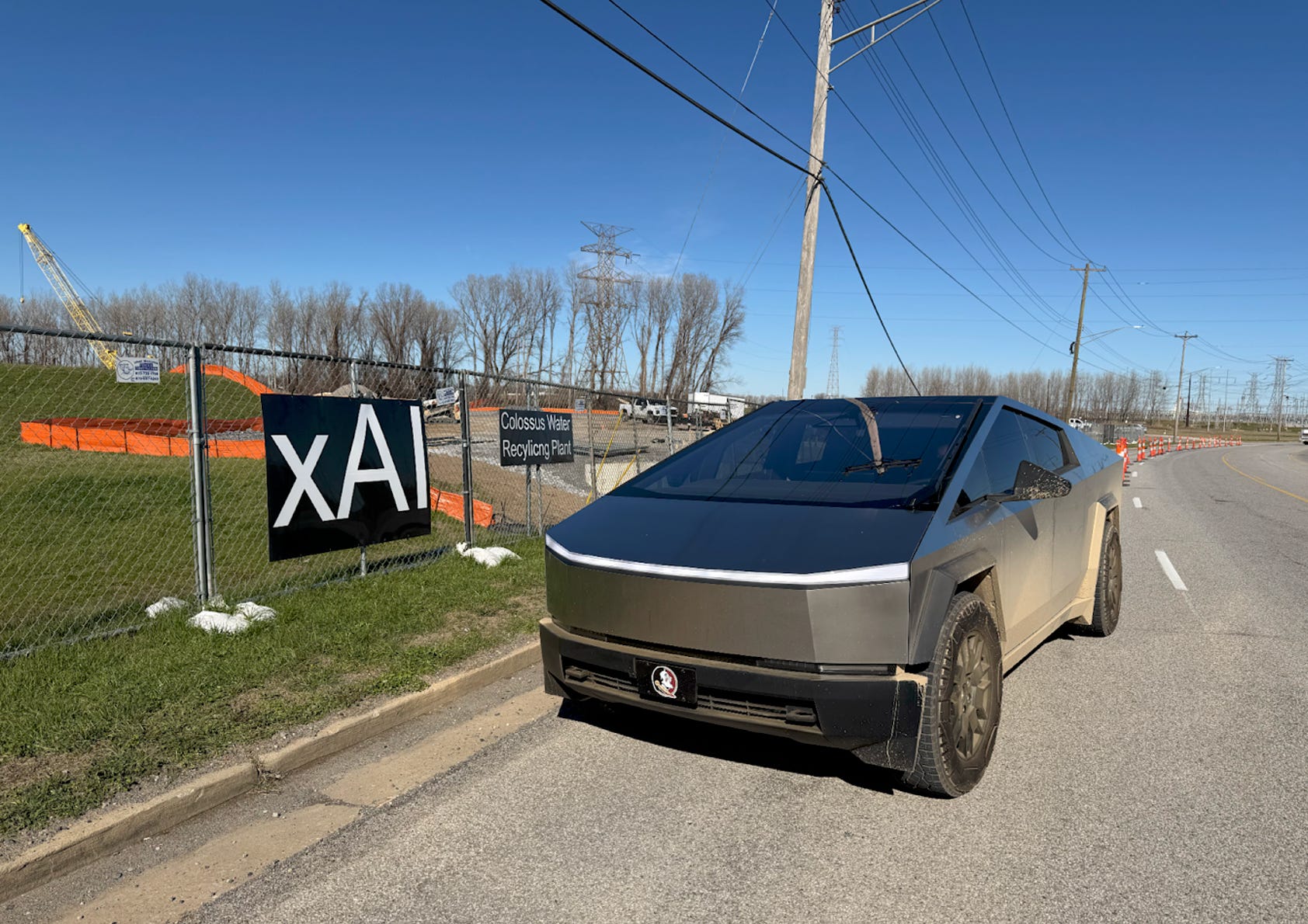
Despite having made numerous field trips to the nearby Chucalissa Indian Village historic site and attending family reunions at T.O. Fuller State Park, I had never actually ventured into the industrial park where xAI’s operations are located. As I drove by the massive, fenced and heavily guarded Colossus I data center, the construction being undertaken to build the Colossus Water Recycling Plant caught my eye, so with the road partially blocked off, I decided to stop and take some pictures of xAI’s expansion to meet their increasing water demand. I was the only one on the road at the time, and to my surprise, as I was taking my photos, a Cybertruck emblazoned with a Florida State logo on the front pulled up behind my vehicle, and I could see the driver taking pictures of me and my truck. Because I was on a public road with no surveillance cameras on the construction site and no workers visible, I wondered who sent them and why they had suddenly appeared. These questions were never answered.
I approached the truck and was reluctantly greeted by a young woman who I later discovered to be Briana Hamilton, xAI’s health, safety and environmental manager, but who at the time refused to identify herself to me. She also refused to answer any of my questions, and bluntly informed me that security was on the way. At that point, she had been sitting in her vehicle behind me for at least five minutes.
Matt DeFore, a security worker for xAI, soon showed up in a regular Ford truck and told me that although they did not police public spaces—which I was in—he had received a call saying someone was on the property taking pictures. I explained that I was a reporter working on a story about the facility, and made clear that I was not interested in any particular slant. DeFore initially said he could help me reach whomever I was looking for, but ended up simply encouraging me to reach out via the company’s site. It occurred to me that if simply taking photos from a public road elicited this kind of response, how transparent was the company being with residents of Boxtown? It did not take long to find the answer.
“They doing what they want to do in the bottom,” observed longtime Boxtown resident Darryl Sledge, referring to the lowlands along the river. “We had no knowledge of what was going on. All we saw was trucks dumping and digging, dumping and digging.”
xAI’s site boasts that the construction of the Colossus data center was initially projected to take 24 months to build. But, by proceeding unilaterally—some of the infrastructure was reportedly installed without permits—the company had compressed that timeline. According to its site, xAI, “questioned everything, removed whatever was unnecessary, and accomplished our goal in four months.”
By signing NDAs with key stakeholders including Memphis Light, Gas and Water and having government relations staff at both the federal and state level, xAI was able to quietly and quickly erect the world’s largest data center.
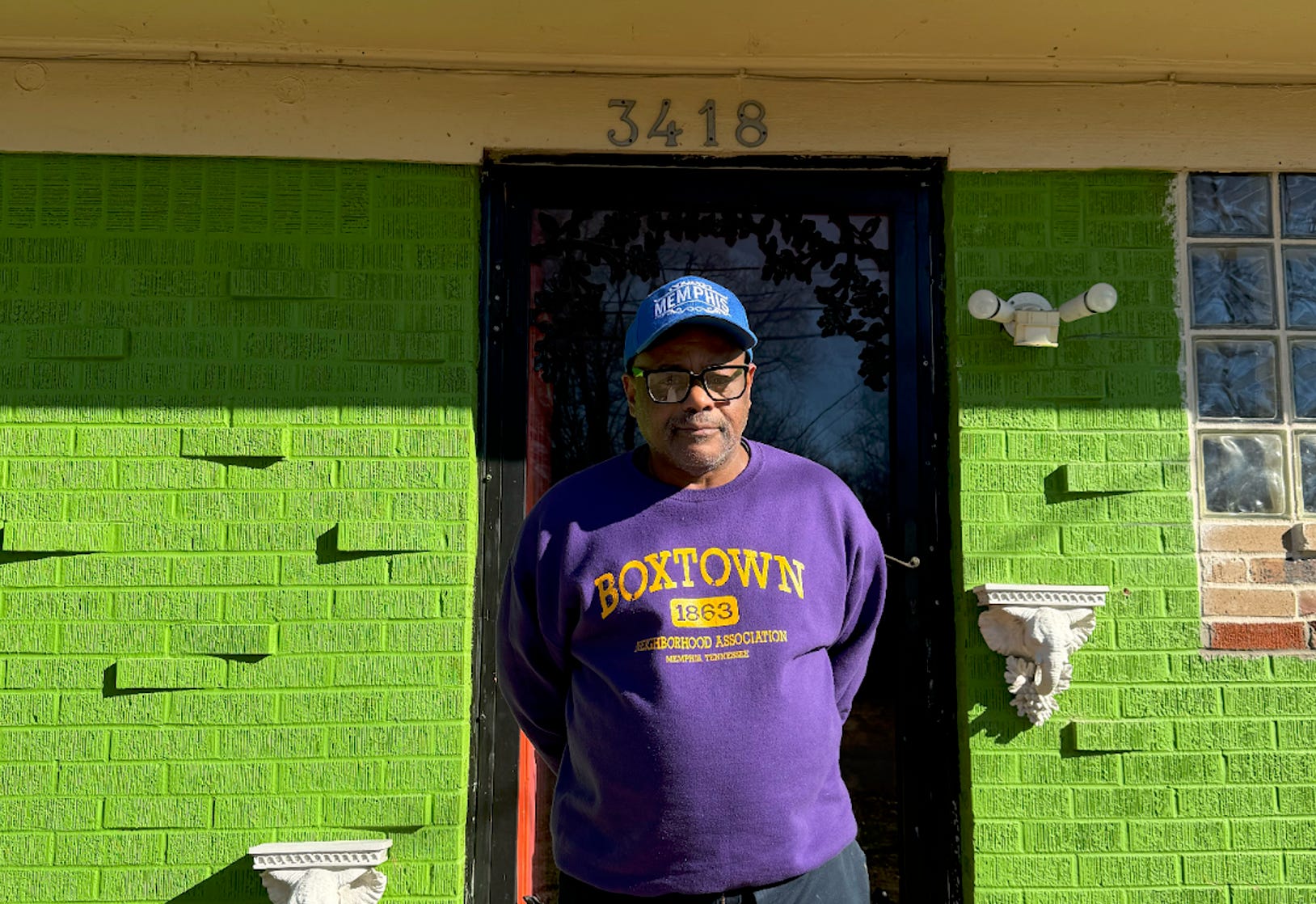
Like many Boxtown residents, Sledge, 62, has called this community home since his youth. After his military service took him around the globe, he returned home and has seen firsthand the changes that have come. “I love my community. And I love Memphis,” he said.
In a conversation on his front porch, Sledge claimed his health has begun to feel the effects of living in proximity to the massive data center. Every day at around 5 p.m., he said, the xAI facility releases airborne particulate debris, making the air insufferable to the point that he cannot even sit on his porch without needing to use his inhaler.
The Colossus data center houses 35 methane gas turbines that have reportedly been operating without Clean Air Act permits. In total, these turbines have the capacity to generate 421 megawatts—a comparable amount to that of entire Tennessee power plants. According to manufacturer emissions data, these turbines also have the potential to emit between 1,200 and 2,000 tons of smog-forming nitrogen dioxide (NO2) a year. For comparison, that is more than the yearly output of the Memphis airport.
Even before xAI, Memphis performed poorly in air quality measures. In 2025, the American Lung Association gave Shelby County an F in its “State of the Air” ozone report. Memphis ranks third in the nation in asthma-related emergency department visits and fifth in the nation in terms of asthma-related deaths. With a population already increasingly vulnerable to air pollution, the coming of xAI has exacerbated the issue in Boxtown.
“If it affects me and I’m 62, what do you think it does to those of us in their 80s and 90s?” Sledge asked.
Speaking to Time magazine, Austin Dalgo, a primary care physician in south Memphis, acknowledged that air pollutants pose the greatest risk to the city’s most vulnerable residents, including children, the elderly and people with respiratory conditions such as asthma and COPD. Boxtown’s historical roots have resulted in a population skewed toward the elderly, with more than 30 percent of the population falling into that category.
Independent studies have provided some validity to the concerns about the air voiced by Sledge and other community members. In the first major effort to quantify the environmental impact of Colossus’s turbines, researchers at the University of Tennessee Knoxville, using publicly available satellite data from NASA and the European Space Agency, ran an analysis on the air quality in South Memphis over the past couple of years. Their research uncovered that average concentrations of nitrogen dioxide have increased by 3 percent compared with pre-June 2024 levels. The study also found that peak NO2 levels increased 79 percent from pre-xAI levels in the areas immediately surrounding the data center and by 9 percent in Boxtown.
Sledge noted that the studies had little impact on the company’s plans. “I don’t give a damn if you white, blue or black,” he said. “They don’t care as long as they can make money. They giving people mesothelioma, lung cancer, all kinds of stuff. Do you know the debris, and all the stuff they sending out them pipes, it don’t affect them. The wind gotta blow, and all that stuff falls back over here.”
Despite the results of this independent study, both xAI and city leaders, such as the Greater Memphis Chamber of Commerce, have asserted that xAI’s turbines are legal, generate negligible amounts of pollution, and are only temporary. In April 2025, Memphis Mayor Paul Young said that only 15 of the 35 turbines were in use and that the rest were only there as a backup power source. Since then, xAI has applied for permits for 15 permanent turbines which local xAI representative Brent Mayo claimed would make “xAI the lowest-emitting facility in the country,” although the company did not plan to install pollution controls until the application was approved.
With environmentalists having discovered heat coming off of 33 of the 35 turbines, and with the EPA considered unlikely to intervene, xAI has created a cloud around their actual impact.
“Some folk like me, I don’t see no proof,” said Boxtown resident Terry Davis. “They want to sue the Shelby County Department of Health. Whatever he used to let them come down here. I can’t go with that. When you give me some proof, then I can follow you.”
As Davis, whom many residents call the unofficial “mayor of Boxtown,” took me for a ride through the community, one thing became abundantly clear: He knew everybody and everybody knew him. He pointed out residents’ homes by name, the old neighborhood grocery store, and other notable relics of Boxtown history.
Born and raised in Boxtown, Davis still lives in his childhood home, passed down from his parents. He was there when the community was self-sufficient and residents hunted game for sustenance. He was there when the city annexed the community and made promises that went unkept. He was there when Martin Luther King was murdered in Memphis in 1968 and took part in protests in the city. However, he says of taking the role of an activist, “I’ve done all of that once or twice in my life. Now it’s too late for that.”
After feeling that his community has been exploited for years, Davis said that instead of fighting he has taken the approach: “What can I do about it? I’m not here to fight against it.”
Still, Davis urges residents to show they care about the community. He compared xAI’s relationship with Boxtown with that of Tennessee Valley Authority, which runs a plant near xAI. While TVA took residents on tours of coming facilities, communicated with residents, and continues to donate money and provide other support to the Boxtown Neighborhood Association, xAI has made no such efforts to directly engage the community. Davis said that as far as he knows, neither Musk nor Mayo, or any representative of xAI, has set foot in the Boxtown community, which he believes signals the level of concern they have for residents.
The impacts of pollution and other environmental harms are subject to debate, yet xAI’s impact on Memphis Light, Gas and Water is not. xAI has used between $4.5 million and $7.5 million monthly in electricity and more than 300,000 gallons of water daily from the city’s aquifer. Usage at this level has spurred xAI’s investment in the $80 million wastewater plant down the road from the facility.
Despite this investment, Boxtown residents have questioned the impacts of xAI’s utility usage. “What are y’all doing? Tapping into our water line?” Sledge asked.
Davis, a retired union bricklayer, said he recently reached out to the Community Services Agency to get help paying his Memphis Light, Gas and Water bill. On a fixed income of $800 per month, Davis said he does not have the flexibility to address any sudden changes to his monthly expenses. On a fixed income, he said, “You just stay alive. You ain’t got no money put up in the bank. You ain’t got nothing to hide.”
For Sledge, seeing the impacts the xAI facility on Boxtown leaves him with one question: “Why Boxtown? Why not Germantown or Cordova? Better yet, why not build it where you live?”
xAI is the largest investor in the Greater Memphis Chamber of Commerce, and one of the first things a visitor notices when entering the chamber building is the xAI logo. A symbol to its interconnectedness with local, state and federal governments, it illustrates the overlap of access and power that xAI wields and makes its vision for the area seem inevitable. Yet this vision is nightmarish for many Boxtown residents. As a community of less than 3,000 people, they argue that they are once again at risk of being forgotten—and exploited, for others’ gain.
In 1980, after seeing the lagging level of development in Boxtown, city and federal representatives secured $12 million in federal funds from the U.S. Department of Housing and Urban Development, though ultimately only $1.7 million was allocated to Boxtown. Residents claim such a scenario appears to be playing out again. As originally proposed, an ordinance would utilize 25 percent of xAI’s property taxes for infrastructure improvements within five miles of Colossus, but Davis contended the money would instead go to the entire area code 901 region, just as it did with HUD funds in 1980, leaving Boxtown behind.
Sledge recalled going to Memphis City Hall and looking at the city’s five-to-10-year plan, and said one thing was instantly apparent: “If you go look at the plan, you will not see Boxtown.”
For now, the Boxtown community is alive, attempting to be well, and pushing for residents’ often-forgotten voices to be represented in matters that affect their community.
With all of the changes that Terry Davis has seen in the community, he observed, “I know the best is yet to come. So is the worst.”
Images: Outside Colossus 1; Boxtown sign; Darryl Sledge (all credit Nic Hayes)
