


Just hours after House Speaker Jason White announced 15 appointments to the legislature’s redistricting committee and one week after the U.S. Supreme Court’s decision in Louisiana v. Callais changed the legal framework underlying the case, the parties on both sides of a separate U.S. District Court lawsuit in Mississippi filed a motion to vacate a court order requiring the state to redraw its Supreme Court districts.
Citing the Supreme Court ruling, the parties to the district case filed a joint motion asking the Fifth Circuit to vacate U.S. District Judge Sharion Aycock’s previous order requiring Mississippi to redraw its Supreme Court district lines to increase the opportunity for Black voters to elect candidates of their choice.
Parties in that lawsuit are the State of Mississippi, represented by Attorney General Lynn Fitch’s office, and as plaintiffs a group of Black Mississippi voters who brought the case in 2022, including Senate Minority Leader Derrick Simmons of Greenville, represented by the American Civil Liberties Union, the ACLU of Mississippi, the Southern Poverty Law Center and private counsel.
In the Mississippi case, White v. Mississippi Board of Election Commissioners, Aycock ruled in late 2025 that the existing district map diluted the voting strength of Black Mississippians in the Delta and the Jackson metropolitan area in violation of Section 2 of the Voting Rights Act and ordered the Mississippi Legislature to redraw the lines.
The case was pending before the Fifth Circuit on appeal. The motion asks the appellate court to vacate Aycock’s ruling and remand the case back to district court for further proceedings.
If the Fifth Circuit grants the motion, the injunction preventing Mississippi from using its current Supreme Court districts in the 2026 elections would be lifted, potentially removing the immediate need for the special session that Gov. Tate Reeves announced after the Callais ruling.
The order rested on a legal framework that the Supreme Court substantially narrowed last week in Callais, when a 6-3 majority held that race-conscious redistricting under Section 2 cannot survive strict constitutional scrutiny solely because a state seeks to comply with the Voting Rights Act. The ruling immediately reshaped ongoing redistricting litigation across the South, including the Mississippi case already pending before the Fifth Circuit. Plaintiffs argued in a separate filing in Aycock’s court that if the Fifth Circuit grants the joint motion, the existing injunction blocking the 2026 Mississippi Supreme Court elections would be lifted, allowing those races to move forward under the current district lines.
The posture of the case is that both sides now agree the Supreme Court’s ruling in Louisiana v. Callais changed the legal standard governing the litigation. In their joint motion, they wrote that “when intervening Supreme Court precedent affects a case pending before [this court] on direct appeal, this court’s normal practice is to vacate the judgment below and remand for reconsideration in light of the new decision.”
State officials had already announced plans for a special session to redraw the districts after the Callais ruling, but the joint motion asks the Fifth Circuit to vacate the lower court order that originally compelled the redraw and send the case back to district court for reconsideration under the new standard. The dispute is therefore no longer simply whether the districts should be redrawn, but whether the federal court order requiring the redraw can remain in place after Callais.
During its regular session, Mississippi legislative leadership refused to redraw the Supreme Court districts, arguing that Aycock’s ruling was incorrect and appealing the decision rather than complying with it. Senate Bill 2138 and House Bill 1749 both died in conference before adjournment. Gov. Reeves announced after the Callais ruling that he would convene lawmakers in special session to address the districts under what he described as “the new rules of the game.”
White’s appointments on May 6, 2026, move the House formally into the redistricting process even as the legal basis for the redraw comes under renewed challenge. The speaker selected 15 Republican lawmakers to serve on the special committee that will help oversee the legislature’s response to the litigation and any proposed revisions to the Supreme Court map.
The Mississippi Supreme Court districts also govern elections for the Public Service Commission and the Transportation Commission. The court’s Central District Supreme Court justice, Leslie King, initially reached the bench through gubernatorial appointment before later winning election. No Black candidate has ever won election to the Mississippi Supreme Court without first being appointed by a governor.
The plaintiffs’ argument in the Mississippi litigation is that the existing district configuration unlawfully diluted Black voting strength despite Mississippi having the highest percentage of Black residents in the nation.
Civil rights plaintiffs previously submitted multiple proposed remedial maps to the federal court, while the state maintained that the existing districts complied with federal law. Wednesday’s motion asks the court to withdraw the remedial order entirely in light of Callais and places Mississippi in the position of preparing for a special redistricting session while simultaneously arguing that the legal obligation requiring the redraw may no longer exist.
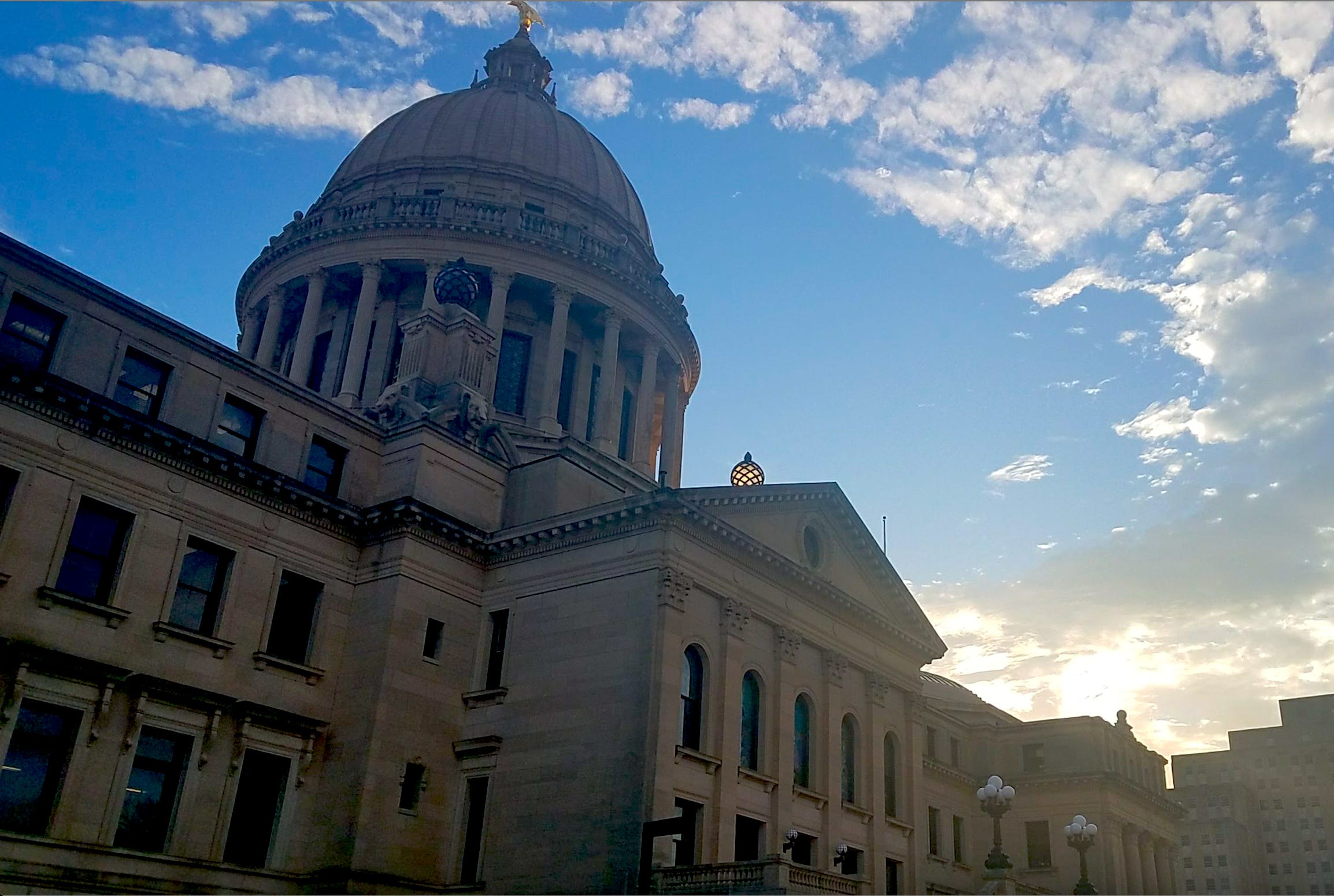
Image: Mississippi State Capitol (credit R.L. Nave)
